Ipomoea maxima
(Linn. f.) G. Don ex Sweet
ConvolvulaceaeLeaves
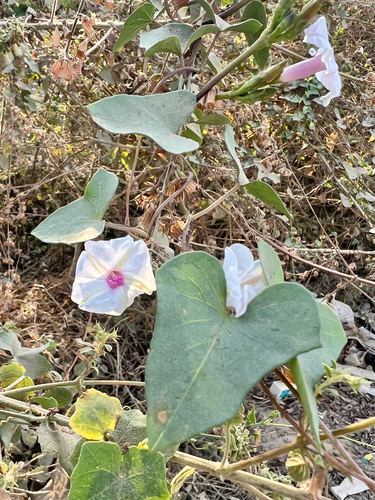
iNaturalist · cc-by
(c) haemanthus, some rights reserved (CC BY)
(c) haemanthus, some rights reserved (CC BY)

iNaturalist · cc-by-nc
(c) Priyanjana Pramanik, some rights reserved (CC BY-NC)
(c) Priyanjana Pramanik, some rights reserved (CC BY-NC)

iNaturalist · cc-by-nc
(c) smathichong, some rights reserved (CC BY-NC)
(c) smathichong, some rights reserved (CC BY-NC)
What to Eat
Edible parts: Leaves
The leaves are eaten as a pot-herb.
Where to Find It
It is a subtropical plant.
Asia, Australia, Bangladesh, India,
Countries: United Arab Emirates, Afghanistan, Armenia, Australia, Azerbaijan, Bangladesh, Bahrain, Brunei, Bhutan, China, Georgia, Indonesia, Israel, India, Iraq, Iran, Jordan, Japan, Kyrgyzstan, Cambodia, North Korea, South Korea, Kuwait, Kazakhstan, Laos, Lebanon, Sri Lanka, Myanmar, Mongolia, Maldives, Malaysia, Nepal, Oman, Philippines, Pakistan, Qatar, Saudi Arabia, Singapore, Syria, Thailand, Tajikistan, Timor-Leste, Turkmenistan, Turkey, Taiwan, Uzbekistan, Vietnam, Yemen
How to Identify
A twining herb. The leaves are 3-8 cm long. They are oval and heart shaped at the base and taper to the tip.
Notes
There are about 500 Ipomoea species.
Names & Synonyms
Amtivel, Bankalmi, Bilona, Bonkalmishak, Hanimanvel, Manjigai, Mettatuti, Mushakani, Purititige, Talikirai, Tirutali
Convolvulus maximus L.f.Ipomoea sepiaria Koenig ex Roxb.Probably now Ipomoea alba L.
References (4)
- Ambasta, S.P. (Ed.), 2000, The Useful Plants of India. CSIR India. p 292
- Dobriyal, M. J. R. & Dobriyal, R., 2014, Non Wood Forest Produce an Option for Ethnic Food and Nutritional Security in India. Int. J. of Usuf. Mngt. 15(1):17-37
- Hort. brit. ed. 2:372. 1830 (As Ipomoea maxima)
- Hossain, U. & Rahman, A., 2018, Study and quantitative analysis of wild vegetable floral diversity available in Barisal district, Bangladesh. Asian J. Med. Biol. Res. 2018, 4 (4), 362-371


