Distimake dissectus
(Jacq.) Hallier f.
Noon flower
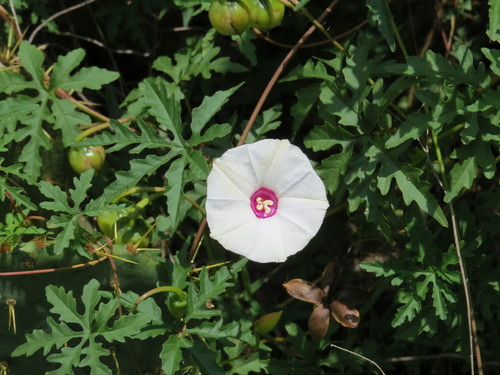
(c) Kenneth Bader, some rights reserved (CC BY-NC), uploaded by Kenneth Bader
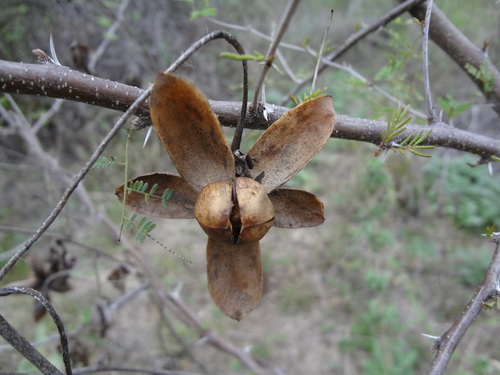
(c) Daniela Arrocena, some rights reserved (CC BY-NC), uploaded by Daniela Arrocena

(c) Douglas Goldman, some rights reserved (CC BY-SA), uploaded by Douglas Goldman
What to Eat
Edible parts: Seeds - flavouring, Tuber, Root
The seeds, which smell of bitter almonds, are used to flavor liqueurs and as an almond substitute in cakes, sweet breads, and candy. The tuber is edible when cooked in ashes or boiled.
Where to Find It
A tropical plant. It grows in tropical and subtropical places. In Argentina it grows below 500 m above sea level.
Africa, Argentina, Aruba, Asia, Australia, Bahamas, Bangladesh, Benin, Bolivia, Brazil, Burkina Faso, Central Africa, Central America, China, Colombia, Congo DR, Congo R, Costa Rica, Cuba, Dominican Republic, El Salvador, Equatorial Guinea, Fiji, French Guiana, Ghana, Guatemala, Guianas, Guinea, Guyana, Haiti, Hawaii, Himalayas, Honduras, India, Indonesia, Ivory Coast, Jamaica, Leeward Is., Madagascar, Malaysia, Mexico, Myanmar, Nicaragua, Nigeria, North America, Oman, Pacific, Pakistan, Panama, Papua New Guinea, PNG, Paraguay, Philippines, Puerto Rico, Reunion, Rwanda, Samoa, Saudi Arabia, SE Asia, Senegal, Seychelles, Sierra Leone, Solomon Islands, South Africa, South America*, Sri Lanka, Sudan, Suriname, Togo, Tonga, Trinidad-Tobago, Uruguay, USA, Venezuela, West Africa, West Indies,
How to Identify
A twining vine. The stems are hairy. The exudate from the plant is clear. The leaves are simple and have 5-7 lobes. The leaves are 3-15 cm long by 4-15 cm wide. A few flowers occur together in the axils of leaves. The flowers are 3-4 cm across. They are white or cream with a reddish-purple throat. The fruit is a brown or black capsule. It has 4 valves. The capsule is 1.2-1.8 cm long by 1.3-1.8 cm wide. There are 2-4 black seeds.
How to Grow
Plants can be grown from seeds or cuttings.
Wikipedia
Source ↗Distimake dissectus is a species of plant in the family Convolvulaceae and is native to North, Central, and South America.
Other Information
It is occasionally cultivated as a food plant.
Names & Synonyms
Flor-de-pau, Noya vine, Pujukuode
References (13)
- Arenas, P. and Scarpa, G. F., 2006, Edible wild plants of the Chorote Indians, Gran Chaco, Argentina. Botanical Journal of the Linnean Society. Vol. 153 (1): pp 73-85 (As Merremia dissecta)
- Ambasta, S.P. (Ed.), 2000, The Useful Plants of India. CSIR India. p 367 (As Merremia dissecta)
- Bot. Jahrb. Syst. 16:552. 1893 (As Merremia dissecta)
- Cooper, W. and Cooper, W., 2004, Fruits of the Australian Tropical Rainforest. Nokomis Editions, Victoria, Australia. p 137 (As Merremia dissecta)
- Kew Plants of the World Online
- Kinupp, V. F., 2007, Plantas alimenticias nao-convencionais da regiao metropolitana de Porto Alegre, RS, Brazil p 74 (As Merremia dissecta)
- Latham, P & Mbuta, A., 2017, Useful Plants of Central Province, Democratic Republic of Congo. Volume 2. Salvation Army p 11 (As Merremia dissecta)
- Levitt, D., 1981, Plants and people. Aboriginal uses of plants on Groote Eylandt. Australian Institute of Aboriginal Studies, Canberra. p 91 (As Merremia dissecta)
- Paczkowska, G. & Chapman, A.R., 2000, The Western Australian Flora. A Descriptive Catalogue. Western Australian Herbarium. p 218 (As Merremia dissecta)
- Plants of Haiti Smithsonian Institute http://botany.si.edu/antilles/West Indies (As Merremia dissecta)
- Scarpa, G. F., 2009, Wild food plants used by the indigenous peoples of South American Gran Chaco: A general synopsis and intercultural comparison. Journal of Applied Botany and Food Quality 83:90-101 (As Merremia dissecta)
- Schmedia-Hirschmann, G., 1994, Plants resources Used by the Ayoreo of the Paraguayan Chaco. Economic Botany Vol. 48. No. 3. pp. 252-258 (As Merremia dissecta)
- Smith, A.C., 1991, Flora Vitiensis Nova, Lawaii, Kuai, Hawaii, Volume 5 p 48 (As Merremia dissecta)


