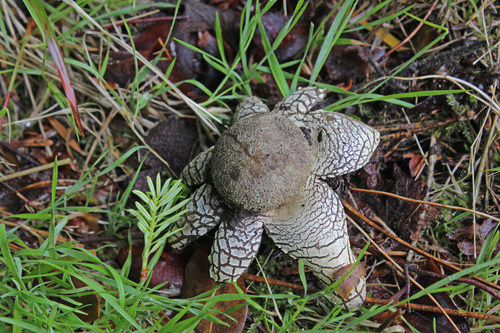
Podaxis pistillaris
(Linn.) Fr.
Stalked puffball

(c) Damon Tighe, some rights reserved (CC BY-NC), uploaded by Damon Tighe

(c) Eric Knight, some rights reserved (CC BY)

(c) Jasper Nance, some rights reserved (CC BY-NC-ND)
What to Eat
Edible parts: Fungus, Mushroom
The species is not poisonous, but is not commonly eaten. It is said to be edible when young and still white inside. It is reportedly difficult to cultivate. In Australia, it was used by many desert tribes to darken the white hair in old men's whiskers and for body painting. The fungus was presumably used by many desert Aboriginal peoples due to its distribution around drier areas of Australia. There are reports of its also being used as a fly repellent. Apart from the more common, ground-inhabiting P. pistillaris, there is one other Podaxis species in Australia, P. beringamensis, found on termite mounds; presumably both species were used. Like many "puffballs", the species can be used to dye textiles, resulting in either a tan or a reddish hue. This requires an alkaline base, and many home dyers use ammonia. Urine was used in former times.
Where to Find It
It is a tropical plant. It grows in the desert.
Afghanistan, Africa, Asia, Benin, China, India, Mali, Middle East, Pakistan, Saudi Arabia, South Africa, Southern Africa, West Africa, Zimbabwe,
How to Identify
A mushroom.
Wikipedia
Source ↗Podaxis pistillaris is a xerophilic agaric mushroom related to the puffballs and inkcaps. It is commonly known as the desert shaggy mane. The cap grows to 11 cm tall and thrives in deserts and semi-deserts of North America, Australia, and South Africa.
Names & Synonyms
Zhou huibao
References (5)
- Ambasta, S.P. (Ed.), 2000, The Useful Plants of India. CSIR India. p 473 (As Podaxon)
- Boa, E. R., Wild edible fungi and their importance to people. FAO Non Wood Forest Products Booklet 17
- efta-online.org, Edible Fungi of Tropical Africa, Jardin botanique Meise
- Hall, I. R., et al, 2003, Edible and Poisonous Mushrooms of the World. Timber Press. p 317
- Mandaville, J. P., 2004, Bedouin ethnobotany: Plant concepts and plant use in a desert pastoral world. PhD thesis University of Arizona. p 178