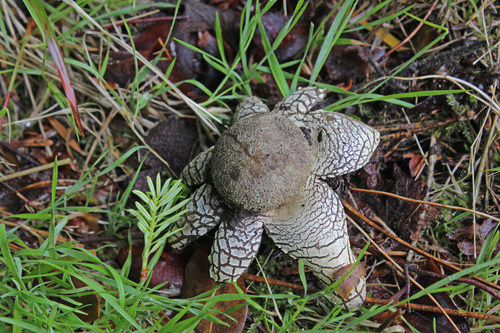
Astraeus odoratus
Phosri, Watling, M. P. Martin & Whalley

Takeaway (via Wikimedia Commons)

Sven Manguard (via Wikimedia Commons)
What to Eat
Edible parts: Mushroom, Fungus
Since they cannot be cultivated commercially, these mushrooms fetch a high price on the market. Young fruit bodies are collected from the wild and sold in the markets of Thailand. Thai people eat the blanched mushroom with nam phrik (Thai chilli pastes) or nam chim (dipping sauces), or cooked in curry and also only boiled in water with fish sauce and palm sugar.
Where to Find It
It is a tropical plant.
Asia, Indochina, Laos, SE Asia, Thailand,
How to Identify
A mushroom.
Wikipedia
Source ↗Astraeus odoratus (Thai: เห็ดเผาะหนัง; Het pho nang เห็ดเผาะหนัง, Het pho เห็ดเผาะ, or Het nang เห็ดหนัง, the latter meaning "skin mushroom") is a species of false earthstar in the family Diplocystaceae. Described as a new species in 2004, it was originally found in the Thai highlands growing in sandy or laterite-rich soil in dry lowland dipterocarp forests. The species is found in Southeast Asia.
Other Information
It is sold in local markets.
Notes
It is probably useful against TB and cancer. Also put in the family Diplocystidiaceae.
Names & Synonyms
Het pho
References (3)
- Arpha, K., et al, 2012, Astraodoric Acids A-D: New Lanostane Triterpenes from Edible Mushroom Astraeus odoratus and Their Anti-Mycobacterium tuberculosis H37Ra and Cytotoxic Activity. Journal of Agricultural and Food Chemistry. 60: 9834-9841
- Luczaj, L., et al, 2021, Wild food plants and fungi sold in the markets of Luang Prabang, Lao PDR. Journal of Ethnobiology and Ethnomedicine (2021) 17:6
- Petcharat, V., 2005, Edible Astraeus (Basidiomycota) from Thailand. Nordic Journal of Botany. Vol. 23, 4: pp 499-503 (As Astraeus thailandicus)