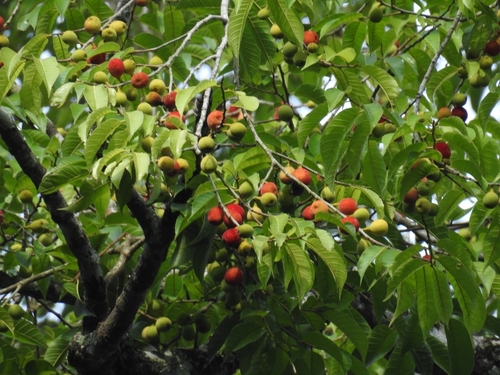
Streblus indicus
(Bureau) Corner
MoraceaeFruit

wikimedia · cc0
Wikimedia Commons - Almeloveen, Theodoor Jansson ab; Boom, Henrik & Dirk.; Casearius, Johannes; Commelin, Johannes; Dyck, Jan van.; Munniks, Johannes; Poot, Abraham van; Reede tot Drakestein, Hendrik van; Someren, Joannes van.; Syen, Arnold
Wikimedia Commons - Almeloveen, Theodoor Jansson ab; Boom, Henrik & Dirk.; Casearius, Johannes; Commelin, Johannes; Dyck, Jan van.; Munniks, Johannes; Poot, Abraham van; Reede tot Drakestein, Hendrik van; Someren, Joannes van.; Syen, Arnold

gbif · cc-by-sa
GBIF
GBIF
What to Eat
Edible parts: Fruit
The fruit (berries) are edible.
Where to Find It
It is a tropical plant. It grows up to 1,500 m altitude in NE India. In southern China it grows between 600-1,400 m above sea level. It grows in moist shaded areas.
Asia, China, India, Indochina, Laos, Northeastern India, SE Asia, Thailand,
Countries: United Arab Emirates, Afghanistan, Armenia, Azerbaijan, Bangladesh, Bahrain, Brunei, Bhutan, China, Georgia, Indonesia, Israel, India, Iraq, Iran, Jordan, Japan, Kyrgyzstan, Cambodia, North Korea, South Korea, Kuwait, Kazakhstan, Laos, Lebanon, Sri Lanka, Myanmar, Mongolia, Maldives, Malaysia, Nepal, Oman, Philippines, Pakistan, Qatar, Saudi Arabia, Singapore, Syria, Thailand, Tajikistan, Timor-Leste, Turkmenistan, Turkey, Taiwan, Uzbekistan, Vietnam, Yemen
How to Identify
A medium sized evergreen tree. It grows 15 m tall. The trunk is 15-20 cm across. The leaves are narrowly oval or sword shaped. They are 7-15 cm long by 3-4 cm wide. The berries are edible.
Production
In southern China it flowers between October to November.
Names & Synonyms
Dieng-chiri-khlaw
Pseudostreblus indicus Bureau
References (5)
- Ambasta, S.P. (Ed.), 2000, The Useful Plants of India. CSIR India. p 604
- Flora of China @ efloras.org Volume 5
- Sawian, J. T., et al, 2007, Wild edible plants of Meghalaya, North-east India. Natural Product Radiance Vol. 6(5): p 420 (As Pseudostreblus indicus)
- Singh, H.B., Arora R.K.,1978, Wild edible Plants of India. Indian Council of Agricultural Research, New Delhi. p 69 (As Pseudostreblus indica)
- Swaminathan, M.S., and Kochnar, S.L., 2007, An Atlas of major Flowering Trees in India. Macmillan. p 242 (As Pseudostreblus indicus)