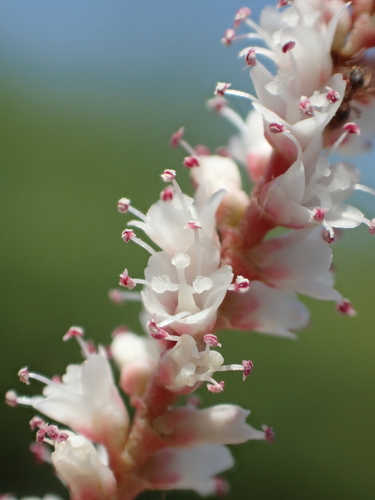
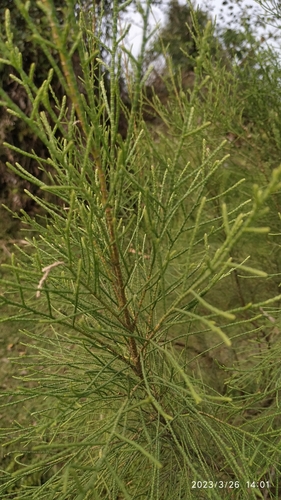
Tamarix dioica
Roxb. ex Roth

(c) Dr. Alexey Yakovlev, some rights reserved (CC BY), uploaded by Dr. Alexey Yakovlev

(c) Dr. Alexey Yakovlev, some rights reserved (CC BY), uploaded by Dr. Alexey Yakovlev
(c) Smritirekha Bortamuly, some rights reserved (CC BY-NC), uploaded by Smritirekha Bortamuly
What to Eat
Edible parts: Manna
Manna produced by the tree is used in confectionery.
Where to Find It
It is native from Iran to India.
Afghanistan, Asia, Bangladesh, Central Asia, Himalayas, India, Iran, Middle East, Myanmar, Nepal, Pakistan, SE Asia, Tajikistan,
How to Identify
A small tree. It grows 3 m high. The bark is red-brown. The leaves form a sheath. The flowers are simple and in a loose compound arrangement.
Medicinal Uses
Tamarix dioica is used in traditional medicine as a diuretic and a carminative, as an astringent, and for the treatment of inflammation of the liver and spleen. An extract of the leaves has been shown to have antifungal activity. Phytochemical screening reveals the presence of several unusual phytochemicals and further investigation needs to be undertaken to determine whether any of these are a potential source of useful drugs.
Wikipedia
Source ↗Tamarix dioica is a twiggy shrub or small tree that grows in saline habitats in western Asia. Common names include ghaz and khagal in Pakistan, lal jhau, urusia, ban jhau, nona-gach, urichiya in Bangladesh and nona jhau in the Sunderbans.
Notes
There are 54 Tamarix species.
Names & Synonyms
Byaing-chedauk, Gyogyi, Jhau, Kachlei, Khau, Lal-jhau, Nirumari, Palivela, Pilchi, Pisula, Rgelta
References (3)
- Ambasta, S.P. (Ed.), 2000, The Useful Plants of India. CSIR India. p 619
- Barwick, M., 2004, Tropical and Subtropical Trees. A Worldwide Encyclopedic Guide. Thames and Hudson p 403
- Nov. pl. sp. 185. 1821