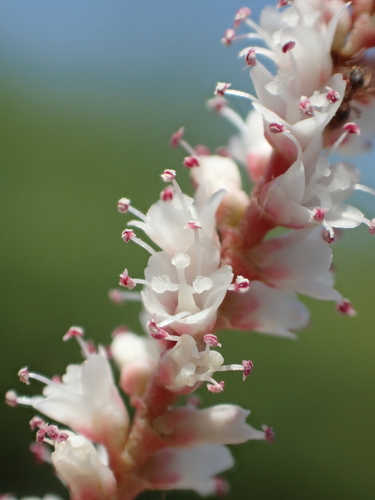
Tamarix anglica
Webb.
English Tree

Meise Botanic Garden

Meise Botanic Garden

Meise Botanic Garden
What to Eat
Edible parts: Manna
A manna is produced by the plants in response to insect damage to the stems. It is sweet and mucilaginous.
Where to Find It
Western Europe in Britain, W. France, N.W. Spain and Portugal.
Coming Soon
How to Identify
Tamarix anglica is a deciduous Shrub growing to 5 m (16ft 5in) at a medium rate. See above for USDA hardiness. It is hardy to UK zone 7. The species is hermaphrodite (has both male and female organs) and is pollinated by Insects. Suitable for: light (sandy), medium (loamy) and heavy (clay) soils, prefers well-drained soil and can grow in heavy clay soil. Suitable pH: mildly acid, neutral and basic (mildly alkaline) soils and can grow in very alkaline and saline soils. It cannot grow in the shade. It prefers dry or moist soil. The plant can tolerate maritime exposure.
How to Grow
An easily grown plant, succeeding in most soils and tolerant of saline conditions. Grows well in heavy clay soils as well as in sands and even shingle. Usually found near the coast, it succeeds inland if given a fairly good deep loam and a sunny position. Tolerant of maritime winds and dry soils when grown near the coast, plants require a moister soil and shelter from cold drying winds when they are grown inland in non-saline soils because they use the soil salts that are found in saline soils to help them reduce transpiration. Growth can be restricted by cutting back the plants in spring, hedges are also best trimmed at this time. This species is very closely related to T. gallica and is considered to be no more than a part of that species by many botanists. Plants in this genus are notably resistant to honey fungus.
Propagation: Seed - sow spring in a cold frame and only just cover the seed. When they are large enough to handle, prick the seedlings out into individual pots and grow them on in the greenhouse for their first winter. Plant them out into their permanent positions in late spring or early summer, after the last expected frosts. Cuttings of half-ripe wood, July/August in a frame. Very easy. Cuttings of mature wood of the current seasons growth, 15 - 25cm long, planted outdoors in late autumn in a nursery bed or straight into their permanent position. High percentage.
Medicinal Uses
Astringent Diuretic. Astringent, diuretic.
Other Uses
Fuel Hedge Hedge Soil stabilization Wood. Very tolerant of maritime exposure, it makes a good shelter hedge in coastal gardens. Dislikes being trimmed. The extensive root system of this plant makes it suitable for use in erosion control in sandy soils. Wood - fairly hard, not strong, close grained, takes a high polish. Used for general construction, poles, turnery. It makes a good fuel, burning well even when green due to the wax content of the wood.