Wrightia tinctoria
(Roxb.) R. Br.
Pala Indigo-plant

(c) Amol Patwardhan, some rights reserved (CC BY-NC), uploaded by Amol Patwardhan
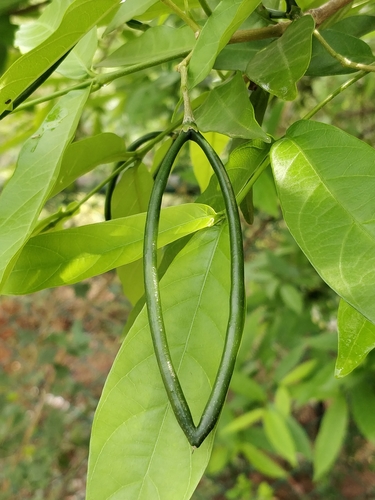
(c) Suhel Quader, some rights reserved (CC BY), uploaded by Suhel Quader
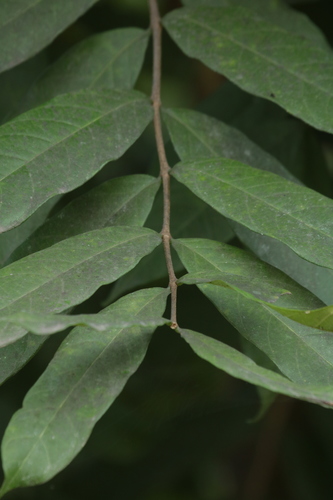
(c) tutikpitik, some rights reserved (CC BY-NC), uploaded by tutikpitik
What to Eat
Edible parts: Flowers, Leaves, Stems, Seeds, Pods, Fruit
The flowers, leaves, fruits and seeds are edible. The tree is harvested from the wild as a medicine and source of a dye and wood. Leaves are extracted as fodder for livestock. The leaves, flowers, fruits and roots are sources of indigo-yielding glucoside, which produces a blue dye or indigo- like dye. About 100–200 kilos of leaves are needed to prepare 1 kilo of dye. It is occasionally planted as an ornamental in the tropics. The branches are trampled into the puddle soil in rice field for green manuring. It is recommended as a good agroforestry species as it intercrops well. High levels of extraction is resulting in it becoming scarce in some regions. The sap added to milk has been reported to have preservative properties; the milk will remain fresh for some time, the taste remaining unaltered.
Where to Find It
A tropical plant. It grows in dry deciduous forest. It grows up to 1,200 m altitude in Peninsula India.
Asia, Australia, East Timor, Himalayas, India, Myanmar, Nepal, Pakistan, SE Asia, Timor-Leste, Vietnam,
How to Identify
A small deciduous tree. It grows 8 m tall. The bark is grey or pale brown and becomes cracked with age. The leaves are in pairs opposite each other. They are pointy at the tip. They can be 15 cm long. The are softly hairy. The leaf stalk is very short. The flowers are white and about 3 cm wide. There are 5 narrow twisted petals. The stamens form a cone at the centre. There are lacy threads around the cone. The flowers have a smell of vanilla. The fruit are a pair of long slender cylinders. They hang down and are joined below at the tip. They are green when young.
How to Grow
Plants can be grown from seed or using cuttings. Root suckers can also be used.
Medicinal Uses
The plant contains wrightial, a triterpenoid phytochemical, along with cycloartenone, cycloeucalenol, β-amyrin, and β-sitosterol isolated from the methanol extract of the immature seed pods. In Ayurveda and other traditional medicine practices, the plant is called shwetha kutaja and its seeds are called indrayava or indrajava. There is no high-quality clinical evidence that it is safe or has any beneficial effect.
Other Uses
The seeds, roots and leaves furnish an indigo-yielding glucoside used for dyeing cloth. About 100 - 200 kilos of leaves are needed to prepare 1 kilo of dye. The seedpods contain a floss that is used for stuffing cushions. The cream-coloured latex has a rubber content varying from 2 - 28% that can be exploited commercially. The white wood is light in weight, soft and fine-textured. Of high quality, it is in high demand for use in carving and turnery. Carved items are said to resemble ivory in appearance. The wood is also used to make implements, furniture, small boxes, toys etc.
Wikipedia
Source ↗Wrightia tinctoria, Pala indigo plant or dyer's oleander, is a flowering plant species in the genus Wrightia found in India, southeast Asia and Australia. It is found in dry and moist regions in its distribution. Various parts of the plant have been used in traditional medicine, but there is no scientific evidence it is effective or safe for treating any disease.
Production
The growth is slow.
Names & Synonyms
Aiyapala, Amkuda, Bepalle, Doodhi, Dudh kuvad, Dudhokriya, Hyamaraka, Indrajau, Irumpalai, Jeddapaala, Kala Huda, Kala kuda, Karu, Khirni, Kodamurki, Kodesige, Kotakappalla, Krya, Milky way, Mitha-indrajau, Pita karuan, Runchallo-duhlo, Safed kuvad, Sweet Indrajau, Tedlapaala, Thonthapalai, Toothache plant, Veypale
References (9)
- Ambasta, S.P. (Ed.), 2000, The Useful Plants of India. CSIR India. p 691
- Chauhan, S. H., et al, 2018, Consumption patterns of wild edibles by the Vasavas: a case study from Gujarat, India. Journal of Ethnobiology and Ethnomedicine (2018) 14:5
- Jadhav, R., et al, 2015, Forest Foods of Northern Western Ghats: Mode of Consumption, Nutrition and Availability. Asian Agri-History Vol. 19, No. 4: 293-317
- Kiran, K. C., et al, 2019, Diversity and Seasonal Availability of Potential Wild Edible Plants from Vidarbha Region of Maharashtra State, India. Int.J.Curr.Microbiol.App.Sci (2019) 8(2): 1434-1446
- Krishen P., 2006, Trees of Delhi, A Field Guide. DK Books. p 137
- Mem. Wern. Nat. Hist. Soc. 1:73. 1809
- Pradhan, R., et al, 2020, Potential Wild Edible Plants and its Significance in Livelihood of Indigenous People of Male Mahadeshwara Hills, Karnataka. Economic Affairs Vol. 64, No. 4 pp. 01-14
- Swaminathan, M.S., and Kochnar, S.L., 2007, An Atlas of Major Flowering Trees in India. Macmillan. p 201
- www.worldagroforestrycentre.org/treedb/


