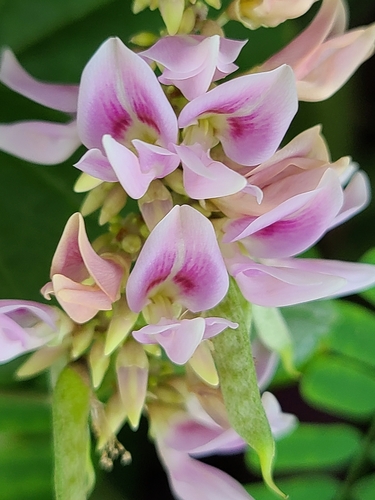
Dialium orientale
Baker f.

Renee Comet (photographer) AV Number: AV-9400-4164 (via Wikimedia Commons)

Royal Botanic Gardens, Kew
What to Eat
Edible parts: Fruit
Fruit - raw. The white, soft, mealy pulp surrounding the seeds has a sour taste similar to tamarind. The hard seeds are discarded and the pulp is eaten like chewing gum. The ripe fruit can be peeled, soaked in warm water and then squeezed. Sugar is added to the thick liquid, which is then filtered. The juice is then ready for drinking before or after being cooled. The round, reddish seedpods are up to 18mm long. They become dry and brittle as they ripen, eventually cracking open to set free 1 - 2 seeds in a mealy edible pulp.
Where to Find It
A tropical plant. It grows in coastal, dry evergreen forest. In Kenya it grows in coastal areas. It grows from sea level to 100 m altitude.
Africa, East Africa, Kenya, Somalia, Tanzania,
How to Identify
A tree or a shrub with many stems. It grows 18 m high. The bark is smooth and grey. It is a spreading plant. The leaves have narrow or sword shaped leaflets. There are 1-4 pairs. These are 2-5 cm long by 1-3 cm wide. The flowers are white but do not have petals. They are in wide and much branched panicles. The fruit is round, red and 2 cm across. It is edible. It contains 1 or 2 seeds.
Nutrition Score: 13/100
| Part | Moisture | kJ | kcal | Protein | Vit A | Vit C | Iron | Zinc |
|---|---|---|---|---|---|---|---|---|
| Fruit | 20.4 | — | — | 2.4 | — | — | — | — |
How to Grow
Plants can be grown from seeds that are sowed directly where they are to grow.
Other Uses
The wood is very hard. It is used for tool handles, dhow ribs and grain mortars. The wood is used for fuel and is made into charcoal. The reddish-brown wood is heavy and hard. It is used for poles in construction, joinery, furniture, boat ribs, mortars and tool handles. The wood is used for fuel and to make charcoal.
Wikipedia
Source ↗Dialium orientale is a species of plant in the family Fabaceae.It is found in Kenya, Somalia, and Tanzania. The fruit of this tree is a popular snack in Kenya and known as pepeta. It is threatened by habitat loss.
Production
Peeled fruit can be kept for 2 years. The fruit are collected from July to October.
Notes
There are about 40 Dialium species. They grow in tropical SE Asia. They probably all have edible fruit. Also as Caesalpinaceae.
Names & Synonyms
Mhetele, Mpekechu, Mpepeta, Mshugwi, Mtsumbwi, Sgusholwe, Shishoble, Shoshobli, Sishoble
References (11)
- Barwick, M., 2004, Tropical and Subtropical Trees. A Worldwide Encyclopedic Guide. Thames and Hudson p 143
- Cunningham, 1985
- Dale, I. R. and Greenway, P. J., 1961, Kenya Trees and Shrubs. Nairobi. p 104
- Lovett, J. C. et al, Field Guide to the Moist Forest Trees of Tanzania. p 77
- Maundu, P. et al, 1999, Traditional Food Plants of Kenya. National Museum of Kenya. 288p
- Mutie, F. M., et al, 2023, Important Medicinal and Food Taxa (Orders and Families) in Kenya, Based on Three Quantitative Approaches. Plants 2023, 12, 1145
- Oldfield, S., et al, 1998, The World List of Threatened Trees. World Conservation Press. p 169
- Palmer & Pitman, 1972,
- Peters, C. R., O'Brien, E. M., and Drummond, R.B., 1992, Edible Wild plants of Sub-saharan Africa. Kew. p 122
- Ruffo, C. K., Birnie, A. & Tengnas, B., 2002, Edible Wild Plants of Tanzania. RELMA p 264
- World Checklist of Useful Plant Species 2020. Royal Botanic Gardens, Kew