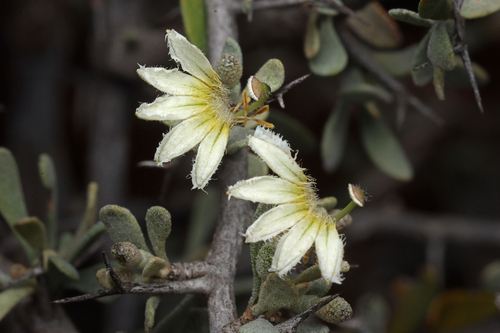
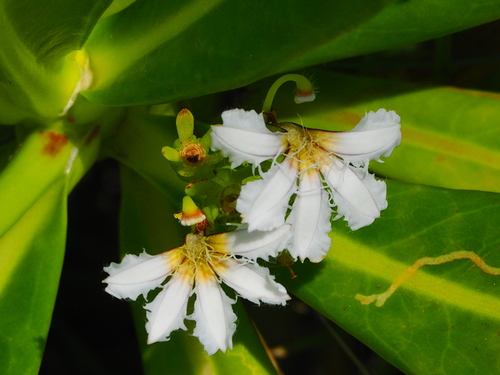
Scaevola plumieri
(L.) Vahl
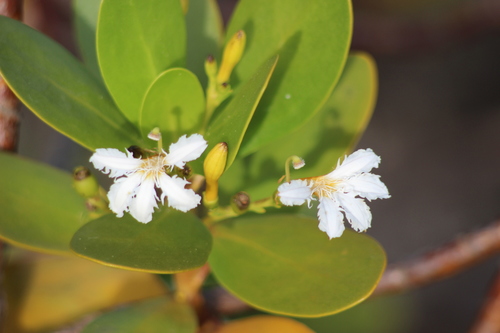
(c) Douglas Meyer, some rights reserved (CC BY-NC), uploaded by Douglas Meyer
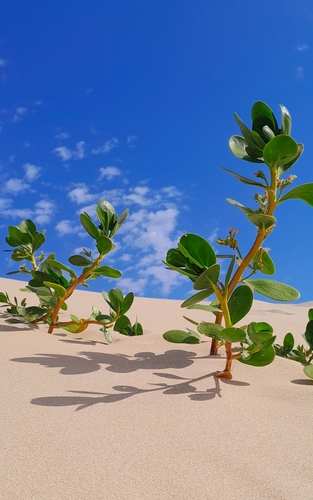
(c) megan_rhinos, some rights reserved (CC BY-NC), uploaded by megan_rhinos

(c) dbond, some rights reserved (CC BY-NC)
What to Eat
Edible parts: Fruit
The fruit is fleshy and edible, though acrid in taste.
Where to Find It
A tropical plant. They grow in coastal areas in coastal sands. They are widespread on tropical seashores. It grows on sandy soils and dunes.
Africa, Angola, Anguilla, Asia, Australia, Bahamas, Benin, Brazil, Cayman Islands, Central Africa, Central America, Congo, Côte d'Ivoire, Dominican Republic, East Africa, Gabon, Ghana, Guinea, Guinée, Guinea-Bissau, India, Ivory Coast, Liberia, Madagascar, Mozambique, Nigeria, North America, Pakistan, Sao Tome and Principe, Senegal, Sierra Leone, Somalia, Sri Lanka, St. Kitts and Nevis, Togo, USA, West Africa, West Indies,
How to Identify
A small shrub. It grows up to 50 cm high. It is branched and leans over. The branches are thick and succulent. The leaves are 2-8 cm long by 8-35 mm wide. They taper to the base. The leaf scars are prominent. The fruit is fleshy and purple. It is edible but acrid.
How to Grow
The fruit can float in sea water.
Wikipedia
Source ↗Scaevola plumieri (common name gullfeed) is a species of plant in the family Goodeniaceae which grows on coastal dunes in the tropics and subtropics.
Names & Synonyms
Hel u buki, Ndiob diuam, Wogbo
References (8)
- Burkill, H. M., 1985, The useful plants of west tropical Africa, Vol. 2. Kew.
- Dalziel, J. M., 1937, The Useful plants of west tropical Africa. Crown Agents for the Colonies London.
- Flora of Pakistan. www.eFloras.org
- JSTOR Global Plants edible
- Peters, C. R., O'Brien, E. M., and Drummond, R.B., 1992, Edible Wild plants of Sub-saharan Africa. Kew. p 116
- Smith, N., Mori, S.A., et al, 2004, Flowering Plants of the Neotropics. Princeton. p 174 (Drawing), Plate 22 (Photo)
- Symb. bot. 2:36. 1794
- World Checklist of Useful Plant Species 2020. Royal Botanic Gardens, Kew