Albuca canadensis
(Linn.) F. M. Leight.
Slym
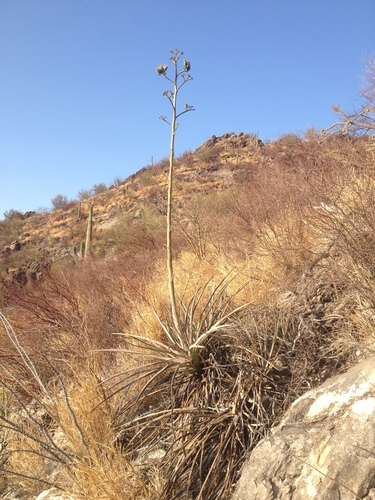
(c) Felix Riegel, some rights reserved (CC BY-NC), uploaded by Felix Riegel
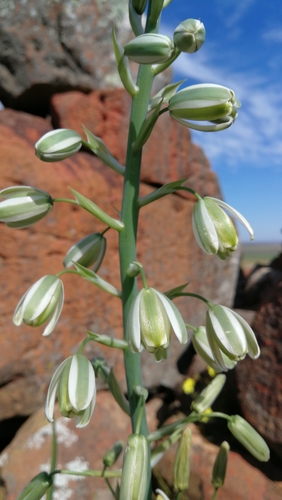
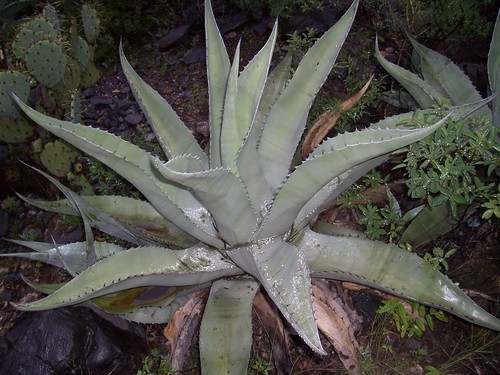
(c) Craig Peter, some rights reserved (CC BY-NC), uploaded by Craig Peter

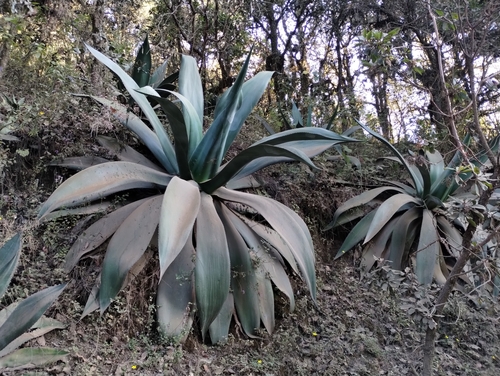
(c) Nicola van Berkel, some rights reserved (CC BY-SA), uploaded by Nicola van Berkel
What to Eat
Edible parts: Stalks - drink, Roots, Flowers
The succulent stems are chewed to relieve thirst. They are notably mucilaginous. This use is recorded for the closely related A. major, and is considered almost certain to apply to this species as well.
Where to Find It
It is a subtropical plant. It grows in clay soils.
Africa, Australia, Namibia, South Africa, Southern Africa,
How to Identify
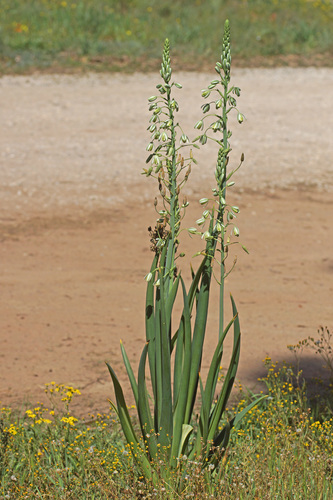
A bulb that that keeps growing from year to year. It grows 50-120 cm high and spreads 10 cm wide. It has 5-6 fleshy, sword shaped leaves. They are 45-90 cm long. There are 40-50 flowers in a group. The flowers are bell shaped and white. They hang down and outwards. The flowers are 1.5-2.5 cm across.
Nutrition Score: 14/100
| Part | Moisture | kJ | kcal | Protein | Vit A | Vit C | Iron | Zinc |
|---|---|---|---|---|---|---|---|---|
| Fruit | 93.2 | 101 | 24 | 0.3 | — | 7.4 | 0.5 | 0.1 |
| Bulb | 77.1 | — | — | 0.6 | — | — | — | — |
How to Grow
Propagation: Sow seed in a greenhouse in a light, well-drained compost as soon as it is ripe if possible, otherwise in spring. Sow thinly so that young plants can be grown on in the same pot for their first year. Apply a liquid feed occasionally if seedlings appear to need nutrients, then prick out at the end of their first growing season. Grow on for at least one more winter in the greenhouse before planting out with bulbs dormant in late summer or early autumn. Can also be propagated by division of offsets in late summer.
Medicinal Uses
None known.
Other Uses
None known.
Wikipedia
A bulbous perennial reaching 0.4 m tall by 0.2 m wide, growing at a medium rate. Hardy to UK zone 8 with April flowers. Prefers light sandy to medium loamy, well-drained soil across mildly acidic to alkaline pH ranges. Needs full sun and tolerates both dry and moist soils.
Notes
There are about 30 Albuca species. They are native to Southern Africa. Also put in the family Hyacinthaceae.
Names & Synonyms
Mototse, Slymstok uintjie
References (8)
- Fox, F. W. & Young, M. E. N., 1982, Food from the Veld. Delta Books. p 248
- Hedrick, U.P., 1919, (Ed.), Sturtevant's edible plants of the world. p 32 (As Albuca major)
- Hibbert, M, 2002, The Aussie Plant Finder 2002. Florilegium. p 24 (As Albuca altissima)
- Prodr. fl. cap. 9. 1768
- Ruiters-Welcome, A. K., 2019, Food plants of southern Africa. Ph.D. thesis. Univ. of Johannesburg p 65
- Wehmeyer, A. S, 1986, Edible Wild Plants of Southern Africa. Data on the Nutrient Contents of over 300 species (As Albuca altissima)
- Welcome, A. K. & Van Wyk, B.-E., 2019, An inventory and analysis of the food plants of southern Africa. South African Journal of Botany 122 (2019) 136–179
- Youngblood, D., 2004, Identification and Quantification of Edible Plant Foods in the Upper (Nama) Karoo, South Africa. Economic Botany 58 (Supplement) :S43-S65