Ambelania acida
Aubl.
Acid ambelania
(c) Enrique Salazar, some rights reserved (CC BY), uploaded by Enrique Salazar
(c) Enrique Salazar, some rights reserved (CC BY), uploaded by Enrique Salazar

(c) Enrique Salazar, some rights reserved (CC BY), uploaded by Enrique Salazar
What to Eat
Edible parts: Fruit, Vegetable
The fruit are eaten raw or cooked. For raw consumption, the fruit are beaten or scratched and soaked in cold water to remove the latex. They can be cooked as a vegetable or used for jams and jellies.
Where to Find It
A tropical plant. It grows in northern estuaries in the Amazon in Brazil. It grows in dry forests.
Amazon, Brazil*, Colombia, French Guiana, Guianas, Guyana, Peru, South America, Suriname, Venezuela,
How to Identify
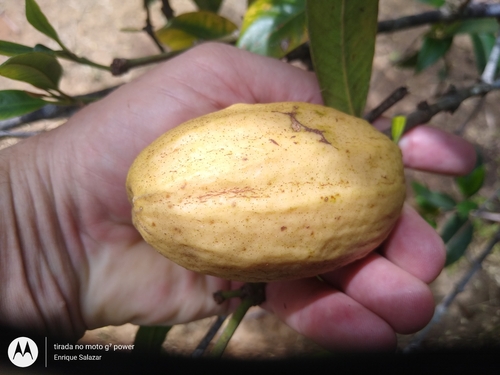
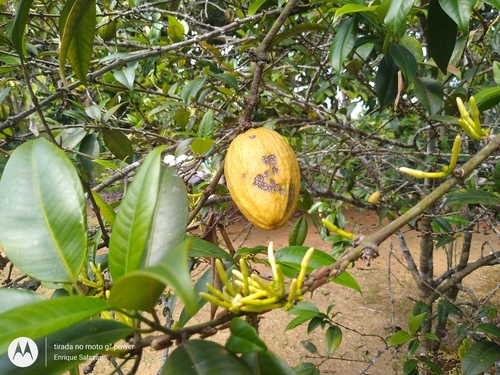
A small evergreen tree. It grows 4-8 m high. It can be 30 m tall. The trunk is 15-20 cm across. The bark is thick and produces latex. The branches occur opposite. The leaves are simple and opposite. They are 15-24 cm long. The flowers are in groups in the axils of leaves. They are 3-4 cm long. There are 2-10 tube shaped flowers in a group. They are white or cream. The fruit is an oblong berry. It is 10-12 cm long and 4 cm wide. There are many dark seeds.
How to Grow
Plants can be grown from seed. The ripe fruit are harvested and put into a plastic bag to decompose to make it easier to remove the seeds. They are washed in running water. Fresh seed are planted and germinate in 30-50 days.
Propagation: Seed - best sown as soon as it is ripe in a partially shaded position in a nursery seedbed. A low germination rate can be expected, with the seed sprouting within 30 - 50 days.
Medicinal Uses
The latex obtained from the stems and incised trunk is astringent. It is licked from the plant as a treatment for diarrhoea. The latex is used externally for treating cataracts of the eye and to accelerate healing of sores. A decoction of the bark is used as a treatment for dysentery and diarrhoea. The fruit is mildly purgative. It is eaten as a remedy for diarrhoea, whilst a jam made from the skinned fruit is used to treat dysentery.
Other Uses
A latex exudes from all parts of the plant. The wood is fine-textured; straight-grained; moderately heavy, with moderate mechanical properties and moderately durable. It is only used for fuel and to make charcoal.
Production
In Guyana plants flower August to October and fruit in August to November.
Other Information
The fruit are enjoyed.
Names & Synonyms
Bagasse, Balati, Batibati, Makouro, Makulira, Makurriro, Mambali, Mambaye, Mapa, Papaye-bich, Paraveris, Pau-de-colher, Pepino-do-mato, Pubo, Quienbiendent
References (17)
- Allorge, L., Flore des trois Guyanes, Apocynaceae. p 16
- Bircher, A. G. & Bircher, W. H., 2000, Encyclopedia of Fruit Trees and Edible Flowering Plants in Egypt and the Subtropics. AUC Press. p 23
- Etkin, N.L. (Ed.), 1994, Eating on the Wild Side, Univ. of Arizona. p 136
- Fouqué, A. 1972. Espèces fruitières d'Amérique tropicale. Institut français de recherches fruitierès outre-mer (ifac (As Ambelania sagotii)
- Grandtner, M. M. & Chevrette, J., 2013, Dictionary of Trees, Volume 2: South America: Nomenclature, Taxonomy and Ecology. Academic Press p 27
- Useful plants of Guyana. Non-Timber Forest Products of the North-West District of Guyana Part 1. p 103
- Hedrick, U.P., 1919, (Ed.), Sturtevant's edible plants of the world. p 48
- INFOODSUpdatedFGU-list.xls (Also as Ambelania sagotii)
- Lorenzi, H., 2002, Brazilian Trees. A Guide to the Identification and Cultivation of Brazilian Native Trees. Vol. 02 Nova Odessa, SP, Instituto Plantarum p 34
- Lorenzi, H., Bacher, L., Lacerda, M. & Sartori, S., 2006, Brazilian Fruits & Cultivated Exotics. Sao Paulo, Instituto Plantarum de Estuados da Flora Ltda. p 58
- Martin, F. W., et al, 1987, Perennial Edible Fruits of the Tropics. USDA Handbook 642 p 82 (Also as Ambelania tenuifolia)
- Paz, F. S., et al, 2021, Edible Fruit Plant Species in the Amazon Forest Rely Mostly on Bees and Beetles as Pollinators. Journal of Economic Entomology, XX(XX), 2021, 1–13
- Reis, S. V. and Lipp, F. L., 1982, New Plant Sources for Drugs and Foods from the New York Botanical Garden herbarium. Harvard. p 241
- Roa, J. A. G. & Boada, D. S. G., 2018, Fundación para el Fortalecimiento de la Fruticultura y Plantas Alimenticias no Convencionales en Colombia.
- van Roosmalen, M.G.M., 1985, Fruits of the Guianan Flora. Utrecht Univ. & Wageningen Univ. p 22
- World Checklist of Useful Plant Species 2020. Royal Botanic Gardens, Kew
- www.colecionandofrutas.org


