Calyptranthes aromatica
St. Hil.
Brazil pimento, Fragrant lidflower
(c) edvandroabreuribeiro, some rights reserved (CC BY-NC)
(c) edvandroabreuribeiro, some rights reserved (CC BY-NC)

(c) Victor Hugo Rebecchi Siqueira, some rights reserved (CC BY-NC)
What to Eat
Edible parts: Flower buds, Fruit, Bark, Spice
The flower buds are used as a clove substitute, and the ripe berries are used as allspice. The bark is also edible.
Where to Find It
A tropical plant. It grows on slopes in the Atlantic forest in Brazil.
Brazil*, South America,
How to Identify
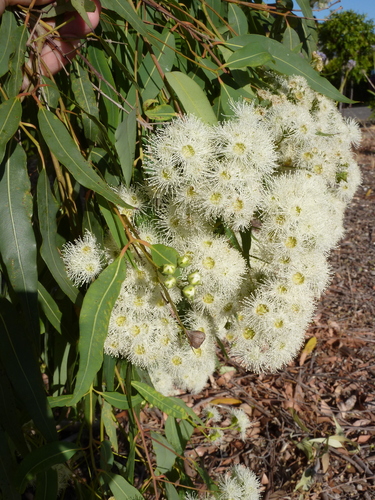
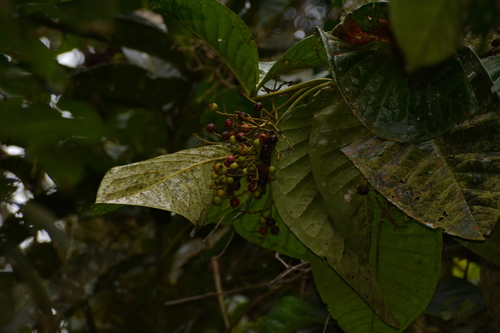
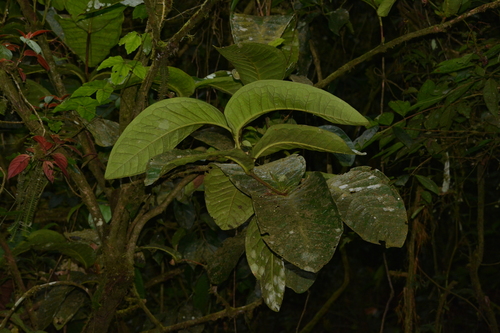
A tree. It grows 4-7 m high. It has the smell of cloves. The crown is wide and the leaves are spread out. The trunk is short and crooked. The branches are long and almost touch the ground. The leaves are reddish when young. The leaves are oval and rough. They are 35-50 cm long by 17-23 cm wide. There are 14-20 pairs of side veins. The flowers can be in the axils of leaves or at the ends of branches. The fruit are round and red and become black when ripe.
How to Grow
The plant is grown from seeds. The seeds are collected by shaking the ripe fruit onto a canvas and putting them into a plastic bag so they can partly decompose and the seeds washed out in running water. The seeds need to be planted while fresh and are best in light shade. Seeds germinate in 30-50 days.
Propagation: Seed - of limited viability, it should be sown as soon as it is ripe in a partially shaded position in a nursery seedbed. A germination rate in excess of 80% can be expected, with the seed sprouting within 30 - 50 days. Seedlings grow away slowly.
Medicinal Uses
The leaves are antispasmodic and stimulant. It is an effective treatment against tapeworm. The powdered bark is used as a carminative.
Other Uses
An essential oil obtained from the plant has an aroma of lemons. The wood is medium-textured, straight-grained, moderately heavy, susceptible to wood-eating organisms. The wood is of too small dimensions to be of much use other than as fuel and to make charcoal.
Production
Plants grow slowly. They can be 2 m high after 2 years.
Notes
There are about 200 Calyptranthes species. They are trees and shrubs in tropical America.
Names & Synonyms
Craverio-da-terra
References (7)
- Bircher, A. G. & Bircher, W. H., 2000, Encyclopedia of Fruit Trees and Edible Flowering Plants in Egypt and the Subtropics. AUC Press. p 75
- Grandtner, M. M. & Chevrette, J., 2013, Dictionary of Trees, Volume 2: South America: Nomenclature, Taxonomy and Ecology. Academic Press p 93
- Hedrick, U.P., 1919, (Ed.), Sturtevant's edible plants of the world. p 144
- Kermath, B. M., et al, 2014, Food Plants in the Americas: A survey of the domesticated, cultivated and wild plants used for Human food in North, Central and South America and the Caribbean. On line draft. p 167
- Lorenzi, H., 2009, Brazilian Trees. A Guide to the Identification and Cultivation of Brazilian Native Trees. Instituto Plantarum de Estuados da Flora Ltda. Vol. 3 p 234
- Seidemann J., 2005, World Spice Plants. Economic Usage, Botany, Taxonomy. Springer. p 76
- www.colecionandofrutas.org