Dracaena draco
(L.) L.
Dragon tree, Dragon's blood tree
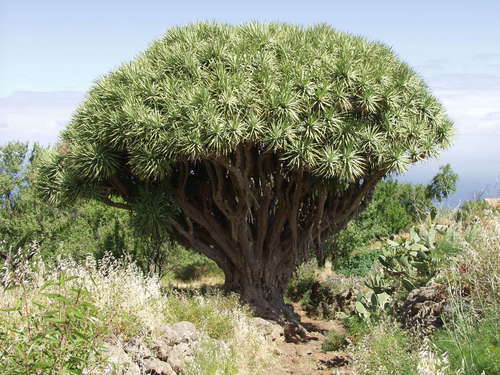
no rights reserved, uploaded by Ina Siebert
(c) wormsy, some rights reserved (CC BY-NC), uploaded by wormsy
(c) hchavez, some rights reserved (CC BY-NC), uploaded by hchavez
What to Eat
Edible parts: Fruit
When the bark or leaves are cut they secrete a reddish resin, one of several sources of substances known as dragon's blood. Red resins from this tree contain many mono- and dimeric flavans that contribute to the red color of the resins. Dragon's blood has a number of traditional medical uses, although dragon's blood obtained from Dracaena draco was not known until the 15th century, and analyses suggest that most dragon's blood used in art was obtained from species of the genus Calamus formerly placed in Daemonorops. The primary and secondary plant body are the site of the secretory plant tissues that form dragon's blood. These tissues include ground parenchyma cells and cortex cells. Dragon's blood from Dracaena draco and Dracaena cinnabari can be distinguished by differences in 10 compounds and a dominant flavonoid DrC11 missing in Dracaena draco. The Guanches worshiped a specimen in Tenerife, and hollowed its trunk into a small sanctuary. Alexander von Humboldt saw it at the time of his visit. It was 70 feet (21 m) tall and 45 feet (14 m) in circumference, and was estimated to be 6,000 years old. It was destroyed by a storm in 1868.
Where to Find It
Adelaide Botanical Gardens. Melbourne Botanical gardens. It suits places with moderate moisture or dry areas. It does well on a gritty, well-drained soil. It needs full sun. It suits hardiness zones 10-12.
Africa, Asia, Australia, Canary Islands*, Hawaii, Indonesia, Mediterranean, Morocco*, North Africa, Pacific, SE Asia, Slovenia, USA,
How to Identify
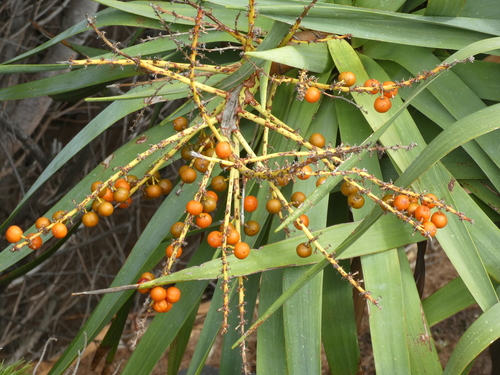
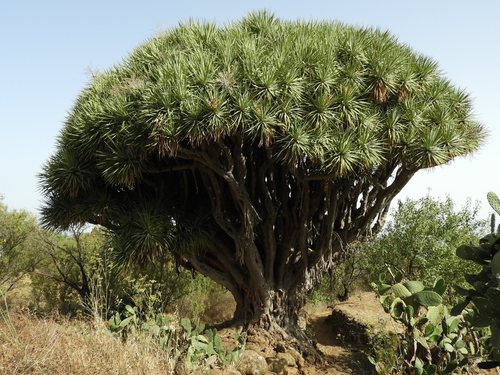
A palm like tree. It is evergreen. The trunk is erect and the branches spread out like spokes in a wheel. It grows 6-17 m tall. The sap is orange-red. The leaves are sword shaped and leathery. They are 35-50 cm long. The forked base is orange. They are in clusters at the ends of branches. The edges are smooth. The flowers are greenish-white and very small. They are in large flower heads. The fruit are orange-red.
How to Grow
Plants can be grown from seeds or by stem cuttings.
Propagation: Seed - Cuttings. Dracaena species are generally easy to propagate. Only a small piece of the plant is required to form a new plant, and even when thrown away it may easily root.
Medicinal Uses
The resin, the so-called 'dragon's blood', is used as a folk medicine and fumigating agent.
Other Uses
The red resin has a wide range of uses: as a varnish; for staining wood in items such as violins; for embalming the dead etc. The plant is cultivated in various tropical regions as a supporter for Vanilla plants.
Wikipedia
Source ↗Dracaena draco, the Canary Islands dragon tree or drago, is a subtropical tree in the genus Dracaena, native to the Canary Islands, Cape Verde, Madeira, western Morocco, and possibly introduced into the Azores. It was first described by Carl Linnaeus in 1762 as Asparagus draco. In 1767 he assigned it to the new genus, Dracaena. A related tree of similar appearance, the Socotra dragon tree Dracaena cinnabari, grows on the island of Socotra, Yemen, more than 7,000 km from the Canary Islands.
Production
It is slow growing.
Notes
There are about 60-100 Dracaena species. The sap is used to stain Stradivarious violins. Also put in the family Dracaenaceae.
Names & Synonyms
Zmajasti zmajevec
References (11)
- Blamey, M and Grey-Wilson, C., 2005, Wild flowers of the Mediterranean. A & C Black London. p 488
- Bodkin, F., 1991, Encyclopedia Botanica. Cornstalk publishing, p 354
- Cundall, P., (ed.), 2004, Gardening Australia: flora: the gardener's bible. ABC Books. p 511
- Hedrick, U.P., 1919, (Ed.), Sturtevant's edible plants of the world. p 282
- Heywood, V.H., Brummitt, R.K., Culham, A., and Seberg, O., 2007, Flowering Plant Families of the World. Royal Botanical Gardens, Kew. p 366
- Hibbert, M., 2002, The Aussie Plant Finder 2002, Florilegium. p 89
- Llamas, K.A., 2003, Tropical Flowering Plants. Timber Press. p 336
- Marinelli, J. (Ed), 2004, Plant. DK. p 104
- Staples, G.W. and Herbst, D.R., 2005, A tropical Garden Flora. Bishop Museum Press, Honolulu, Hawaii. p 584
- Sukarya, D. G., (Ed.) 2013, 3,500 Plant Species of the Botanic Gardens of Indonesia. LIPI p 1012
- Syst. nat. ed. 12, 2:246. 1767