Elaeodendron glaucum
(Rottboll) Persoon
Ceylon tea

(c) swanand kesari, some rights reserved (CC BY)
(c) SONU KUMAR, some rights reserved (CC BY-NC)
(c) SONU KUMAR, some rights reserved (CC BY-NC)
What to Eat
Edible parts: Leaves - tea, Root
The leaves are used as tea, and the root is edible.
Known Hazards
Where to Find It
A tropical plant. It grows in tropical Asia.
Asia, Hawaii, India, Myanmar, Pacific, SE Asia, Sri Lanka*, USA,
How to Identify
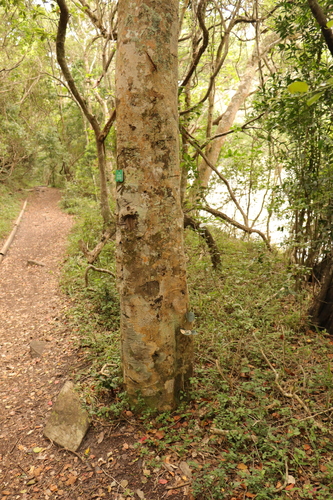
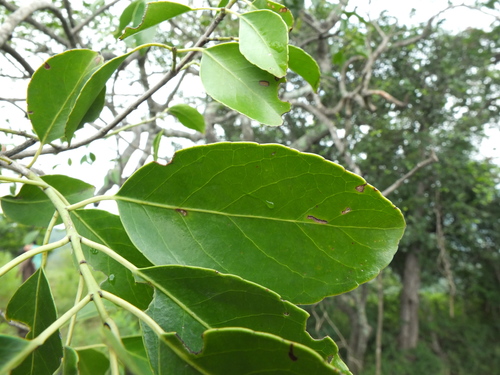
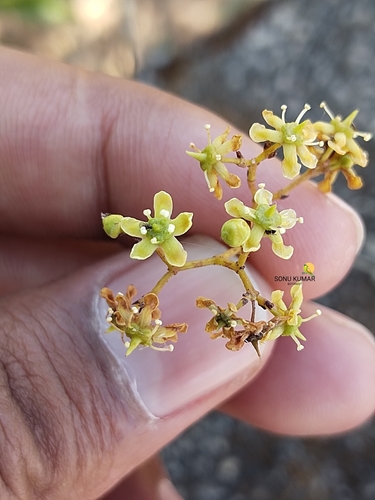
A tree. It is like Elaeodendron orientale. The leaves remain the same size. The edges of the leaves are scalloped. The flower group are loose and 10 cm long.
How to Grow
Prefers a clay soil.
Medicinal Uses
The dried and powdered leaves are used as sternutatoires. They are also burnt and the smoke used as a fumigant in the treatment of certain nerve diseases, particularly to rouse women from hysteria. The powdered leaves are used as a snuff to relieve headaches. The bark is astringent and is also considered poisonous. The fresh root bark is rubbed into a paste with water and applied as a poultice on swellings. The root is said to be specific against snake-bite. A cold water extract of the crushed roots is used as an emetic.
Other Uses
A high quality gum is obtained from the plant. It is only available in small quantities. The bark contains from 8 - 13.5% tannins. The leaves contain from 8 - 15% tannins. The heartwood is a dirty brick-red; it is not clearly demarcated from the white outer wood. It has an exceedingly close, firm grain, is moderately hard and durable. It is easy to work, yielding a very smooth surface. An excellent wood, but usually only available in smaller sizes and so not very useful commercially. It can be used for cabinet work and picture frames.
Names & Synonyms
Ratangaura
References (4)
- Hedrick, U.P., 1919, (Ed.), Sturtevant's edible plants of the world. p 287
- Kumar, R. & Saikia, P., 2020, Wild edible plants of Jharkhand and their utilitarian perspectives. Indian Journal of Traditional Knowledge Vol 19 (2), April 2020, pp 237-250
- Staples, G.W. and Herbst, D.R., 2005, A tropical Garden Flora. Bishop Museum Press, Honolulu, Hawaii. p 232
- Syn. pl. 1:241. 1805