Ficus aspera
Forster f.
Tongue fig, Clown fig, Mosaic fig
(c) Jesús Cabrera, some rights reserved (CC BY)

(c) Geoff Nichols, some rights reserved (CC BY-NC), uploaded by Geoff Nichols

(c) Kaleiheana-a-Pōhaku Stormcrow, some rights reserved (CC BY-NC), uploaded by Kaleiheana-a-Pōhaku Stormcrow
What to Eat
Edible parts: Fruit, Leaves
The fruit and young leaves are cooked and eaten.
Where to Find It
A tropical plant. It grows in the Pacific islands. It needs regular moisture. It needs and average, well-drained soil. It can grow in full or part sun. It suits hardiness zones 11-12.
Australia, Fiji, Hawaii, New Caledonia, Pacific, USA, Vanuatu*,
How to Identify
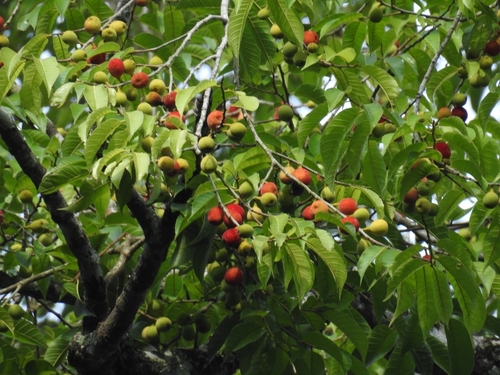
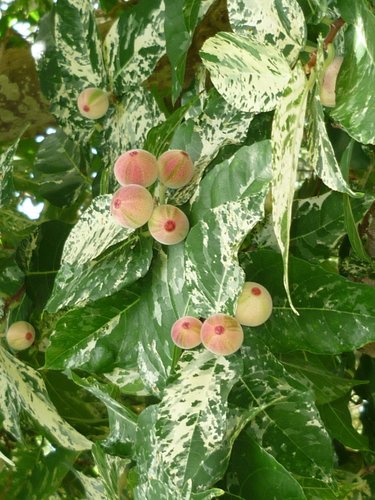
A sandpaper fig. It is a tree which loses its leaves for a short time. It grows 5-10 m high. The leaves are broadly oval and 38 cm long. The leaves have a rough, harsh surface. The edges of the leaves can have rounded teeth or lobes. One cultivated variety has a pattern of pale green and pink patches on the dark green leaf. (This is caused by a virus). This variety is small and crooked. The flowers are small. The fruit are round and 2.5-4 cm across. They are red with maroon stripes. They are downy. The fruit are produced on the trunks and large branches.
How to Grow
It is grown by cuttings.
Propagation: Seed - germinates best at a temperature around 20°c. Air layering. Tip cuttings around 4 - 12cm long, taken from lateral branches.
Other Uses
The rough-textured leaves can be used in place of sandpaper, and as scourers for cleaning pot and pans. The leaves are large enough to be used as plates for serving food, and are also used to wrap food for cooking. The bark is fibrous. We have no specific information for this species, but the fibre is likely to be used for making cordage, possibly cloth and maybe also to make tapa bark cloth. The fibrous branches can be used to clean the teeth. The wood of plants in this genus is usually of low quality, light in weight, soft and not very durable. It is sometimes used for purposes such as light construction, digging sticks, yam stakes, etc. The wood is also used for fuel and sometimes for making fire by friction.
Wikipedia
Source ↗Ficus aspera, the mosaic fig, a plant native to Vanuatu in the south Pacific region. The plant first appeared in scientific literature in 1786, published by the German botanist Georg Forster, from a specimen collected from Tanna Island. The mosaic fig is used as an ornamental plant. The fruit are cauliflorous (fruit forming from their main stems or woody trunks rather than from new growth and shoots). It is also called the clown fig.
Names & Synonyms
Buliva
References (12)
- Bourret, D., 1981, Bonnes-Plantes de Nouvelle-Caledonie et des Loyaute. ORSTOM. p 38
- Cabalion, P. and Morat, P., 1983, Introduction le vegetation, la flore et aux noms vernaculaires de l'ile de Pentcoste (Vanuatu), In: Journal d'agriculture traditionnelle et de botanique appliquee JATBA Vol. 30, 3-4
- Cundall, P., (ed.), 2004, Gardening Australia: flora: the gardener's bible. ABC Books. p 602
- Diss. pl. esc. 36. 1786
- Etherington, K., & Imwold, D., (Eds), 2001, Botanica's Trees & Shrubs. The illustrated A-Z of over 8500 trees and shrubs. Random House, Australia. p 325
- Gillaumin, R., 1954, Les Plantes utiles des Nouvelles-Hebrides (fin et complement) In: Journal d'agriculture tropicale et de botanique appliquee Vol. 1, No. 10-12 pp 453-460
- Hedrick, U.P., 1919, (Ed.), Sturtevant's edible plants of the world. p 307
- Llamas, K.A., 2003, Tropical Flowering Plants. Timber Press. p 278
- Staples, G.W. and Herbst, D.R., 2005, A tropical Garden Flora. Bishop Museum Press, Honolulu, Hawaii. p 408
- Thaman, R. and W. Clarke, Paper on Agroforestry on Aneityum and Tanna, Vanuatu from Internet
- Walter, A. & Sam C., 2002, Fruits of Oceania. ACIAR Monograph No. 85. Canberra. p 160, 279
- Wheatley, J.I., 1992, A Guide to the Common Trees of Vanuatu. Department of Forestry, Republic of Vanuatu. p