Gouania lupuloides
(L.) Urb.
Toothbrush tree

(c) Reinaldo Aguilar, some rights reserved (CC BY-NC-SA)

(c) Chuck Sexton, some rights reserved (CC BY-NC), uploaded by Chuck Sexton
(c) Francisco Farriols Sarabia, some rights reserved (CC BY), uploaded by Francisco Farriols Sarabia
What to Eat
Edible parts: Stems, Bark - stimulant, Fruit
The aromatic, bitter stems have been used as a substitute for hops in brewing beer, and are also used to add flavour and body to a range of drinks including soda, ginger beer, root beer, and root tonics. The flavour is described as a very agreeable bitter.
Where to Find It
A tropical plant. In Argentina it grows below 500 m above sea level.
Argentina, Bahamas, Brazil, Central America, Colombia, Cuba*, Dominican Republic, Ecuador, Grenada, Guiana, Haiti, Jamaica, Lesser Antilles*, Mexico, North America, Paraguay, Puerto Rico, South America*, Uruguay, USA, Virgin Islands, West Indies*,
How to Identify
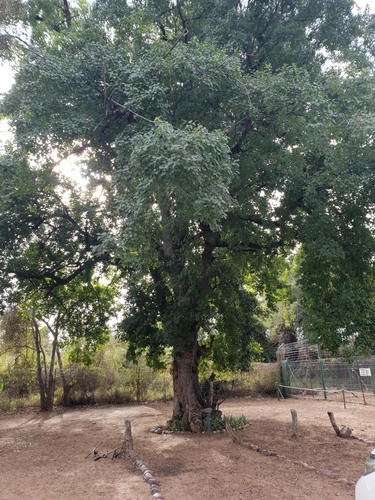
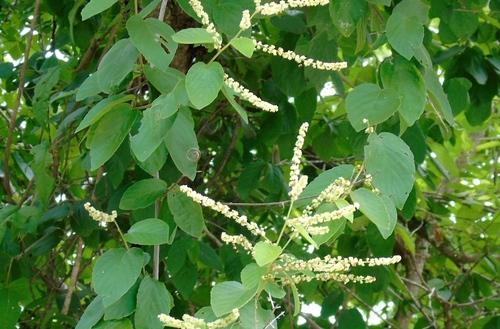
A woody climber. It grows 7-12 m long. It has tendrils. The young stems are hairy. The leaves are 11 cm long by 7 cm wide. They are often heart shaped at the base. The flowers are as 5-8 in long heads. These are 8-18 cm long. The fruit has 3 wings. They are 5-7 mm long. The seeds are 3-4 mm long.
How to Grow
The flowers are much frequented by bees.
Propagation: Propagate from seed.
Medicinal Uses
A decoction of the root is used in Yucatan as a gargle for sores in the mouth and throat. An infusion of the stem has been used to treat gonorrhoea and dropsy, and as a light, pleasant bitter to restore tone to the stomach in cases of debility.
Other Uses
The stems likely contain saponin and produce large quantities of lather when chewed. They are commonly chewed to clean the teeth and harden the gums. A branch piece roughly the thickness of a little finger is softened by chewing and rubbed against the teeth, functioning simultaneously as a toothbrush and tooth powder. When powdered, the stem makes an excellent dentifrice; its aromatic bitter promotes healthy gums, and its mucilage works up into a soap-like froth during brushing.
Wikipedia
Source ↗Gouania lupuloides, known as chewstick or whiteroot, is a neotropical plant of the family Rhamnaceae. It is occasionally used as a teeth-cleaning implement.
Other Information
It is available in local markets.
Notes
There are about 70 Gouania species. They grow in the tropics.
Names & Synonyms
Ahorca buey, Bejuci candlillo rojo, Bejuco indio, Bejuco de sopla, Canelillo negro, Chaw-stick, Chewstick, Chirapa, Chow stick, Jaboncillo, Jabonera, Sgui pu chua, Shuipu chuwa, Soap stick, Soap vine, Sopla, White root
References (12)
- Barfod, A. S. & Kvist, L. P., 1996, Comparative Ethnobotanical Studies of the Amerindian Groups in Coastal Ecuador. The Danish Academy of Sciences and Letters. p 79
- Facciola, S., 1998, Cornucopia 2: a Source Book of Edible Plants. Kampong Publications, p 190
- Hedrick, U.P., 1919, (Ed.), Sturtevant's edible plants of the world. p 332 (As Gouania domingensis)
- Heywood, V.H., Brummitt, R.K., Culham, A., and Seberg, O. 2007, Flowering Plant Families of the World. Royal Botanical Gardens, Kew. p 278 (As Gouania domingensis)
- Kermath, B. M., et al, 2014, Food Plants in the Americas: A survey of the domesticated, cultivated and wild plants used for Human food in North, Central and South America and the Caribbean. On line draft. p 396
- Morton,
- Plants of Haiti Smithsonian Institute http://botany.si.edu/antilles/West Indies
- Roa, J. A. G. & Boada, D. S. G., 2018, Fundación para el Fortalecimiento de la Fruticultura y Plantas Alimenticias no Convencionales en Colombia.
- Symb. antill. 4:378. 1910
- Torre, de la, L., et al, 2008, Enciclopedia de las Plantas Útiles del Ecuador. Herbario QCA. Pontificia Universidad Católica del Ecuador. p 530
- Woodson, R. E., et al, 1971, Flora of Panama. Part 4. Family 111. Rhamnaceae. Annals of the Missiouri Botanical garden. Vol. 58. No. 3, p 277 (Drawing)
- World Checklist of Useful Plant Species 2020. Royal Botanic Gardens, Kew