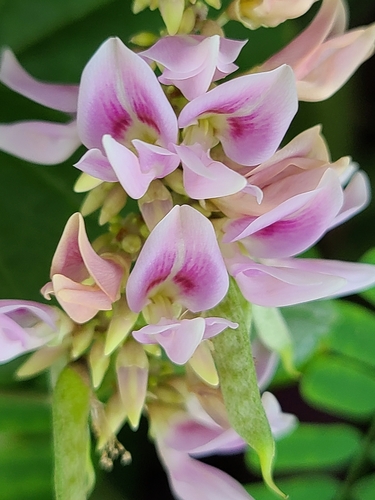
Lathyrus magellanicus
Lam.
Cape Horn pea

(c) Nicolás Villaseca Merino, some rights reserved (CC BY-SA), uploaded by Nicolás Villaseca Merino

(c) Nicolás Villaseca Merino, some rights reserved (CC BY-SA)
What to Eat
Edible parts: Seeds
The seeds are eaten cooked and have been used as an emergency food.
Known Hazards
Where to Find It
It can grow in tropical places. It grows in coastal sands and open grassland. In the tropics it can grow to 2,400 m above sea level. It grows in Subantarctic forests of Araucaria araucana in Argentina. In Argentina it grows below 500 m above sea level. It can tolerate frost.
Andes, Argentina*, Bolivia, Brazil, Chile, Colombia, Ecuador, Peru, South America*, Uruguay,
How to Identify
A herb. It is a climbing plant with stems produced each year from a rootstock. It lasts for a few years. It grows 30-60 cm tall. The stems scramble over the ground and can climb with tendrils. The leaves are 25-85 mm long by 8-25 mm wide. The flowers are blue to purple. The seeds are 3-4 mm across.
How to Grow
Plants can be grown from seeds. It is probably best to pre-soak them.
Propagation: Pre-soak the seed for 24 hours in warm water and then sow in containers in light shade. When they are large enough to handle, prick the seedlings out into individual pots and plant them out when 10cm or more tall. If you have sufficient seed, then it can also be sown in situ.
Names & Synonyms
Lord Anson's pea, Alvergilla, Arvejilla
References (11)
- Encycl. 2:708. 1788
- Fern, K., 2012, Tropical Species Database http://theferns.info/tropical/
- Hedrick, U.P., 1919, (Ed.), Sturtevant's edible plants of the world. p 372
- Kermath, B. M., et al, 2014, Food Plants in the Americas: A survey of the domesticated, cultivated and wild plants used for Human food in North, Central and South America and the Caribbean. On line draft. p 472
- Kew Plants of the World Online
- Ladio, A. H. & Lozada, M., 2000, Edible Plant Use in a Mapuche Community of North-western Patagonia, Human Ecology. Vol. 28, No. 1. pp. 53-71
- Ladio, A. H., 2001, The Maintenance of Wild Edible Plant Gatherings in a Mapuche Community of Patagonia. Economic Botany, Vol. 55, No. 2, pp. 243-254
- Leon-Lobos, P., et al, 2022, Patterns of Traditional and Modern Uses of Wild Edible Native Plants of Chile: Challenges and Future Perspectives. Plants (Basel) v 11 (6) Table S1
- Molares, S. & Ladio, A., 2012, The Usefulness of Edible and Medicinal Fabaceae in Argentine and Chilean Patagonia: Environmental Availability and Other Sources of Supply. Evidence-Based Complementary and Alternative Medicine. Volume 2012, Article ID 901918, 12 pages, Hindawi Publishing Corporation.
- Rapoport, E. H. & Ladio, A. H., 1999, Plantas comestibles. Bosque Volume 20 No. 2. ISSN 0314-8799
- www.hidawi.com/journals/ecam/2012/901918/tab1/