Ononis arvensis
Linn.
Rest-harrow

(c) Vadim Prokhorov, some rights reserved (CC BY-NC), uploaded by Vadim Prokhorov

(c) Sergey Mayorov, some rights reserved (CC BY-NC), uploaded by Sergey Mayorov
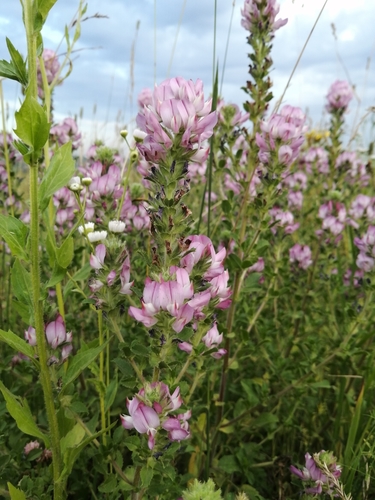
(c) Alexandra Soldatova, some rights reserved (CC BY-NC), uploaded by Alexandra Soldatova
What to Eat
Edible parts: Shoots
The shoots are pickled, used as a sauce, and eaten fresh in salads.
Where to Find It
It is a temperate plant. It grows in moist sandy soils.
Afghanistan, Asia, Central Asia, China, Europe, India, Iran, Lithuania, Middle East, Pakistan, Russia, Tajikistan, Tibet, Turkey, Türkiye,
How to Identify
A shrub. The stem is erect. The leaves have 3 leaflets. The leaflets are 1-2.5 cm long by 5-15 mm wide. They are broadly oval. The flowers are in a group at the ends of branches. The flowers are in pairs at each node. They are pink. The fruit is a pod 6-9 mm long. It has 1-3 seeds.
Wikipedia
Source ↗Ononis arvensis, the field restharrow, is a widespread species of flowering plant in the family Fabaceae, native to Eurasia from central Europe through to western Siberia and the western Himalayas. It is a perennial hemicryptophyte usually 50–100 cm (20–39 in) tall, typically found in meadows, but also in old fields and dry grasslands. It is closely related to Ononis spinosa and Ononis repens, being treated (together with O. repens) by some authors as a subspecies of O. spinosa. It shares pink flower colour with these two; from O. spinosa it differs in having its flowers in pairs at each node rather than singly, and (like O. repens) in lacking stiff spines; the wing petal size is small as in O. spinosa, rather than equalling the keel petal as in O. repens. It has a more easterly distribution than either O. spinosa or O. repens, not being found west of southern Scandinavia and Germany, and extending further into central Asia.
Notes
There are about 80 Ononis species.
Names & Synonyms
References (4)
- Facciola, S., 1998, Cornucopia 2: a Source Book of Edible Plants. Kampong Publications, p 109
- Flora of Pakistan. www.eFloras.org
- Hedrick, U.P., 1919, (Ed.), Sturtevant's edible plants of the world. p 449
- Syst. nat. ed. 10, 2:1159. 1759




