Rhazya stricta
Decne.
Harmal
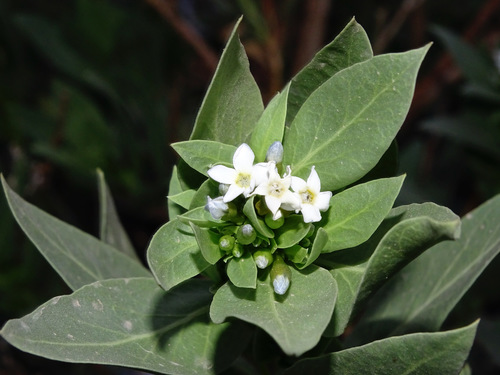
(c) Miguel A. Casado, some rights reserved (CC BY-NC), uploaded by Miguel A. Casado
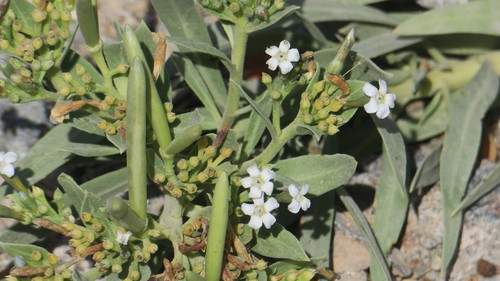
(c) Altaf Habib, some rights reserved (CC BY-NC), uploaded by Altaf Habib

(c) Jacky Judas, some rights reserved (CC BY), uploaded by Jacky Judas
What to Eat
Edible parts: Leaves - drink, Seeds - oil, Medicine
The bitter leaves are used to make a cooling drink.
Where to Find It
It is a Mediterranean climate plant. It grows in arid regions and the desert. It has some salt tolerance.
Asia, Middle East, Pakistan, Saudi Arabia, United Arab Emirates, UAE,
How to Identify
A shrubby plant. It grows 70 cm tall. It has a woody base and branches spread upwards. The leaves are 3-10 cm long by 1-2 cm wide. The flowers are in dense groups at the ends of branches. The fruit follicles are in pairs and slender and 3-6 cm long. They have many seeds with short wings.
Medicinal Uses
The leaves are used medicinally, and the seeds are processed for oil with medicinal applications.
Wikipedia
Source ↗Rhazya stricta (Persian: اشورک Eshvarak) is a native poisonous plant in Southern Iran, Afghanistan, Pakistan, India, Iraq, Oman, Yemen, and Saudi Arabia. The plant is an evergreen dwarf shrub of the family Apocynaceae.
Other Information
They are sold in markets.
Notes
It is used as medicine.
References (2)
- Ann. Sci. Nat. Bot. ser. 2, 4:80. 1835
- Hedrick, U.P., 1919, (Ed.), Sturtevant's edible plants of the world. p 556


