Inga alba
(Sw.) Willd.
White inga
(c) Julien Piolain, some rights reserved (CC BY-NC)
(c) Julien Piolain, some rights reserved (CC BY-NC)
(c) Julien Piolain, some rights reserved (CC BY-NC)
What to Eat
Edible parts: Fruit, Aril
The thin flesh and pulp surrounding the seeds are eaten fresh, and the fruit is sold in local markets. The pulp is slightly bitter.
Where to Find It
A tropical plant. It grows in rainforest and savanna forest.
Amazon, Bolivia, Brazil, Central America, Colombia, Costa Rica, Ecuador, French Guiana, Guianas, Guyana, Mexico, Nicaragua, North America, Panama, Peru, South America, Suriname, Venezuela,
How to Identify
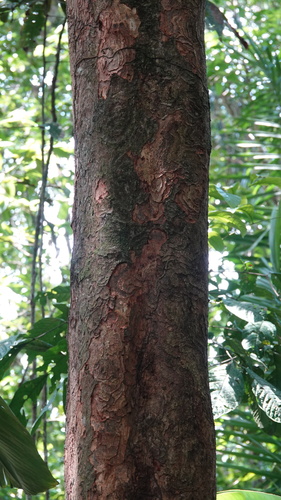
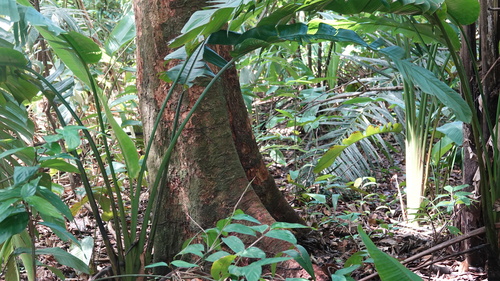
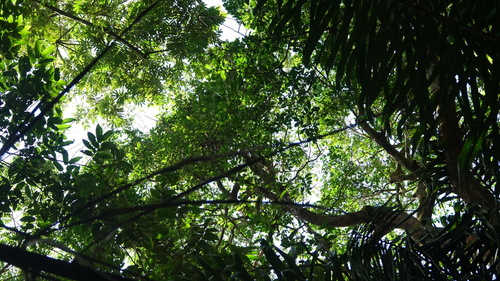
A tree. It grows 35 m tall. It has straight buttresses. The bark is light red to brown. It has an irregular pattern from fallen pieces of bark. The twigs are angular. They are softly hairy when young. The leaves are compound. There are 3 stalks of leaflets and the leaflets are papery. The flowers are in spikes in the axils of leaves. They are brown and hairy. The spikes are in clusters. The flowers are white. The fruit is a pod 15 cm long by 1.7 cm wide and 0.8 cm thick. There are some veins across it. The pods are constricted between the seeds. There are about 10 seeds. The pulp of the pod is sweet and tasty.
How to Grow
Plants grow easily from seeds. Seeds germinate in 1-2 weeks given moisture and shade.
Medicinal Uses
The thin flesh around the seeds is used traditionally.
Other Uses
The heartwood is a pale reddish-brown to reddish-white, occasionally streaked with darker colours; it is not demarcated from the whitish sapwood. The texture is coarse; the grain straight to interlocked, sometimes wavy; growth rings are generally rather distinct; lustrous; and there is no distinctive taste or odour once seasoned. The wood is moderately heavy, moderately hard, strong, not very durable. It seasons fairly quickly, with only a slight rish of checking and distortion; once dry it is moderately stable to stable in service. It is easy to work with ordinary tools; finishes to a smooth surface though there is a tendency to woolliness; nailing and screwing are good; gluing is correct. The timber has been recommended for utility plywood, flooring, sheathing, general construction, carpentry, interior woodwork, furniture, boxes and crates, and light cabinet making.
Wikipedia
Source ↗Inga alba is a species of tree from the family Fabaceae, native to Central and South America. The common name in English is white inga.
Other Information
It is sold in local markets. The fruit pulp is thin and slightly bitter.
Notes
Also as Mimosaceae.
Names & Synonyms
Aboonkini, Aganahuan, Anganawe, Apokonion, Apurukuni, Burzquillo, Doho arau, Ebenbawe, Guamito, Guamo, Guavo, Kuariyek, Kurang, Kwari, Kwariye, Lebioueko, Lebi-weko, Maborokoni, Manniballi, Maparokon, Montanero, Moximahi, Prokoni, Shimbillo, Whitey, Xixi rupe-'y, Yokar, Yoko pene
References (16)
- Etkin, N. L. (Ed.), 1994, Eating on the Wild Side, Univ. of Arizona. p 138
- Grandtner, M. M. & Chevrette, J., 2013, Dictionary of Trees, Volume 2: South America: Nomenclature, Taxonomy and Ecology. Academic Press p 318
- ILDIS Legumes of the World http:www;ildis.org/Legume/Web
- Kew Plants of the World Online
- Lopez-Diago, D. & Garcia, N., 2021, Wild edible fruits of Colombia. Biota ColomBiana 22 (2) p 37
- Maas, P.J. M., Non-Timber Forest Products of the North-West District of Guyana Part 2. The 85 most important NTFP species. p 110
- Martin, F. W., et al, 1987, Perennial Edible Fruits of the Tropics. USDA Handbook 642 p 98
- Paz, F. S., et al, 2021, Edible Fruit Plant Species in the Amazon Forest Rely Mostly on Bees and Beetles as Pollinators. Journal of Economic Entomology, XX(XX), 2021, 1–13
- Philips, O., 1992, The potential for harvesting fruits in tropical rainforests: new data from Amazonian Peru. Biodiversity and Conservation 2, 18-38
- Polak, A. M., 1992, Major Timber Trees of Guyana. A Field Guide. Tropenbos Series 2. Wageningen. p 107
- Roa, J. A. G. & Boada, D. S. G., 2018, Fundación para el Fortalecimiento de la Fruticultura y Plantas Alimenticias no Convencionales en Colombia.
- Sp. pl. 4(2):1013. 1806
- Torre, de la, L., et al, 2008, Enciclopedia de las Plantas Útiles del Ecuador. Herbario QCA. Pontificia Universidad Católica del Ecuador. p 342
- van Roosmalen, M.G.M., 1985, Fruits of the Guianan Flora. Utrecht Univ. & Wageningen Univ. p 232
- Vasquez, R. and Gentry, A. H., 1989, Use and Misuse of Forest-harvested Fruits in the Iquitos Area. Conservation Biology 3(4): 350f
- www.proyanomami.org




