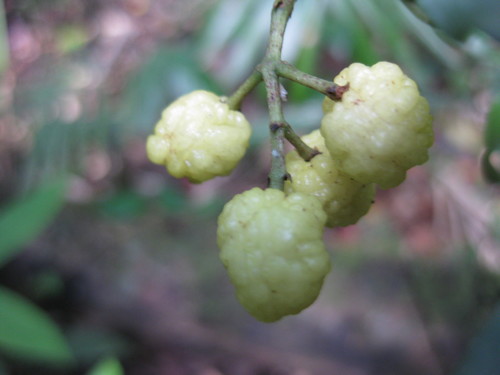
Zanthoxylum fagara
(L.) Sarg.
Lime prickly ash

(c) Jane Weeden, some rights reserved (CC BY)

(c) Jane Weeden, some rights reserved (CC BY)

(c) Jane Weeden, some rights reserved (CC BY)
What to Eat
Edible parts: Bark - spice, Leaves - spice
The powdered bark and leaves have been used as a spice, with an odor similar to that of limes.
Where to Find It
It is a tropical plant. It grows in moist soils near the sea coast. It grows up to 150 m altitude in the SE region of USA. In Argentina it grows from sea level to 1,000 m above sea level.
Argentina, Bahamas, Bolivia, Brazil, Cuba, Dominican Republic, Guiana, Haiti, Jamaica, Lesser Antilles, Mexico, North America, Paraguay, South America, Uruguay, USA, Venezuela, West Indies,
How to Identify
An evergreen shrub or small tree. The crown is round and spreading. The trunk is often leaning. The gland dots on the leaves, flowers and fruit have an aroma. It grows 7.6 m high. The trunk is 20 cm wide. The leaves are compound. They are 7.5-10 cm long. There are 5-13 leaflets along the stalk. These are 1-2.5 cm long. They have wavy teeth beyond the middle. They narrow to the base. The leaves are thick and leathery. They are shiny green above and paler underneath. The flowers are 3 mm wide. The flowers are in small clusters 12 mm wide. The petals are yellow-green. The fruit are 5 mm long and pod like. They are brown and warty. They are in clusters along the twigs.
How to Grow
A plant of the subtropics and tropics, where it can be found from near sea level to over 2,000 metres. Grows best in a sunny position. Tolerates seasonal inundation of the soil. Plants have a moderate rate of growth. The whole plant has a disagreeable odour. A dioecious species, both male and female forms need to be grown if seed is required.
Propagation: Seed - best sown as soon as it is ripe in a sunny position in a nursery seedbed. A low germination rate can usually be expected, with the seed sprouting within 40 - 60 days.
Medicinal Uses
The bark, leaves and roots have medicinal properties.
Other Uses
The wood is almost white, pale yellow, or light brown. It is odourless and tasteless; straight or roey-grained; medium-textured; fairly light in weight, but firm and rather tough for its weight; very durable. It saws slightly woolly; is easy to work; capable of taking a smooth, lustrous polish; and holds its place well when finished. It is used in general construction, for stays, poles, stakes, cart bodies, lathe work and cabinet making in general.
Wikipedia
Source ↗Zanthoxylum fagara or wild lime, is a species of flowering plant that—despite its name—is not part of the genus Citrus with real limes and other fruit, but is a close cousin in the larger citrus family, Rutaceae. It is more closely related to Sichuan pepper. It is native to southern Florida and Texas in the United States, and to Mexico, Central America, the Caribbean, and South America as far south as Paraguay. Common names include: lime prickly-ash, wild lime, colima, uña de gato, and corriosa.
Names & Synonyms
Colima
References (3)
- Little, E.L., 1980, National Audubon Society Field Guide to North American Trees. Alfred A. Knopf. p 538
- Piedra-Malagón, E. M., et al, 2022, Edible native plants of the Gulf of Mexico Province. Biodiversity Data Journal 10: e80565 p 29
- Plants of Haiti Smithsonian Institute http://botany.si.edu/antilles/West Indies