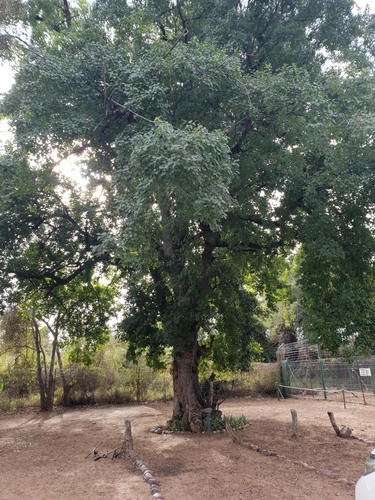
Condalia hookeri
M.C. Johnst.
Bluewood, Capul negro, Brasil
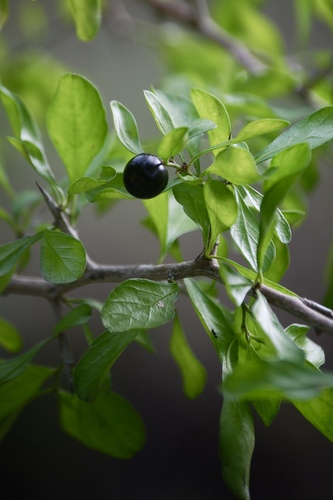
(c) Ron Chang (curated by Cat Chang), some rights reserved (CC BY-NC), uploaded by Ron Chang (curated by Cat Chang)
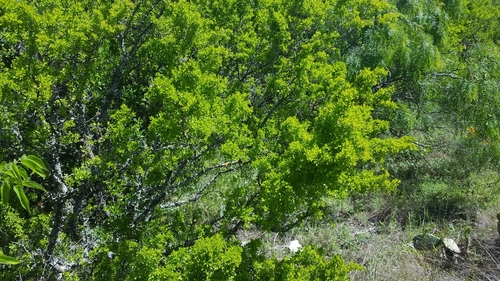
(c) Andrew Eberly, some rights reserved (CC BY-NC)

no rights reserved, uploaded by 葉子
What to Eat
Edible parts: Fruit
The fruits are sweet, fleshy, and pleasant when ripe and can be eaten fresh or cooked. The thin flesh surrounds a hard stone containing the seed. Cooking softens the flesh and makes separating it from the pits easier. The fruit is mainly used for making jellies; it has also been boiled, strained, and the juice boiled again to make a syrup. Among Condalia species, this one stands out as a high-value fruit, in contrast to the bitter-fruited relatives. Within its limited geographic range it offers a meaningful wild fruit resource for foragers. Fruiting is seasonal and climate-dependent, with best production in favourable rainfall years. For harvesting, placing tarps beneath the tree and dislodging ripe fruits with sticks avoids injury from the spines; fully ripe fruits detach most easily.
Known Hazards
Where to Find It
It is a temperate plant. It grows in dry soils of plains in Southern USA up to 600 m altitude.
Mexico, North America, USA,
How to Identify
A spiny shrub. It has many branches and forms thickets. The crown is thin and widely spreading. The branches are stiff. It grows 6 m high. The trunk is 15 cm across. The leaves are alternate and 1.5-2.5 cm long by 10-12 mm wide. They are spoon shaped and do not have teeth. The tips are rounded and have a small point. They are hairy when young. They are shiny yellow-green above and paler underneath. The flowers are 3 mm wide. They are cup-shaped. There are 5 pointed green sepals. There are 1-3 flowers at the base of the leaves. The fruit are 5 mm across. They are shiny black. The pulp is purple. They are sweet and edible. They contain one seed.
How to Grow
Brazilian bluewood is one of the few genuinely valuable fruit-producing species within the Condalia genus. Where it occurs, it offers a sweet, edible desert fruit with real foraging potential. Its limited range and spiny structure reduce accessibility, but fruit quality makes it a meaningful resource in its native region. Growing Conditions: Brazilian bluewood grows in arid and semi-arid environments, primarily along washes and desert drainage systems. It thrives in sandy, rocky soils with low fertility and minimal water availability, relying on deep root systems and drought tolerance. Habitat & Range: This species is found primarily in southern Texas and southward into northeastern Mexico, especially in the state of Tamaulipas. It is associated with the Chihuahuan Desert region and desert wash habitats. Size & Landscape Performance: Plants typically reach 3–9 meters in height, forming small desert trees or large shrubs. Dense spines and woody growth make the species structurally dominant but difficult to access. Cultivation (Horticulture): Brazilian bluewood is not cultivated for food and remains a wild desert species. It has potential value for native edible landscaping in arid environments but is limited by its spiny form and harvesting difficulty. Pests & Problems: Fruits may be damaged by insects, and dense spines complicate harvesting. Fruit production is not consistent year to year. Pollination: Likely insect-pollinated, though flowers are small and inconspicuous. Identification & Habit: Brazilian bluewood grows as a spiny shrub or small tree with a rigid, woody structure and dense branching. The plant forms thorny frameworks that deter herbivores and make physical access difficult. Leaves are simple, egg-shaped to broadly obovate, and occur alternately or in clusters along short branches. The plant presents a more tree-like form than many desert shrubs, often developing a single main trunk with multiple spiny lateral branches. Its overall architecture is upright, woody, and defensive. FAMILY: Buckthorn family (Rhamnaceae) – Condalia genus. COMMON NAMES: Brazilian bluewood. HARDINESS / RANGE: Southern Texas and northeastern Mexico (Chihuahuan Desert region). GROWTH FORM: Spiny shrub or tree, 3–9 m tall.
Propagation: Propagated from seed. Natural regeneration is slow and dependent on favourable rainfall patterns.
Medicinal Uses
None known
Other Uses
A blue dye is obtained from the wood. The wood itself is very heavy, hard, dense, and close-grained, with a brilliant red-coloured dense heartwood used to make ornamental objects. It burns with intense heat and is valued as fuel. The dense, thorny structure provides nesting and shelter for birds and small mammals, and the fruits likely serve as wildlife food in productive years.
Wikipedia
Source ↗Condalia hookeri, called the Brazilian bluewood, is a widespread species of flowering plant in the family Rhamnaceae, native to Texas and eastern Mexico. It is a thorny shrub or small tree reaching 6 m (20 ft) but usually much shorter. Typically it is found growing in marginal habitats such as limestone slopes, sandstone bluffs, lunettes, shell ridges, juniper-dominated woodlands, or along watercourses, often in clayey or sandy soils, at elevations from 10 to 400 m (30 to 1,300 ft). It may come to dominate an area as a thorny scrubland.
Names & Synonyms
Edwards' b.luewood. Brazilian bluewood
References (5)
- Little, E.L., 1980, National Audubon Society Field Guide to North American Trees. Alfred A. Knopf. p 592
- Piedra-Malagón, E. M., et al, 2022, Edible native plants of the Gulf of Mexico Province. Biodiversity Data Journal 10: e80565 p 28
- Reis, S. V. and Lipp, F. L., 1982, New Plant Sources for Drugs and Foods from the New York Botanical Garden herbarium. Harvard. p 172
- Tull, D., Edible and Useful Plants of the Southwest: Texas, New Mexico and Arizona p 197
- World Checklist of Useful Plant Species 2020. Royal Botanic Gardens, Kew