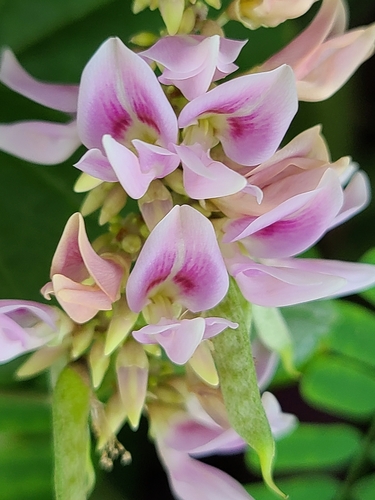
Saraca asoca
(Roxb.) de Wilde
Sorrow-less tree
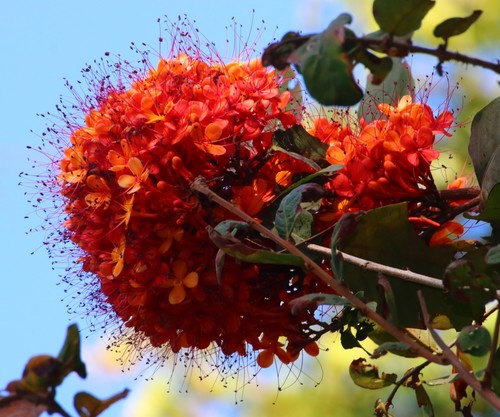
(c) Shiwalee Samant, some rights reserved (CC BY-NC), uploaded by Shiwalee Samant
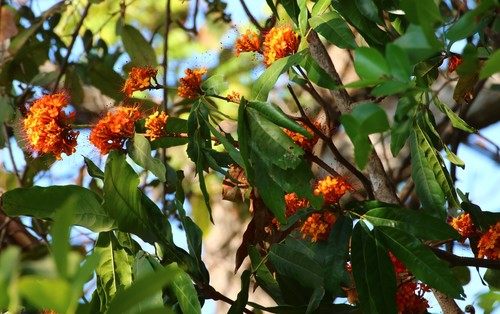
(c) Shiwalee Samant, some rights reserved (CC BY-NC), uploaded by Shiwalee Samant

(c) jayakumar, some rights reserved (CC BY-NC)
What to Eat
Edible parts: Seeds - masticatory, Leaves
None known
Where to Find It
A tropical plant. In the eastern Himalayas it grows up to 750 m altitude. It needs to be sheltered from hot winds. It is best in a lightly shady place.
Andamans, Asia, Bangladesh, Fiji, Himalayas, India, Myanmar, Nepal, Northeastern India, Pacific, Pakistan, SE Asia, Sri Lanka,
How to Identify
A small evergreen tree. It grows 6-9 m high. The bark is dark brown. The leaves are compound and 30 cm long. There are 4 pairs of leaflets. These are oval and pointed. They can be 25 cm long by 6 cm wide. New leaves are pink. The flowers have a scent. The flowers are orange-yellow. They are in flat topped arrangement 7.5-10 cm across. The individual flowers are 2.5 cm long. The fruit are leathery pods. These are red but turn grey at maturity. They are 5-15 cm long by 2.5 cm wide. They are pointed at the tip. There are 4-8 grey seeds. The pods split into 2 halves and curl up on ripening.
How to Grow
It is easily grown from seed. It can also be grown from stem cuttings.
Propagation: Seed
Medicinal Uses
The bark is a prominent herb in Ayurveda, regarded as particularly useful for treating the female reproductive system. It is strongly astringent and acts as a uterine sedative, and is said to have a stimulating effect on uterine and ovarian tissue. It is used in the treatment of menstrual cramps, certain cases of uterine bleeding, uterine fibroids, haemorrhoids, and internal bleeding. The bark contains tannins and catechol.
Other Uses
The ashoka tree is prized for its beautiful foliage and fragrant flowers. It is considered sacred throughout the Indian subcontinent, especially in India, Nepal, and Sri Lanka, and has many folkloric, religious, and literary associations in the region. The pods are used as fodder. The tree is a nitrogen fixer.
Wikipedia
Source ↗Saraca asoca, commonly known as the ashoka tree (lit. "sorrow-less"), is a plant belonging to the Detarioideae subfamily of the Fabaceae family of plants (also referred to as the legume, pea, or bean family). The tree is native to the Indian subcontinent, with its native range extending from Pakistan to the west, through India and Bangladesh to Myanmar in the east, and from Bhutan and Nepal in the north to Sri Lanka in the south. Within its native range, it is primarily growing in seasonally dry tropical forests. It is an important tree to multiple cultural traditions across the Indian subcontinent and beyond. The flower of ashoka tree is the state flower of Indian state of Odisha.
Production
The tree comes into flowering when 4-6 years old. Fruit take 6 months to ripen.
Notes
There are about 25 Saraca species. Also as Caesalpinaceae.
Names & Synonyms
Ashok, Ashoka, Asogam, Asokam, Bai-kang, Mir krem, Thawka
References (8)
- Blumea 15:393. 1968
- Flora of Pakistan. www.eFlora.org
- Kar, A., et al, 2013, Wild Edible Plant Resources used by the Mizos of Mizoram, India. Kathmandu University Journal of Science, Engineering and Technology. Vol. 9, No. 1, July, 2013, 106-126
- Patiri, B. & Borah, A., 2007, Wild Edible Plants of Assam. Geethaki Publishers. p 45 (As Saraca ashoca)
- Sahni, K.C., 2000, The Book of Indian Trees. Bombay Natural History Society. Oxford. p 80
- Sarma, H., et al, 2010, Updated Estimates of Wild Edible and Threatened Plants of Assam: A Meta-analysis. International Journal of Botany 6(4): 414-423
- Smith, A.C., 1985, Flora Vitiensis Nova, Lawaii, Kuai, Hawaii, Volume 3 p 133
- Swaminathan, M.S., and Kochnar, S.L., 2007, An Atlas of Major Flowering Trees in India. Macmillan. p 126