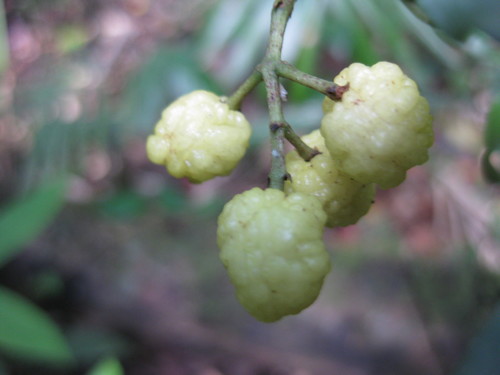
Citrus junos
Siebold ex Tanaka
Yuzu, Juzu
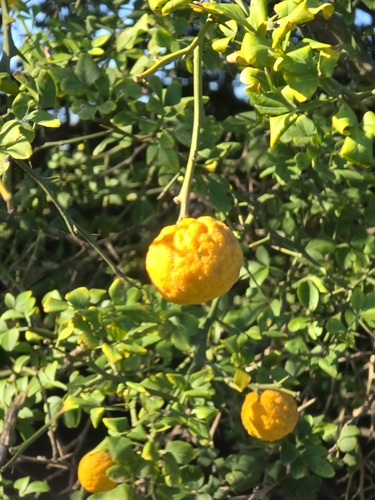
(c) juan “juancho” lopez, some rights reserved (CC BY-NC)
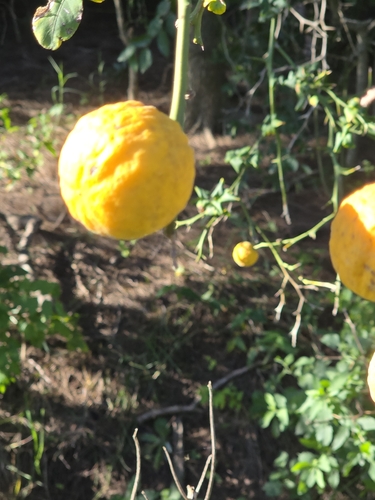
(c) juan “juancho” lopez, some rights reserved (CC BY-NC)
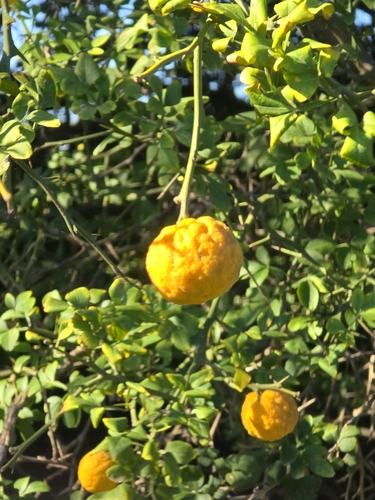
(c) juan “juancho” lopez, some rights reserved (CC BY-NC)
What to Eat
Edible parts: Fruit, Leaves - drink
The grated skin and juice are used as flavoring in soy sauces, miso toppings, and soups. The fruit juice is used for vinegar, and the fruit is eaten raw, used for drinks, and fermented. The leaves can be used for drinks.
Where to Find It
It grows in subtropical places. It can grow in Mediterranean climates. In Sichuan and Yunnan.
Asia, China, Ecuador, Indonesia, Japan, Korea, Nepal, Pacific, Philippines, SE Asia,
How to Identify
An evergreen shrub or small tree. It grows 2-7 m tall. The branches have long stout spines. The leaves are 3-8 cm long by 1-4 cm wide. There are fine teeth along the edge. The flowers occur singly and are white. The fruit are green when young and turn yellow when ripe. They are pear shaped and 4-8 cm across.
Nutrition Score: 36/100
| Part | Moisture | kJ | kcal | Protein | Vit A | Vit C | Iron | Zinc |
|---|---|---|---|---|---|---|---|---|
| Peel | 83.7 | 247 | 59 | 1.2 | — | 150 | 0.3 | 0.1 |
How to Grow
It can be grown by seeds, cuttings or layering.
Medicinal Uses
No medicinal uses documented in provided data.
Other Information
It is a fairly expensive citrus in Japan. It is a cultivated food plant.
Notes
It is possibly a hybrid between Citrus ichangensis x Citrus reticulata.
Names & Synonyms
Kali jyamir, Pohon jeruk cina, Pohon jeruk yuzu, Xiang cheng, Yujanamu
References (14)
- Arora, R. K., 2014, Diversity in Underutilized Plant Species - An Asia-Pacific Perspective. Bioversity International. p 63
- Coronel, R.E., 1982, Fruit Collections in the Philippines. IBPGR Newsletter p 9
- Facciola, S., 1998, Cornucopia 2: a Source Book of Edible Plants. Kampong Publications, p 215
- INFOODS:FAO/INFOODS Databases
- Khanal, R., et al, 2014, Documenting abundance and use of underutilized plant species in the mid hill region of Nepal. ECOPRINT 21: 63-71, 2014
- Lan-Phi, N. T., et al, 2009, Chemical and aroma profiles of yuzu (Citrus junos) peel oils of different cultivars. Food Chemistry 115: 1042-1047
- Seidemann J., 2005, World Spice Plants. Economic Usage, Botany, Taxonomy. Springer. p 107
- Siebold Centen. Celebr. Festschr. 65; Bull. Sci. Fak. Terk.Kjusu Imp. Univ. 1(1):30. 1924
- Song, M., et al, 2013, Traditional knowledge of wild edible plants in Jeju Island, Korea. Indian Journal of Traditional Knowledge. 12(2) pp 177-194
- Sukarya, D. G., (Ed.) 2013, 3,500 Plant Species of the Botanic Gardens of Indonesia. LIPI p 200
- Tanaka,
- Torre, de la, L., et al, 2008, Enciclopedia de las Plantas Útiles del Ecuador. Herbario QCA. Pontificia Universidad Católica del Ecuador. p 558
- Wiersema, J. H. & Leon, B., 2013, World Economic Plants. A Standard Reference CRC Press. 2nd Ed. p 180
- Zeven, A. C. & de West, J. M. J., 1982, Dictionary of cultivated plants and their regions of diversity. Wageningen. p 41