Agave bovicornuta
Gentry
Cow horn agave

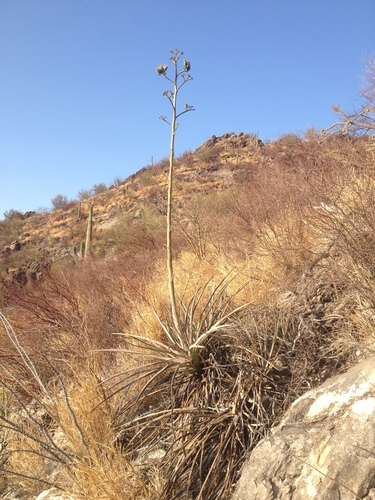
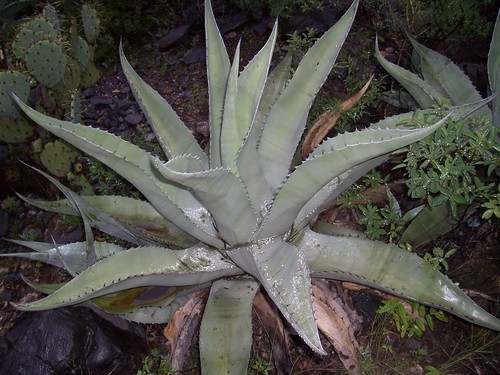
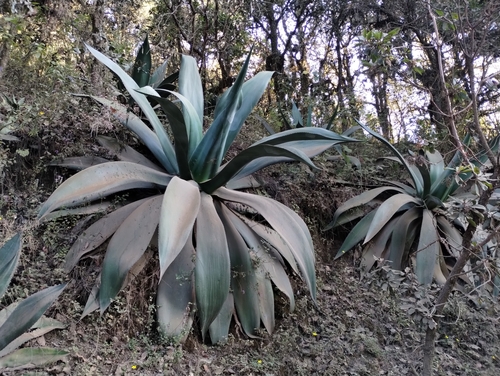
(c) Marcos Torrez Valverde, some rights reserved (CC BY-NC), uploaded by Marcos Torrez Valverde

(c) Eric Hough, some rights reserved (CC BY-NC)
What to Eat
Edible parts: Flowers
The flowers are washed to remove the bitterness and are eaten cooked. They are also used to make tortillas - this species being preferred over others to make this food. The heart of the rosette, after the leaves have been removed, is baked and used to prepare strong 'suguí' a fermented alcoholic beverage. The heart is occasionally used to make the distilled liquor mezcal, though it is considered to be inferior to many other species. This species is not generally used to produce mescal because it has a caustic juice and a bitter taste.
Known Hazards
Where to Find It
It is a temperate plant.
Australia, Mexico, North America,
How to Identify
A large herb in the agave family with edible flowers, native to temperate regions. Agave bovicornuta is one of about 250 agave species, though most members of the family occur in tropical and subtropical climates.
How to Grow
Agave bovicornuta is found in semi-arid regions in the warm temperate zone, extending south in Mexico into the tropical dry forests Agave species generally require a sunny position, succeeding in most soils of medium-fertility so long as they are very well-drained. Most species are undemanding as to the soil pH, though those found in the wild on limestone soils will grow better in neutral to alkaline conditions. Plants are generally very tolerant of dry conditions and of extended periods of drought. Most Agave species are monocarpic, individual rosettes living for a number of years without flowering before sending up an often very large flowering stem and then dying after flowering and setting seed. This species does not produce shoots or bulbils and apparently it also requires cross pollination, thus when cultivated in gardens the plant dies in one generation when it reaches between 12 - 18 years old and flowers. Some plants in gardens have been observed to live up to 30 years. Individual plants take about 7 - 15 years in their native habitat, considerably longer in colder climates, before flowering. Members of this genus are rarely if ever troubled by browsing deer.
Propagation: Seed - surface sow in a container in a light position. The fertile black seeds germinate readily and can easily be cultured in flats or pots during early stages. The seed usually germinates in 1 - 3 months at 15 - 20°c. Prick out the seedlings into individual pots of well-drained soil when they are large enough to handle and grow them on in a sunny position until they are at least 10cm tall before planting out. Offsets and suckers can be potted up at any time they are available. Bulbils, where produced, are an easy method of propagation. Simply pot them up and plant out at the beginning of a growing season when they are 10cm or more tall.
Wikipedia
Source ↗Agave bovicornuta Gentry, is a plant in the genus Agave, native to mountainous regions in the Mexican states of Chihuahua, Sonora and Sinaloa. The common name Cowhorn Agave and the specific epithet refer to the prominent red spines along the edges of the leaves. Other common names include "lechguilla verde" The plant forms a solitary rosette with no suckers. Yellowish-green flowers are borne on a stalk up to 150 cm tall. The Tarahumara peoples who live in the region where the plant is found sometimes eat the leaves although they consider it inferior to other species. It is listed as Vulnerable by the IUCN. Although it encompasses a wide range, its populations are small and isolated, and vulnerable to overcollection and consumption as food.
Notes
There are about 250 Agave species. The Agavaceae are mostly in the tropics and subtropics.
Names & Synonyms
Ime
References (4)
- Camou-Guerrero, A., et al, 2008, Knowledge and use Value of Plant Species in a Raramuri Community: A Gender Perspective for Conservation. Human Ecology, 36:259-272
- Facciola, S., 1998, Cornucopia 2: a Source Book of Edible Plants. Kampong Publications. p 3
- Publ. Carnegie Inst. Wash. 527:92. 1942
- World Checklist of Useful Plant Species 2020. Royal Botanic Gardens, Kew