Agave stricta
Salm-Dyck
Hedgehog agave
(c) Luis Alberto, some rights reserved (CC BY-NC)
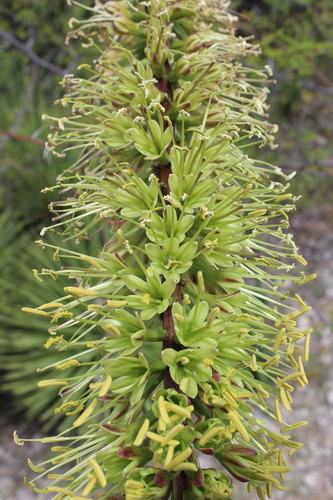
(c) Luis Alberto, some rights reserved (CC BY-NC)

(c) zahir santillan, some rights reserved (CC BY-NC)
What to Eat
Edible parts: Flowers
Young flowers are lightly cooked, dipped in egg batter, and fried.
Known Hazards
Where to Find It
It is a temperate plant.
Australia, Mexico, North America,
How to Identify
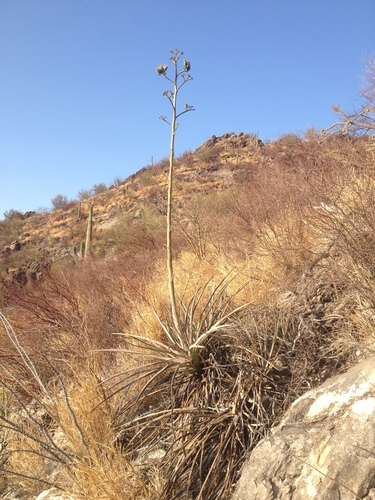
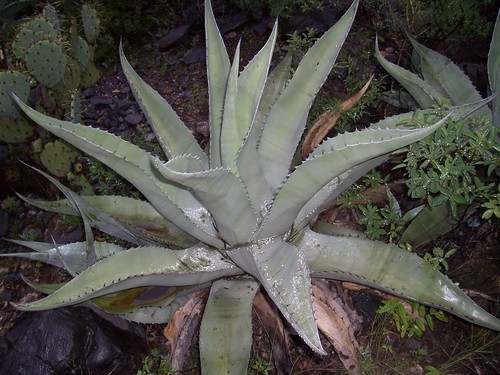
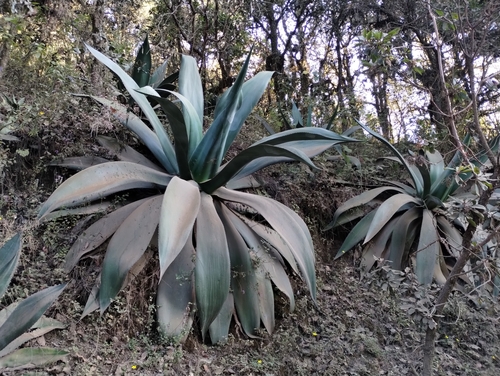
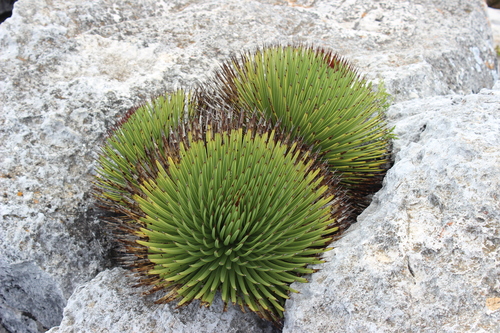
A large succulent agave with leaves arranged in a ring, found in temperate regions. One of approximately 250 Agave species.
How to Grow
Agave species are found mainly in the arid and semi-arid regions of southwestern N. America, especially in Mexico, extending from the warm temperate zone to the tropics often at moderate elevations. Many species can withstand at least a few degrees of frost, but only in drier regions and where soils are very well-drained. Agave species generally require a sunny position, succeeding in most soils of medium-fertility so long as they are very well-drained. Most species are undemanding as to the soil pH, though those found in the wild on limestone soils will grow better in neutral to alkaline conditions. Plants are generally very tolerant of dry conditions and of extended periods of drought. Agave species are usually monocarpic, individual rosettes living for a number of years without flowering before sending up an often very large flowering stem and then dying after flowering and setting seed. However, unlike most Agave species, this species produces branches at the leaf axils and these develop into new rosettes. The plant can become a large dense cluster of rosettes up to 3 metres wide. Individual plants take about 7 - 15 years in their native habitat, considerably longer in colder climates, before flowering. Members of this genus are rarely if ever troubled by browsing deer.
Propagation: Seed - surface sow in a container in a light position. The seed usually germinates in 1 - 3 months at 15 - 20°c. Prick out the seedlings into individual pots of well-drained soil when they are large enough to handle and grow them on in a sunny position until they are at least 10cm tall before planting out. Offsets and suckers can be potted up at any time they are available. Bulbils, where produced, are an easy method of propagation. Simply pot them up and plant out at the beginning of a growing season when they are 10cm or more tall.
Other Uses
The dried plants are used for fuel.
Wikipedia
Source ↗Agave stricta, the hedgehog agave, is a species of flowering plant in the family Asparagaceae, native to Puebla and Oaxaca in Southern Mexico. Growing to 50 cm (20 in) tall, it is an evergreen succulent with rosettes of narrow spiny leaves producing erect racemes, 2 m (7 ft) long, of reddish purple flowers in summer. The foliage may develop a red tinge in the summer. The Latin specific epithet stricta means erect, or upright. As this plant is known to produce pincushion-like offsets, or "pups", as it grows—an unusually polycarpic trait among the Agaves (a highly monocarpic group of plants)—a team of Mexican biologists and botanists proposed the formation of a new genus, Echinoagave, in January 2024. This would lead to a new (or synonymous) genus and species name of Echinoagave stricta, in addition to the potential reclassifying of ten or eleven other species. Other species considered for placement into Echinoagave include Agave albopilosa and Agave striata. The name is derived from the Greek word for "spiny", echînos. Similarly to many succulents, A. stricta thrives on air flow, good lighting and well-drained, mostly inert substrates, and may develop root rot if overwatered. With a minimum preferred temperature of 10 °C (50 °F), this plant requires dry and well-lit conditions, ranging from room-temperature to warm, during winter in temperate regions; in appropriate climates, it may be grown outdoors in full- or part-sun year-round, or during the spring and summer months, provided that excessive precipitation does not flood its roots. It has gained the Royal Horticultural Society's Award of Garden Merit.
Notes
There are about 250 Agave species. The Agavaceae are mostly in the tropics and subtropics.
Names & Synonyms
References (2)
- Facciola, S., 1998, Cornucopia 2: a Source Book of Edible Plants. Kampong Publications. p 3
- Nugent, J., 1999, Agaves and cacti., Permaculture plants. Sustainable Agriculture Research Institute. PO Box 10, Nanup, WA, 6275