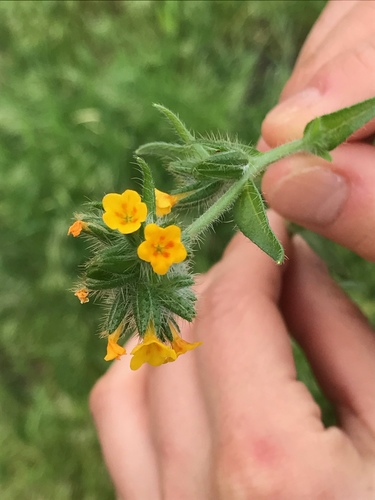
Anchusa capensis
Thunb.
Cape forget-me-not
(c) Tony Rebelo, some rights reserved (CC BY-SA), uploaded by Tony Rebelo
(c) Tony Rebelo, some rights reserved (CC BY-SA), uploaded by Tony Rebelo

(c) Nicola van Berkel, some rights reserved (CC BY-SA), uploaded by Nicola van Berkel
What to Eat
Edible parts: Flowers, Leaves
The vivid blue flowers are added to salads, drinks, and desserts. The leaves are eaten as a potherb.
Where to Find It
It is a subtropical plant. It is not common in Swaziland.
Africa, Asia, Botswana, Eswatini, India, Lesotho, Namibia, South Africa*, Southern Africa, Swaziland,
How to Identify
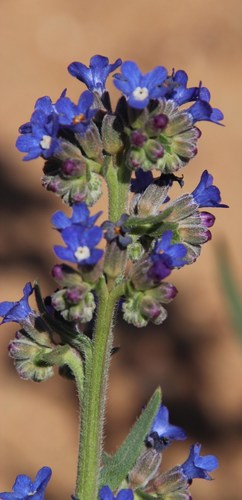
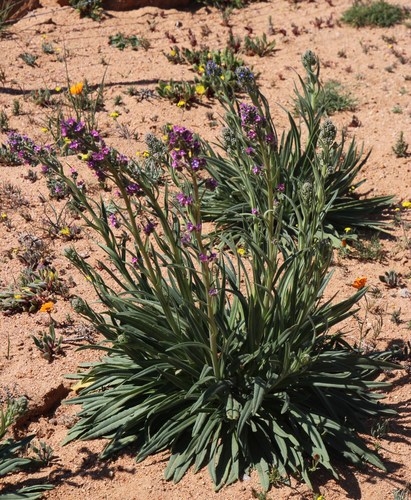
A herb. It has tall stems with grooves along them. It grows 60 cm tall. The leaves are bright green. They are narrow and long and rough and hairy to touch. The flowering stems are 1 m tall. The flowers are a vivid blue. They are on the top half of the stems. They have 5 bright blue petals. The seeds are inside small green cups.
How to Grow
A plant of drier areas, mainly in the subtropics but also moving into the tropics in Namibia and northern S. Africa. Grows best in a sunny position. Prefers a deep, fertile, well-drained but moisture-retentive soil.
Propagation: Seed - does not require pre-treatment, it usually germinates freely within a week or two.
Wikipedia
Source ↗Anchusa capensis, is a species of flowering plant in the family Boraginaceae, native to Namibia, South Africa and Lesotho. The genus Anchusa is from the Greek word anchousa, which makes reference to its use as a dye base for cosmetic paint obtained from the roots of another plant in the genus Anchusa tinctoria. The species capensis translates to ‘from the Cape’ referring to South Africa A. capensis typically reaches about 60 cm (24 in) tall, and grows best in full sun. In summer, red buds open to reveal small, bright cobalt blue flowers with five petals and five white scales protecting the stigma and anthers. In the US, it grows well in zones 8–11. Cultivars include 'Dawn', with white, pink, mauve and blue flowers, 'Blue Angel', with dark blue flowers, and 'Blue Bird', taller and with indigo blue flowers.
Other Information
It is a cultivated plant.
Names & Synonyms
Petlekheme
References (10)
- Facciola, S., 1998, Cornucopia 2: a Source Book of Edible Plants. Kampong Publications, p 51
- Fox, F. W. & Young, M. E. N., 1982, Food from the Veld. Delta Books. p 131
- Guillarmod, J., 1971,
- Kunkel,
- Long, C., 2005, Swaziland's Flora - siSwati names and Uses http://www.sntc.org.sz/flora/
- Peters, C. R., O'Brien, E. M., and Drummond, R.B., 1992, Edible Wild plants of Sub-saharan Africa. Kew. p 70
- Prodr. pl. cap. 34. 1794
- Ruiters-Welcome, A. K., 2019, Food plants of southern Africa. Ph.D. thesis. Univ. of Johannesburg p 38
- Swaziland's Flora Database http://www.sntc.org.sz/flora
- Welcome, A. K. & Van Wyk, B.-E., 2019, An inventory and analysis of the food plants of southern Africa. South African Journal of Botany 122 (2019) 136–179