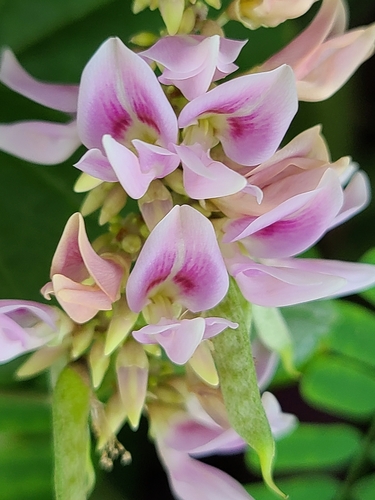
Amorpha fruticosa
L.
Indigo bush, False indigo, Itachi-hagi

(c) Peter May, some rights reserved (CC BY-NC), uploaded by Peter May
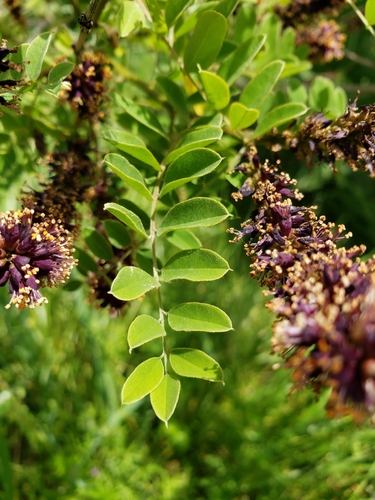
(c) Gavin Slater, some rights reserved (CC BY), uploaded by Gavin Slater

(c) Douglas Goldman, some rights reserved (CC BY-SA), uploaded by Douglas Goldman
What to Eat
Edible parts: Fruit - spice
The crushed fruit is used as a condiment. The plant also yields an oil.
Known Hazards
Where to Find It
It is a temperate plant. In Argentina it grows from sea level to 500 m above sea level. It suits hardiness zones 2-8. It grows in wet areas. In Sichuan.
Argentina, Asia, Canada, Central Asia, China, Japan, Korea, Myanmar, North America*, Pakistan, SE Asia, Slovenia, South America, Tajikistan, Uruguay, USA,
How to Identify
A shrub. It loses its leaves during the year. It can grow 2-6 m tall. The leaves are 15-30 cm long with 11-25 leaflets. These are 1-4 cm long and oval. The flowers are in a group at the end. These are 8-15 cm long. The fruit is 8-10 mm long.
How to Grow
Prefers a light well-drained sandy soil in sun or light shade. Plants are fairly wind-resistant. A very hardy plant, tolerating temperatures down to about -25c. A polymorphic species, there are many named forms. The flowers have a vanilla perfume. Plants resent root disturbance, they should be planted out into their final positions whilst small. Trees only ripen their seed in fine autumns. Plants are said to be immune to insect pests. This species has a symbiotic relationship with certain soil bacteria, these bacteria form nodules on the roots and fix atmospheric nitrogen. Some of this nitrogen is utilized by the growing plant but some can also be used by other plants growing nearby.
Propagation: Seed — pre-soak for 12 hours in warm water and sow in early spring in a greenhouse. Germination usually occurs within 1–2 months at 20°C. When large enough to handle, prick seedlings out into individual pots and grow on in the greenhouse for their first winter, then plant out in late spring or early summer after the last expected frosts. Cuttings of half-ripe wood can be taken in June/July in a frame with a high success rate. Cuttings of mature wood from the current season's growth can be taken in autumn in a sheltered position outdoors, though these take 12 months to root. Suckers can be taken in spring just before new growth begins. Layering is also possible in spring.
Medicinal Uses
The Seminoles used an infusion from the leaves and stems as a general tonic and against rheumatism and chronic sickness, combined with other plants. The Omaha used the plant to cure wounds. The related species A. canescens was used by Native Americans of the Great Plains for stomach pain, intestinal worms, eczema, neuralgia, and rheumatism, with its powdered leaves applied to wounds. Further research into the medicinal uses of A. fruticosa is ongoing.
Other Uses
Plants have an extensive root system and are fairly wind tolerant, making them suitable as a windbreak and for preventing soil erosion. Resinous pustules on the plant contain 'amorpha', a contact and stomachic insecticide that also acts as an insect repellent. The stems are used as bedding. The plant contains some indigo pigment and can produce a blue dye, though the quantity present is too small for commercial harvest. Special uses include nitrogen fixing, carbon farming, food forest applications, and the plant is noted as scented.
Wikipedia
Source ↗Amorpha fruticosa is a species of flowering plant in the legume family Fabaceae, known by several common names, including desert false indigo, false indigo-bush, and bastard indigobush. It is native to North America.
Notes
There are about 25 Amorpha species.
References (5)
- Facciola, S., 1998, Cornucopia 2: a Source Book of Edible Plants. Kampong Publications, p 102
- Flora of Pakistan. www.eFloras.org
- Kermath, B. M., et al, 2014, Food Plants in the Americas: A survey of the domesticated, cultivated and wild plants used for Human food in North, Central and South America and the Caribbean. On line draft. p 58
- Sp. pl. 2:713. 1753
- Tanaka,