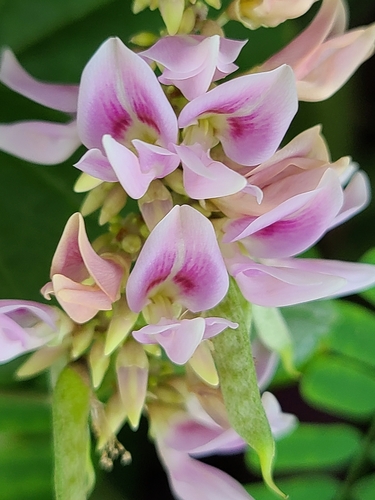
Wisteria frutescens
(L.) Poir.
American wisteria

(c) abelkinser, some rights reserved (CC BY-NC)

(c) joelmc, some rights reserved (CC BY-NC)
What to Eat
Edible parts: Flowers
The fresh flowers are eaten in tossed green salads. They are also said to be excellent when dipped in batter and fried in oil as fritters.
Known Hazards
Where to Find It
It is a temperate plant. It suits hardiness zone 5. Arboretum Tasmania.
Australia, Central Asia, North America*, Tajikistan, Tasmania, USA,
How to Identify
Flowers are formed on the current season's wood. The flowers are in drooping spikes. They are rich lilac colour.
How to Grow
Propagation: Seed has no dormancy requirements and can be sown as soon as it is ripe in a cold frame, germinating in spring. Stored seed should be pre-soaked for 24 hours in warm water before sowing in a greenhouse in early spring. Seed can also be sown in an outdoor seedbed in late spring; germination usually occurs in the first spring but may be delayed a further 12 months. Prick seedlings into individual pots when large enough to handle and grow on in a cold frame for the first winter, then plant out in late spring or early summer. Plants grown from seed are very slow and can take up to 20 years to flower. Basal cuttings of side-shoots can be taken in early to mid summer once new growth has hardened sufficiently, each with 2–3 leaves. Removing a shallow slice of bark from the bottom 15mm of the cutting exposes extra cambium and encourages better callusing and rooting. In a mist frame with bottom heat of 27–30°C, cuttings will root within 4 weeks and produce well-established plants by autumn. Layering in spring is also effective: lay a long shoot along the ground, cover with a shallow layer of soil, and it will produce roots at intervals along the stem. Once roots are well formed, the shoot can be divided into several plants, potted up, and kept in a lightly shaded greenhouse until established before planting out.
Medicinal Uses
None known
Other Uses
Nitrogen fixer.
Wikipedia
Source ↗Wisteria frutescens (common names American wisteria, swamp wisteria, Mississippi wisteria, and Atlantic wisteria) is a woody, deciduous, perennial climbing vine, one of various wisterias of the family Fabaceae. It is native to the wet forests and stream banks of the southeastern United States, with a range stretching from the states of Virginia to Texas (Northeast Texas Piney Woods) and extending southeast through Florida, also north to Iowa, Michigan, and New York.
References (5)
- Facciola, S., 1998, Cornucopia 2: a Source Book of Edible Plants. Kampong Publications, p 114
- Jackes, D. A., 2007, Edible Forest Gardens
- Kermath, B. M., et al, 2014, Food Plants in the Americas: A survey of the domesticated, cultivated and wild plants used for Human food in North, Central and South America and the Caribbean. On line draft. p 925
- Ryan, S., 2008, Dicksonia. Rare Plants Manual. Hyland House. p 80
- Tabl. encycl. 3:674. 1823