Acacia pendula
A. Cunn. ex G. Don
Weeping myall
(c) Ray Turnbull, some rights reserved (CC BY-NC), uploaded by Ray Turnbull

(c) ozzielabrat, some rights reserved (CC BY-NC), uploaded by ozzielabrat
(c) Bruce McLennan, some rights reserved (CC BY-NC), uploaded by Bruce McLennan
What to Eat
Edible parts: Gum, Seeds
The gum and seeds are edible. The ashes are traditionally added to flour for damper.
Known Hazards
Where to Find It
It is best in medium to heavy soils. It needs an open sunny position. It is resistant to drought and frost.
Africa, Australia, East Africa, South Africa, Southern Africa, Zimbabwe,
How to Identify
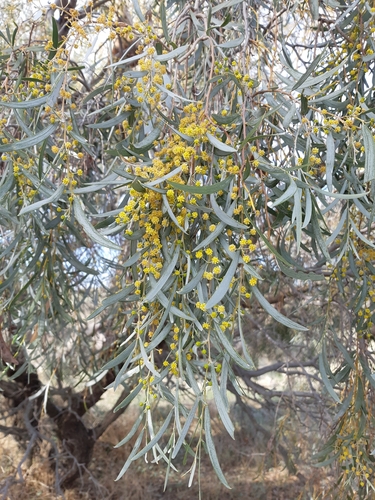
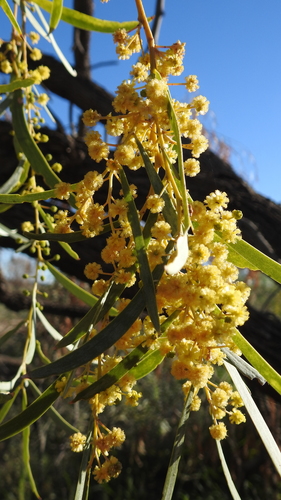
A shrub or small tree. It grows 5 m tall. There are prickles along the stem. The leaves are twice divided and there are 8-18 pairs of pinnae. There are up to 50 pairs of pinnules on each pinnae. The flowers are yellow. They are in large clusters at the ends of branches. The pods are flattened.
How to Grow
Plants are grown from treated seed.
Propagation: The seed of most, if not all, members of this genus has a hard seedcoat and may benefit from scarification before sowing to speed up germination. This can usually be done by pouring a small amount of nearly boiling water on the seeds (being careful not to cook them!) and then soaking them for 12 - 24 hours in warm water. By this time they should have imbibed moisture and swollen - if they have not, then carefully make a nick in the seedcoat (being careful not to damage the embryo) and soak for a further 12 hours before sowing. Acacia seeds that have matured fully on the bush and have been properly dried have a hard seed coat and can be stored in closed containers without deterioration for 5 - 10 years or more in dry conditions at ambient temperatures. It is best to remove the aril, which attracts weevils and can lead to moulds forming. The arils are easilyremoved by placing the seeds in water and rubbing them between the hands, then drying the seeds and winnowing them.
Medicinal Uses
The bark of all Acacia species contains greater or lesser quantities of tannins and are astringent. Astringents are often used medicinally - taken internally, for example. they are used in the treatment of diarrhoea and dysentery, and can also be helpful in cases of internal bleeding. Applied externally, often as a wash, they are used to treat wounds and other skin problems, haemorrhoids, perspiring feet, some eye problems, as a mouth wash etc. Many Acacia trees also yield greater or lesser quantities of a gum from the trunk and stems. This is sometimes taken internally in the treatment of diarrhoea and haemorrhoids.
Other Uses
A gum is obtained from the trunk and branches. It dissolves entirely in cold water, forming a perfectly clear, almost colourless solution of a brownish tint. Like some other wattle-gums, this would require selecting for the market. There is a marked difference in appearance between the old and new gum of this tree. The new gum is in rounded pieces, and very similar in appearance and usual size to Senegal gum (Senegalia senegal) and Aden gum arabic. The gum which remains long on the trees becomes filled with minute fissures. The fissures, which radiate from the centre of a lump, cause the lump to break into sub-triangular or conical pieces. The above report was for Acacia pendula var glabrata - which is currently believed to be a synonym for Acacia melvillei Pedley. The other reports, below, refer to Acacia pendula, without reference to any variety. A good quality gum is obtained from the trunk and branches. The oil from fresh cuts emit a pleasant rich violet fragrance that women placed in their garment drawers. The tree yields a scented wood, which may have potential for use in perfumery. The colour of the wood is a rich, warm brown with darker and lighter streaks. It is close-grained, heavy, very hard, and possesses a highly aromatic scent, but not the same as that of Acacia acuminata (q.v.), for which wood it has sometimes been mistaken. It is very suitable for turnery, as it makes splendid handles of all kinds for bowls, mauls, etc. The tree's heartwood colour of deep chocolate brown to dark toffee orange, coupled with its peculiar fragrance of violets which can remain for many years, has drawn the interest of fine wood working craftsman for the manufacturing of furniture, fancy boxes etc. The wood is used for fuel. The tree makes an excellent windbreak, providing shade and shelter. The tree has a wide-ranging, shallow root system that is excellent for binding the soil but restricts the growth of other species.
Wikipedia
Source ↗Acacia pendula, commonly known as the weeping myall, true myall, myall, silver-leaf boree, boree, and nilyah, is a species of wattle, which is native to Australia. The 1889 book The Useful Native Plants of Australia records that common names included "Weeping Myall", "True Myall", and Indigenous people of western areas of New South Wales and Queensland referred to the plant as "Boree" and "Balaar".
Notes
There are about 1,350 Acacia species. Over 1,000 occur in Australia. Also as Mimosaceae.
Names & Synonyms
Boree
References (7)
- Bodkin, F., 1991, Encyclopedia Botanica. Cornstalk publishing, p 28
- Facciola, S., 1998, Cornucopia 2: a Source Book of Edible Plants. Kampong Publications, p 151
- Gen. hist. 2:404. 1832
- ILDIS Legumes of the World http:www;ildis.org/Legume/Web
- McKerney, M. & White, H., 2011, Bush Tucker, Boomerangs & Bandages. Border River-Gwyder Catchment Management Authority p 45
- Tanaka,
- Williams A. & Sides, T., 2008, Wiradjuri Plant Use in the Murrumbidgee Catchment. Murrumbidgee Catchment Management Authority. Wagga Wagga, p 9