Hemidesmus indicus
(L.) W. T. Aiton
Indian sarsaparilla

no rights reserved
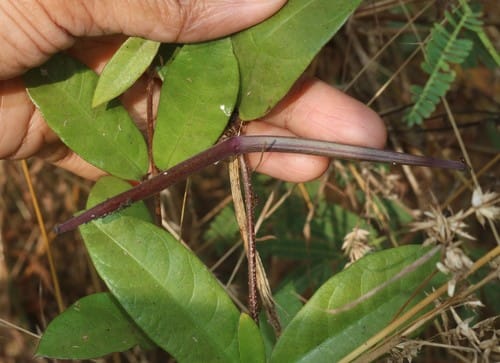
(c) Shiwalee Samant, some rights reserved (CC BY-NC)
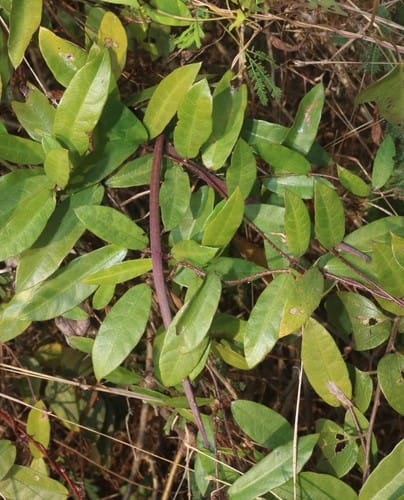
(c) Shiwalee Samant, some rights reserved (CC BY-NC)
What to Eat
Edible parts: Roots - flavouring, Tuber, Leaves
The roots are used as a flavoring in foods as a sarsaparilla substitute, and are brewed in tea and soft drinks. The root bark is powdered and consumed as a coffee drink. Young leaves are cooked and eaten as a vegetable or prepared as a drink.
Where to Find It
It is a tropical plant. In Sri Lanka it grows below 800 m above sea level.
Asia, Himalayas, India, Indochina, Laos, Malaysia, Nepal, Northeastern India, Pakistan, SE Asia, Sikkim, Sri Lanka,
How to Identify
A shrubby twining plant or climber. It has a woody rootstock and long whip-like stems. These are thickened at the nodes. The leaves are simple, long and narrow. They are 5-10 cm long by 0.8-1.8 cm wide. The flower stalks are covered by many bracts. The fruit is a long dry pod. It is 10-15 cm long by 0.6 cm wide. The seeds are 6-8 mm long.
Nutrition Score: 27/100
| Part | Moisture | kJ | kcal | Protein | Vit A | Vit C | Iron | Zinc |
|---|---|---|---|---|---|---|---|---|
| Leaves | 92.1 | 109 | 26 | 2 | — | 28 | — | — |
Medicinal Uses
Used traditionally in various preparations, particularly the roots and root bark.
Wikipedia
Source ↗Hemidesmus indicus, Indian sarsaparilla, is a species of plant found in South Asia. It occurs over the greater part of India, from the upper Gangetic plain eastwards to Assam and in some places in central, western and South India. The root is a substitute for sarsaparilla (the dried root of the tropical species of Smilax, Smilacaceae; in India Smilax aspera L., and Smilax ovalifolia Roxb.). It should be distinguished from Mexican sarsaparilla Smilax aristolochiifolia Mill. and Jamaican sarsaparilla Smilax ornata Hook.f..
Notes
There is only one Hemidesmus species. It has also been put in the family Asclepiadaceae and Periplocaceae.
Names & Synonyms
Anantmool, Anantmul, Anantvel, Arakkam, Aritinviyachi, Iramusu, Khaprilbela, Khobarjadiwel, Nannari, Nunnery root, Paala tiga, Parukia, Raigadi, Sogade beru, Subudi, Uparsul
References (23)
- Arinathan, V., et al, 2007, Wild edibles used by Palliyars of the western Ghats, Tamil Nadu. Indian Journal of Traditional Knowledge. 6(1) pp 163-168
- Baro, D., Baruah, S. and Borthukar, S. K. 2015, Documentation on wild vegetables of Baksa district, BTAD (Assam). Scholars Research Library. Archives of Applied Science Research, 2015, 7 (9):19-2
- Chandrakumar, P., et al, 2015, Ethnobotanical studies of wild edible plants of Gond, Halba and Kawar tribes of Salekasa Taluka, Gondia District, Maharashtra State, India. International Research Journal of Pharmacy 6(8)
- Facciola, S., 1998, Cornucopia 2: a Source Book of Edible Plants. Kampong Publications, p 168
- Hortus kew. ed. 2, 2:75. 1811
- Kahlon, L. K. & Singh, R., 2019, Traditional knowledge & Dynamics of edible plants of primitive tribal group ‘Paudi Bhuyan’ with changing demography migration patterns in Northern Odisha. Indian Journal of Traditional Knowledge Vol 18(1), pp 7-15
- Kumar, G.M., & Shiddamallayya, N., 2014, Documentation of Wild Plant Tubers as Food Resources in Hassan District, Karnataka, International Journal of Applied Biology and Pharmaceutical Technology. 5(2) p 91
- Kumar, R. & Saikia, P., 2020, Wild edible plants of Jharkhand and their utilitarian perspectives. Indian Journal of Traditional Knowledge Vol 19 (2), April 2020, pp 237-250
- Mohan, V. R. & Kalidass, C., 2010, Nutritional and Antinutritional Evaluation of some Unconventional Wild Edible Plants. Tropical and Subtropical Agroecosystems, 12 (2010): 495- 506
- Narzary, H., et al, 2013, Wild Edible Vegetables Consumed by Bodo tribe of Kokrajhar District (Assam), North-East India. Archives of Applied Science Research, 5(5): 182-190
- Pandy, R. K. & Saini, S. K., 2007, Edible plants of tropical forests among tribal communities of Madhya Pradesh. Indian Journal of Traditional Knowledge. 6(1), pp 185-190
- Prafulla, S., 2017, Wild Food Diversity of Nawegaon-Nagzira Tiger Reserve in Gondia-Bhandara district of Maharashtra, India. Int. J. of Life Sciences, 2017, Vol. 5 (4): 620-626
- Rajapaksha, U., 1998, Traditional Food Plants in Sri Lanka. HARTI, Sri Lanka. p 91
- Rajasab, A. H. et al, 2004, Documentation of folk knowledge on edible wild plants of North Karnataka. Indian Journal of Traditional Knowledge. Vol 3(4) pp 419-429
- Rasingam, L., 2012, Ethnobotanical studies on the wild edible plants of Irula tribes of Pillur Valley, Coimbatore district, Tamil Nadu, India. Asian Pacific Journal of Tropical Biomedicine. (2012) S1493-S1497
- Reddy, K. N. et al, 2007, Traditional knowledge on wild food plants in Andhra Pradesh. Indian Journal of Traditional Knowledge. Vol. 6(1): 223-229
- Samydurai, P., et al, 2012, Wild habits of Kolli Hills being staple food of inhabitant tribes of eastern Ghats, Tamil Nadu, India. Indian Journal of Natural Products and Resources. 3(3) September 2012 pp 432-437
- Sarvalingam, A., et al, 2014, Wild edible plant resources used by the Irulas of the Maruthamalai Hills, Southern Western Ghats, Coimbatore, Tamil Nadu. Indian Journal of Natural Products and Resources 5(2):198-201
- Seidemann J., 2005, World Spice Plants. Economic Usage, Botany, Taxonomy. Springer. p 176
- Sivakumar, A. & Murugesan, M., 2005, Ethnobotanical Studies of the wild edible plants used by the tribals of the Anaimalai Hills, the Western Ghats. Ancient Science of Life. XXV(2) Oct-Dec.
- Tamil herbs, 2007, Edible Plants of the Tropical Dry Evergreen Forest.
- Tanaka,
- World Checklist of Useful Plant Species 2020. Royal Botanic Gardens, Kew


