Platanus occidentalis
L.
American sycamore, Plane tree

no rights reserved, uploaded by Andy Wilson

(c) hgarris, some rights reserved (CC BY-NC), uploaded by hgarris
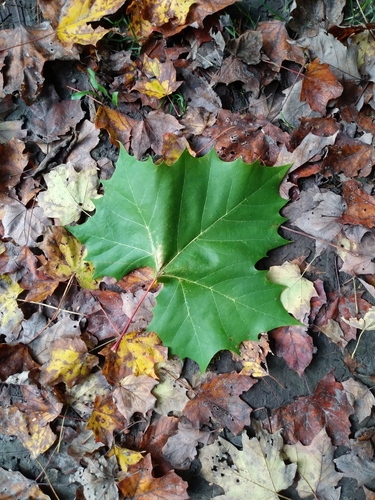
(c) Mitch, some rights reserved (CC BY-NC), uploaded by Mitch
What to Eat
Edible parts: Sap
The sweet sap is tapped in spring and used to make syrup and sugar.
Known Hazards
Where to Find It
It is a temperate plant. It does best in cool deep alkaline soils. It needs an open sunny position. It is resistant to frost but sensitive to drought. Arboretum Tasmania.
Africa, Asia, Australia, Canada, Central Asia, China, East Africa, Korea, Mexico, North America*, Tajikistan, Tasmania, USA, Zimbabwe,
How to Identify
A deciduous tree. It grows 50 m tall and spreads 6 m wide. The stem is erect and branching. The bark is grey and flaking. The leaves are light green and have lobes arranged like fingers on a hand. The flowers are in round heads.
How to Grow
Prefers a deep moist loam, though it tolerates very wet, poorly drained soils. Requires full sun. Tolerates atmospheric pollution and compacted soils. Established plants are drought tolerant. Fairly wind-resistant. A fast-growing and long-lived tree, but it is of no value in Britain, being very susceptible to attack by parasitic fungi. Fairly slow-growing according to another report, which also says that the tree is long-lived in the wild. This species does not do well north of Central France, it requires long hot summers to fully ripen its wood.
Propagation: Two months of cold stratification improves germination. Sow in spring in a cold frame in light shade. Home-grown seed is often of poor quality and low viability; it is best to harvest seed in late winter or spring and sow immediately in a cold frame. Prick seedlings out into individual pots when large enough to handle and grow on in the greenhouse for the first winter. Plant out into permanent positions in late spring or early summer after the last expected frosts. Cuttings of mature wood from the current year's growth, 20–30 cm with a heel, can be taken in autumn and placed in a cold frame — this method is easy. Layering of stools in spring or autumn takes 12 months.
Medicinal Uses
The inner bark is astringent, diuretic, emetic, and laxative. It has been used as a tea to treat dysentery, coughs, colds, lung ailments, haemorrhages, measles, and milky or difficult urination, and also as a blood tonic. Externally, it has been used as a wash on wounds. An infusion of the bark and roots has been used as a foot soak for treating rheumatism. The bark ooze has been applied as a wash on infected sores, and an infusion has been given to treat infant rash. An infusion of the bark mixed with honey locust bark (Gleditsia triacanthos) has been used as a gargle for hoarseness and sore throat.
Other Uses
This fairly wind-resistant tree can be planted as part of a shelterbelt. The wood is coarse-grained, tough, strong, very durable, and difficult to split, though some reports consider it rather weak. It weighs 35 lb per cubic foot and is used for furniture, chopping boards, and similar items. Trunks of wild trees can reach up to 4.5 metres in diameter and were once hollowed out to make barges capable of carrying several tons of goods.
Wikipedia
Source ↗Platanus occidentalis, also known as American sycamore, American planetree, western plane, occidental plane, buttonwood, and water beech, is a species of Platanus native to the eastern and central United States, the mountains of northeastern Mexico, extreme southern Ontario, and extreme southern Quebec. It is usually called sycamore in North America, a name which can refer to other types of trees in other parts of the world; in the United Kingdom, for example, the name sycamore typically refers to Acer pseudoplatanus. The American sycamore is a long-lived species, typically surviving at least 200 years and likely as long as 500–600 years. It is capable of becoming a massive tree, with a wide girth and heights reaching up to 24 m (80 ft) or more. The species epithet occidentalis is Latin for "western", referring to the Western Hemisphere, because at the time when it was named by Carl Linnaeus, the only other species in the genus was P. orientalis ("eastern"), native to the Eastern Hemisphere. Confusingly, in the United States, this species was first known in the Eastern United States, thus it is sometimes called eastern sycamore, to distinguish it from Platanus racemosa which was discovered later in the Western United States and called western sycamore.
Notes
There are 10 Platanus species.
Names & Synonyms
References (5)
- Bodkin, F., 1991, Encyclopedia Botanica. Cornstalk publishing, p 803
- Facciola, S., 1998, Cornucopia 2: a Source Book of Edible Plants. Kampong Publications, p 173
- Flora of China @ efloras.org Volume 9
- Kermath, B. M., et al, 2014, Food Plants in the Americas: A survey of the domesticated, cultivated and wild plants used for Human food in North, Central and South America and the Caribbean. On line draft. p 670
- Sp. pl. 2:999. 1753
