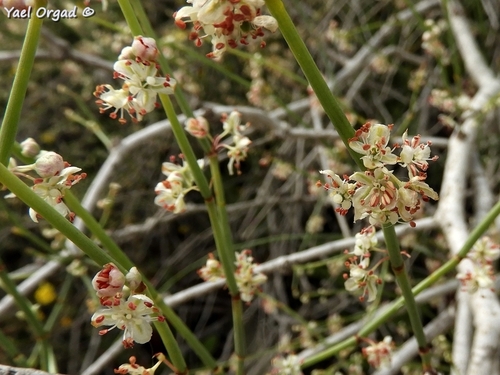
Atraphaxis spinosa
L.
Shir-khecht shrub

(c) Юрий Данилевский (Yuriy Danilevsky), some rights reserved (CC BY), uploaded by Юрий Данилевский (Yuriy Danilevsky)

(c) Еlena, some rights reserved (CC BY-NC)
What to Eat
Edible parts: Manna
Edible Parts: Manna Edible Uses: The plant is a source of a yellowish-white manna-like substance that is eaten as a food or used in making sweetmeats.
Where to Find It
It is a temperate plant. It grows in deserts. It grows between 400-1,800 m above sea level in northern China.
Afghanistan, Arabia, Asia, Central Asia, China, Egypt, Europe, Iran, Kazakhstan, Kyrgyzstan, Mediterranean, Middle East, Mongolia, North Africa, Pakistan, Palestine, Russia, Tajikistan, Turkey, Türkiye, Turkmenistan, Uzbekistan,
How to Identify
A shrub. It grows up to 1 m high. The stems are slender. The woody branches are slender and without leaves at the end. There is a spine at the point. The leaves are grey-green are round or oval. They are 3-7 mm long by 3-5 mm wide. They are leathery. There are 2-6 flowers in the axils of current year's growth.
How to Grow
Requires a sunny position in a light well-drained soil of low to moderate fertility. Succeeds in the rock garden or on a sunny stony bank. Plants are hardy to at least -10°c so long as the soil is not wet over the winter. The tiny flowers have long lasting petals. This species is closely related to A. frutescens. Any pruning should be restricted to the removal of branch tips every second or third year during the spring in order to maintain a neat compact habit. Established specimens resent root disturbance.
Propagation: Seed - sow spring in a greenhouse. When they are large enough to handle, prick the seedlings out into individual pots and grow them on in the greenhouse for at least their first winter. Plant them out into their permanent positions in late spring or early summer, after the last expected frosts. Seedlings are prone to damp off so should be watered with care and kept well ventilated. Cuttings of soft wood in early summer in a frame. Layering in spring.
Medicinal Uses
None known
Other Uses
None known Special Uses
Wikipedia
Source ↗A deciduous shrub growing 60cm tall by 120cm wide, hardy to UK zone 6. Flowers August to September. Hermaphrodite with male and female organs. Prefers light sandy, well-drained soils and tolerates nutritionally poor soil. Full sun required; cannot grow in shade. Prefers moist soil. Tolerates mildly acidic, neutral, and basic pH soils.
Notes
It contains several flavenoids.
Names & Synonyms
Ci mu liao
References (6)
- Donkin,
- Facciola, S., 1998, Cornucopia 2: a Source Book of Edible Plants. Kampong Publications, p 184
- Flora of China @ efloras.org Volume 5
- Flora of Pakistan. www.eFloras.org
- Sp. pl. 1:333. 1753
- Wang, X. & Borris, R., 2017, Phytochemical investigations of Atraphaxis spinosa L. (Polygonaceae). China Botanical Congress