Ceanothus velutinus
Douglas ex Hook.
Sticky laurel, Tobacco bush, Snowbush
(c) Jeff Bisbee, some rights reserved (CC BY-NC), uploaded by Jeff Bisbee

(c) Aiva Noringseth, some rights reserved (CC BY)

(c) Aiva Noringseth, some rights reserved (CC BY)
What to Eat
Edible parts: Leaves - tea
Tea. Edible use is limited to leaf tea in very small quantities, and even that is more “medicinal curiosity” than true food. Fruits and seeds are not used as food and should be avoided due to the expected high saponin content and low nutritional payoff. Snowbrush is best treated as a valuable ecological ally and an external-use plant rather than as a wild vegetable or grain. The leaves are used as a tea substitute. Edible Uses & Rating: Recorded edible use is limited to leaf tea; there is no strong ethnobotanical tradition of eating the fruits or seeds as food, and given the genus-wide chemistry, that is unsurprising. The tea is intensely aromatic and saponin-rich, more suitable as a medicinal or cleansing wash than a beverage. Edible rating is very low: snowbrush is essentially non-food. Taste, Processing & Kitchen Notes: Fresh leaves smell and taste like a composite of balsam, varnish, turpentine, medicinal liniment, and certain “pine-solvent” cleaning products, reflecting the resinous secondary compounds. Teas made from fresh leaves carry these notes and often exhibit a perceptible soapy quality due to saponins. Aged, dried leaves reportedly give a somewhat mellower brew, but it still sits firmly in the “strong medicine” rather than “gentle tea” category. Even dilute infusions will have an unmistakable resinous flavour; stronger infusions can verge on undrinkable for many palates. The leaves foam readily when rubbed in water, which is useful for cleaning skin or hair, but further undercuts their value as a drink. Fruits are small, firm capsules with little flesh and a likely soapy taste if attempted; they are not recommended. Seasonality (Phenology): In many parts of its range, snowbrush is evergreen, retaining foliage through the winter, though harsh conditions can cause some leaf drop. Flowering typically occurs from May through July, depending on latitude, elevation, and post-fire successional stage, with peak flowering in early summer. Capsules mature and harden over late summer. Seedbanks in the soil can remain viable for decades, germinating en masse after fire. Edible Uses & Rating: Recorded edible use is limited to leaf tea; there is no strong ethnobotanical tradition of eating the fruits or seeds as food, and given the genus-wide chemistry, that is unsurprising. The tea is intensely aromatic and saponin-rich, more suitable as a medicinal or cleansing wash than a beverage. Edible rating is very low: snowbrush is essentially non-food. Taste, Processing & Kitchen Notes: Fresh leaves smell and taste like a composite of balsam, varnish, turpentine, medicinal liniment and certain “pine-solvent” cleaning products, reflecting the resinous secondary compounds. Teas made from fresh leaves carry these notes, and often a perceptible soapiness due to saponins. Aged, dried leaves reportedly give a somewhat mellower brew, but it still sits firmly in the “strong medicine” rather than “gentle tea” category. Even dilute infusions will have an unmistakable resinous flavour; stronger infusions can verge on undrinkable for many palates. The leaves foam readily when rubbed in water, which is useful for cleaning skin or hair but further undercuts their value as a drink. Fruits are small, firm capsules with little flesh and a likely soapy taste if attempted; they are not recommended. Seasonality (Phenology): In many parts of its range snowbrush is evergreen, retaining foliage through the winter, though harsh conditions can cause some leaf drop. Flowering typically occurs from May through July depending on latitude, elevation and post-fire successional stage, with peak flowering in early summer. Capsules mature and harden over late summer. Seedbanks in the soil can remain viable for decades, germinating en masse after fire. Look-Alikes & Confusion Risks: Snowbrush can be confused with some other broad-leaved evergreen shrubs in western forests at a distance, but up close the combination of strongly resinous, sticky, glossy leaves and dense white flower clusters in early summer is distinctive. Other ceanothus species with similar leaves and white flowers (e.g., some forms of C. cordulatus or C. sanguineus) may overlap; careful examination of leaf venation, hairiness and capsule details is needed for precise identification. From a safety standpoint, however, all ceanothus carry similar saponin concerns. Traditional/Indigenous Use Summary: Various Indigenous groups and settlers have used snowbrush leaves and flowers primarily for non-food purposes: teas, washes and poultices drawing on its saponin and tannin content, and possibly as a mild respiratory or skin remedy in some traditions. Its role as a wildlife browse plant and nitrogen fixer also made it indirectly important by supporting game and forest recovery after fires. Direct use as a staple food is essentially absent from the record. Safety & Cautions (Food Use): Snowbrush leaves contain substantial saponins, which are exploited in topical cleansers but make the plant unsuitable for regular internal use. While small amounts of tea have been used traditionally, excessive internal consumption could irritate the gastrointestinal tract and potentially affect red blood cells. As with other Ceanothus, snowbrush should not be considered a safe or desirable food plant; any experimental teas should be dilute, infrequent and approached with caution.
Known Hazards
Where to Find It
It is a temperate plant. It grows in open woodland and grassland. It can grow in mountain zones.
Canada, North America, USA,
How to Identify
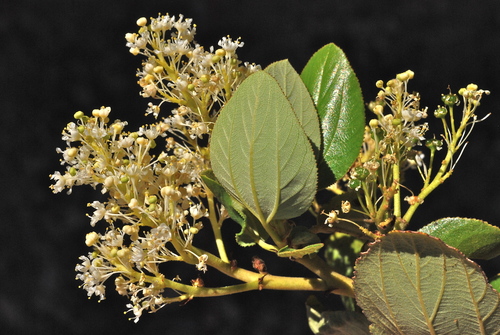
A medium sized shrub. It grows 50 cm to 2 m tall. The flowers are in clusters that are pyramid shape. The leaves are sticky and shiny above. There are fine teeth along the edge. There are 2 small lobes at the base of the stalk.
How to Grow
Snowbrush is a powerful coloniser of burned and disturbed montane forest landscapes, combining dense evergreen foliage, heavy flowering and strong nitrogen-fixing capability. It is a pillar of post-fire succession in many western ecosystems, vital for soil building and wildlife. Its chemistry, rich in resins and saponins, makes it very useful for soaps and medicinal washes but an unattractive and potentially problematic candidate for human food. Prefers a warm sunny position but tolerates light shade. Tolerates some lime, but will not succeed on shallow chalk. One report says that this species is hardy to zone 5 (tolerating temperatures down to about -20°c) whilst another says that it needs the protection of a wall when grown outdoors in Britain. Plants dislike root disturbance; they should be planted out into their permanent positions whilst still small. Dislikes heavy pruning; it is best not to cut out any wood thicker than a pencil. Plants flower on the previous year's growth; if any pruning is necessary, it is best carried out immediately after flowering has finished. Constant pruning to keep a plant small can shorten its life. Fast growing, it flowers well when young, often in its second year from seed. Hybridizes freely with other members of this genus. The leaves have a strong balsam scent. Some members of this genus have a symbiotic relationship with certain soil micro-organisms, which form nodules on the roots of the plants and fix atmospheric nitrogen. Some of this nitrogen is utilized by the growing plant but some can also be used by other plants growing nearby. Identification & Habit: Snowbrush is an evergreen to semi-evergreen shrub usually 0.5–3 m tall, forming dense, often impenetrable thickets. Stems are upright to arching, with numerous leafy side branches. Leaves are simple, alternate, typically 2–6 cm long, oval to broadly elliptic with entire to finely serrate margins, and a thick, leathery texture. Both leaf surfaces, especially the upper, are covered with a sticky resin that gives a glossy sheen and a strong, balsamic, “varnish-and-medicine” scent when crushed. The common name “velvet buckbrush” reflects the slight velvety feel on some forms, but the stickiness is more conspicuous. In late spring to early summer, the shrub is covered in dense clusters of small, white, strongly fragrant flowers, arranged in terminal or upper-axillary panicles. As with other Ceanothus, flowers have five small, hooded petals and five stamens. Fruits are three-lobed capsules, about 3–4 mm across, each lobe containing a single small seed. Snowbrush is insect-pollinated, drawing large numbers of bees, wasps, flies, and butterflies to its nectar. Identification & Habit: Snowbrush is an evergreen to semi-evergreen shrub usually 0.5–3 m tall, forming dense, often impenetrable thickets. Stems are upright to arching, with numerous leafy side branches. Leaves are simple, alternate, typically 2–6 cm long, oval to broadly elliptic with entire to finely serrate margins, and a thick, leathery texture. Both leaf surfaces, especially the upper, are covered with a sticky resin that gives a glossy sheen and a strong, balsamic, “varnish-and-medicine” scent when crushed. The common name “velvet buckbrush” reflects the slight velvety feel on some forms, but the stickiness is more conspicuous. In late spring to early summer, the shrub is covered in dense clusters of small, white, strongly fragrant flowers, arranged in terminal or upper-axillary panicles. As with other Ceanothus, flowers have five small, hooded petals and five stamens. Fruits are three-lobed capsules, about 3–4 mm across, each lobe containing a single small seed. Snowbrush is insect-pollinated, drawing large numbers of bees, wasps, flies and butterflies to its nectar. Habitat & Range: The species is distributed from British Columbia and Alberta south through Washington, Oregon, Idaho, Montana and into northern California, Nevada and parts of Utah and Colorado, typically in montane conifer forests, clearcuts, burns, roadsides and other disturbed sites from roughly 900–2,700 m elevation. It is especially characteristic of Douglas-fir, lodgepole and mixed conifer zones in the interior West. Size & Landscape Performance: In the field, snowbrush commonly forms dense stands 1–2 m tall and wide per stem, coalescing into large patches that may dominate an area for decades after fire. Individual plants can reach about 3 m tall under ideal conditions. In a designed landscape, where used, it provides dense, evergreen screening, heavy fragrance in bloom and strong wildlife value but can become too vigorous and is rarely used in small or formal gardens. Cultivation (Horticulture): Snowbrush is used more in restoration and forestry contexts than in ornamental horticulture. It thrives in sunny, disturbed, well-drained sites and may struggle in rich, heavily irrigated garden beds. Over-watering and poor drainage encourage root problems. In suitable climates it can be seeded or planted to stabilise slopes and restore nitrogen after logging or fire. Pruning is generally unnecessary; if done, it should be light, as hard pruning into old wood may reduce vigour. Pests & Problems: In natural stands, snowbrush tends to be hardy and resilient, with occasional herbivory by insects and vertebrates but few severe disease issues. In cultivation, badly drained or overly rich sites can predispose plants to root rot and decline. The dense litter of leaves and stems in old stands can accumulate, altering fire behaviour if not periodically burned or decomposed. Pests & Problems: In natural stands, snowbrush tends to be hardy and resilient, with occasional herbivory by insects and vertebrates but few severe disease issues. In cultivation, badly drained or overly rich sites can predispose plants to root rot and decline. The dense litter of leaves and stems in old stands can accumulate, altering fire behaviour if not periodically burned or decomposed. Cultivar/Selection Notes: There are no widely known named cultivars of C. velutinus in horticulture; breeding and selection have focused on showy coastal species. For restoration projects, local wild seed sources are typically preferred.
Propagation: Sow seed as soon as it is ripe in a cold frame. Stored seed should be pre-soaked for 12 hours in warm water, then given 1–3 months of stratification at 1°C; germination usually takes 1–2 months at 20°C. One method recommends boiling water treatment, or heating seed in 4 times its volume of sand at 90–120°C for 4–5 minutes, followed by a 12-hour soak in warm water; a subsequent chilling period below 5°C for up to 84 days may then be needed before germination occurs. Seeds have considerable longevity — some that have lain in the soil for 200 years or more have germinated. Seed is ejected forcefully from the capsule at ripeness, so it must be collected just before dehiscence or it becomes hard to extract and rarely germinates satisfactorily. Prick seedlings into individual pots as soon as they are large enough and grow on under glass for at least their first winter before planting out in late spring or early summer. Half-ripe cuttings taken at a node can be struck in a frame in July or August. Mature wood cuttings from the current year's growth, 7–12 cm with a heel, can be taken in October in a cold frame. The roots are brittle — pot up callused cuttings in spring just before the roots break. Success rates are generally good.
Medicinal Uses
The leaves are febrifuge. An infusion of the leaves has been used to treat coughs and fevers. A decoction of the leaves and stems has been used both internally and externally for dull pains and rheumatism. The leaves contain saponins and have been used as a skin wash that is also deodorant and can destroy some parasites. This wash is beneficial for treating sores, eczema, and nappy rash.
Other Uses
A green dye is obtained from the flowers. The dried, powdered leaves have been used as a baby powder for treating nappy rash. Smoke from burning the plant has been used as an insecticide to kill bedbugs. All parts of the plant are rich in saponins — when crushed and mixed with water they produce a good lather that makes an effective and gentle soap. It removes dirt well but does not lift oils, so it will not strip natural skin oils, nor remove engine oil or similar substances. The flowers are a particularly good source and leave a pleasant scent on skin after use. The developing seed cases are also a very good source of saponins.
Wikipedia
Source ↗Ceanothus velutinus, with the common names snowbrush ceanothus, red root, tobacco brush, and sticky laurel, is a species of shrub in the family Rhamnaceae. It is native to western North America from British Columbia to California to Colorado.
Names & Synonyms
Sticky Laurel, Snowbrush ceanothus, Hooker's ceanothus, Velvet Buckbrush, Tobacco Brush, Ceanothus velutinus var. laevigatus Torr. & A.Gray, Ceanothus velutinus var. velutinus
References (6)
- Facciola, S., 1998, Cornucopia 2: a Source Book of Edible Plants. Kampong Publications, p 190
- Fl. bor.-amer. 1:125, t. 45. 1831
- Kermath, B. M., et al, 2014, Food Plants in the Americas: A survey of the domesticated, cultivated and wild plants used for Human food in North, Central and South America and the Caribbean. On line draft. p 202
- MacKinnon, A., et al, 2009, Edible & Medicinal Plants of Canada. Lone Pine. p 148
- Tozer, F., 2007, The Uses of Wild Plants. Green Man Publishing. p 60
- Turner, N., 1997, Food Plants of Interior First Peoples. Royal BC Museum Handbook p 168