Alaria marginata
Postels & Ruprecht
Winged kelp, California wakame

(c) John D Reynolds, some rights reserved (CC BY-NC), uploaded by John D Reynolds

(c) Wendy Feltham, some rights reserved (CC BY-NC), uploaded by Wendy Feltham

(c) faerthen, some rights reserved (CC BY-NC), uploaded by faerthen
What to Eat
Edible parts: Algae, Seaweed, Fronds, Midrib, Sporophyll, Vegetable
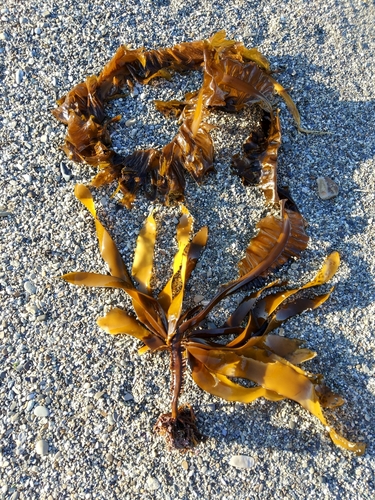
The blades can be cooked and eaten as a vegetable or added to soups fresh or dried. The chopped fresh midrib is added to salads. The sporophylls are fried and eaten. It is also processed into kelp meal used as a food supplement.
Where to Find It
It is a temperate plant.
Alaska, Asia, Canada, Japan, North America, Russia, USA,
How to Identify
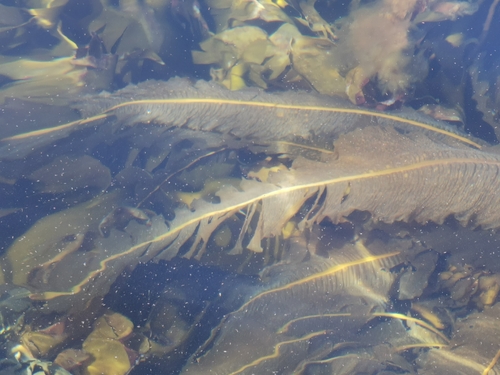
A temperate seaweed in the kelp family with edible fronds and a prominent midrib.
Wikipedia
Source ↗Alaria marginata, the winged kelp, is a brown alga species in the genus Alaria. It can grow up to 13 feet. Fronds are long and narrow with raised midrib and wavy edges. Each frond has two rows of several smooth, oblong, 5 inch spore-bearing blades at the base in winter. According to a study done by Widdowson(1971), the kelp Alaria marginata has been known to occupy certain wave-exosed intertidal habitats. These habitats can be found in the northeast Pacific from Alaska to near Point Conception, California. Alaria marginata has been the dominant macroalga on this exposed mid-to-low rocky shores along the Big Sur coast of California. The kelp commonly grows in large patches, which offers habitat and sustenance for tide pool organisms. In the kelp species Alaria marginata, phenolics act as chemical defence against herbivores. Higher concentrations of the phenolics were found in the reproductive fronds when compared to the vegetative blades, which were consumed at a higher rate by herbivorous snails.
Names & Synonyms
Elquaq
References (5)
- Facciola, S., 1998, Cornucopia 2: a Source Book of Edible Plants. Kampong Publications, p 257
- http://www.seavegetables.com
- Jernigan, K. A., et al, 2017, Naukan ethnobotany in post-Soviet times: lost edibles and new medicinals. Journal of Ethnobiology and Ethnomedicine (2017) 13:61
- Kuhnlein, H. V. and Turner, N. J., 1991, Traditional Plant Foods of Canadian Indigenous Peoples. Food and Nutrition in History and Anthropology Volume 8. Gordon and Breach. p 18
- Zemke-White, W. L. & Ohno, M., 1999, World seaweed utilisation: An end-of-century summary. Journal of Applied Phycology 11: 369-376