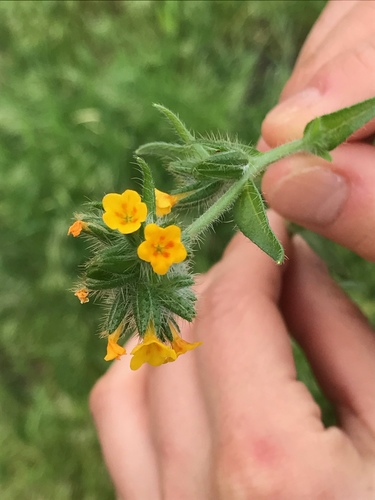
Cordia caffra
Sond.
Septee saucer-berry
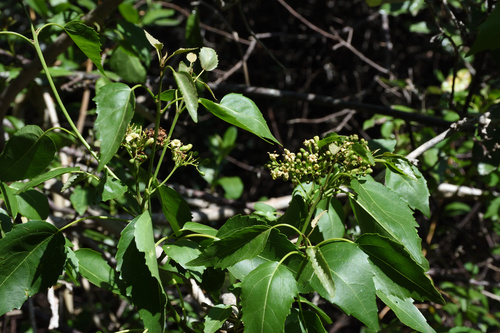
(c) Andrew Gillespie, some rights reserved (CC BY-SA)
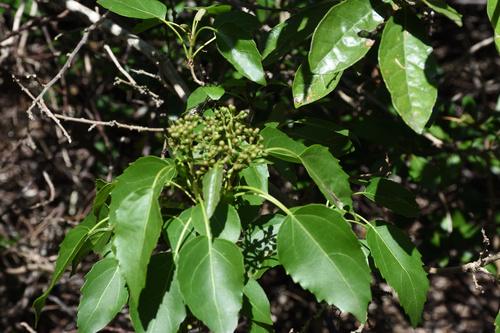
(c) Andrew Gillespie, some rights reserved (CC BY-SA)
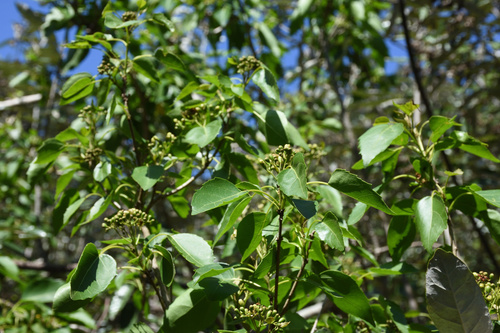
(c) Andrew Gillespie, some rights reserved (CC BY-SA)
What to Eat
Edible parts: Fruit
The round orange fruit can be eaten fresh or used in jams, desserts, and preserves, though they are not particularly tasty; the fruit are especially popular with children.
Known Hazards
Where to Find It
It is a subtropical plant. It is hardy to light frosts. It can grow in sun or shade. It usually grows in dry forest.
Africa, Botswana, East Africa, Eswatini, Mozambique, South Africa, Southern Africa, Swaziland,
How to Identify
A small tree. The crown is spreading or drooping. The bark is smooth, light and flaking. It grows 6 m tall and spreads 7 m wide. It is taller in forests. It loses its leaves during the year. The leaves are thin and oval and pointed. They are dark green above and paler underneath. They are 6-12 cm long. The flowers are creamy-white and have a scent. They are bell shaped and in clusters at the ends of the stems. The fruit are round and deep orange colour when ripe. They are produced in small clusters. They have a cup shaped calyx around the base.
How to Grow
Plants can be grown from seeds.
Propagation: Seed - germinates fairly quickly.
Medicinal Uses
Parts of this tree are used medicinally to treat sore eyes, fever and wounds.
Other Uses
Dry sticks are rubbed together to make fire caused by friction heat. The heartwood is a pinkish colour. The wood is moderately heavy, hard, compact and durable. Easily worked, it does not chip and cut when planed and polishes well. It is used to make attractive furniture. The sapwood is used to build huts. Trees respond well to trimming and can be pruned successfully into any desired shape. This probably means that it could be grown as a hedge.
Production
It is fairly fast growing.
Other Information
The fruit are not tasty. The fruit are especially eaten by children.
Names & Synonyms
Muconanjoho, Septee tree, Umbofu, Umlovi, Umlovu
References (11)
- Cunningham, 1985,
- Fox, F. W. & Young, M. E. N., 1982, Food from the Veld. Delta Books. p 133
- Joffe, P., 2007, Creative Gardening with Indigenous Plants. A South African Guide. Briza. p 51
- Long, C., 2005, Swaziland's Flora - siSwati names and Uses http://www.sntc.org.sz/flora/
- Lyle, S., 2006, Discovering fruit and nuts. Land Links. p 154
- Peters, C. R., O'Brien, E. M., and Drummond, R.B., 1992, Edible Wild plants of Sub-saharan Africa. Kew. p 70
- Ruiters-Welcome, A. K., 2019, Food plants of southern Africa. Ph.D. thesis. Univ. of Johannesburg p 38
- Schmidt, E., Lotter, M., & McCleland, W., 2007, Trees and shrubs of Mpumalanga and Kruger National Park. Jacana Media p 570
- Swaziland's Flora Database http://www.sntc.org.sz/flora
- Van Wyck, B., & Van Wyck, P, 1997, Field Guide to Trees of Southern Africa. Struik. p 134
- Welcome, A. K. & Van Wyk, B.-E., 2019, An inventory and analysis of the food plants of southern Africa. South African Journal of Botany 122 (2019) 136–179