Spondias macrocarpa
Engl.
Caja-rendondo, Cajazeiro

(c) Geovane Siqueira, some rights reserved (CC BY-NC), uploaded by Geovane Siqueira

Wikimedia Commons - Engler, Adolphus
What to Eat
Edible parts: Fruit
Fruit . Very acid, it is occasionally eaten raw, but is more commonly made into sorbets and juices. Thin skinned, with a succulent, thin, fibrous flesh that has an acidic flavour. The yellow fruit is a globose or ovoid drupe about 2 - 4cm long, containing a single, large seed.
Where to Find It
It is a tropical plant. It grows in Brazil on the Atlantic plateau.
Brazil*, South America,
How to Identify
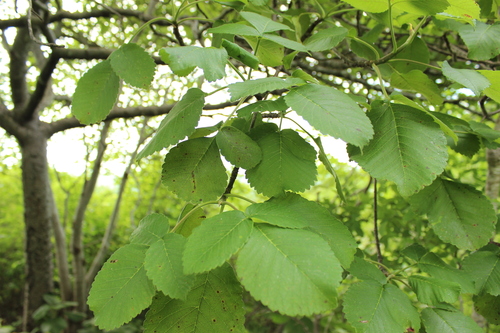
A tree. It grows 10-15 m high. The crown is open and rounded. The trunk is 30-50 cm across. The bark is thin and rough. The leaves have leaflets along the stalk. The leaves are grouped at the ends of the stems. The leaves are 15-30 cm long and have 17-23 leaflets that are opposite each other. They have short stalks and the edges are wavy. They are slightly hairy underneath. The leaflets are 5-9 cm long by 1.5-2.5 cm wide. The flowers occur in large groups at the ends of branches. The flowering groups are 8-14 cm long. The fruit is round and 3-4 cm across. There is one seed inside covered with ridged fibres. Probably now Spondias purpurea
How to Grow
Plants are grown from seed. The ripe fruit are harvested and put into plastic bags to allow them to decompose so the seed can be removed. The fresh seed should be planted and germinate in 20-30 days.
Propagation: Seed - best sown as soon as it is ripe in a sunny position in individual containers. A high germination rate can be expected, with the seed sprouting within 20 - 30 days. Plant out to their permanent positions when the seedlings are 25 - 35cm tall.
Medicinal Uses
The bark is antispasmodic, astringent, emetic and tonic. It is useful in the treatment of piles and gonorrhoea. A decoction of the bark and shoots is used to treat swelling of the feet caused by erysipelas. The leaves are a useful treatment for constipation, gastralgia, ophthalmia and laryngitis. The flowers are cardiac and stomachic. A decoction is used in the treatment of laryngitis, ophthalmia and children's diarrhoea. The pulp of the fruit is used in the treatment of cystitis and urethritis. The pit of the fruit is used in decoction to treat leucorrhoea.
Other Uses
The wood is medium-textured, cross-grained, light in weight, with poor mechanical properties and very susceptible to rot. It is only used for low value items such as boxes, hardboard filling, linings, toys etc.
Names & Synonyms
Caja-mirim, Caja-redondo, Cajazeiro
References (4)
- Grandtner, M. M. & Chevrette, J., 2013, Dictionary of Trees, Volume 2: South America: Nomenclature, Taxonomy and Ecology. Academic Press p 625
- Kermath, B. M., et al, 2014, Food Plants in the Americas: A survey of the domesticated, cultivated and wild plants used for Human food in North, Central and South America and the Caribbean. On line draft. p 833
- Lorenzi, H., 2002, Brazilian Trees. A Guide to the Identification and Cultivation of Brazilian Native Trees. Vol. 02 Nova Odessa, SP, Instituto Plantarum p 22
- Lorenzi, H., Bacher, L., Lacerda, M. & Sartori, S., 2006, Brazilian Fruits & Cultivated Exotics. Sao Paulo, Instituto Plantarum de Estuados da Flora Ltda. p 38