Boscia albitrunca
(Burch.) Gilg. et Benedict
Shepherd’s tree, Caper bush, White-stemmed Boscia
(c) Tony Rebelo, some rights reserved (CC BY-SA), uploaded by Tony Rebelo

(c) Troos van der Merwe, some rights reserved (CC BY-NC), uploaded by Troos van der Merwe

(c) Marco Schmidthttp://www.senckenberg.de/root/index.php?page_id=1750&preview=true, some rights reserved (CC BY-SA)
What to Eat
Edible parts: Fruit, Roots, Seeds, Flower buds, Leaves, Coffee
The round fruit is eaten raw or used for juice and is commonly used in Mozambique. The flower buds are pickled and used as capers. The roots are boiled into syrup, baked and used as a coffee substitute, or dried and crushed for porridge. The seeds are edible, and the leaves are eaten raw as a famine food.
Known Hazards
Where to Find It
A tropical plant. It tends to grow in hot places with low rainfall. It is hardy and drought resistant. It grows in places with a rainfall of less than 50 mm per year. It can tolerate frost. It grows between 5-1,850 m above sea level. It can grow in arid places. It is often on termite mounds.
Africa, Angola, Botswana, Central Africa, East Africa, Eswatini, Mozambique, Namibia, South Africa, Southern Africa, Swaziland, Zambia, Zimbabwe,
How to Identify
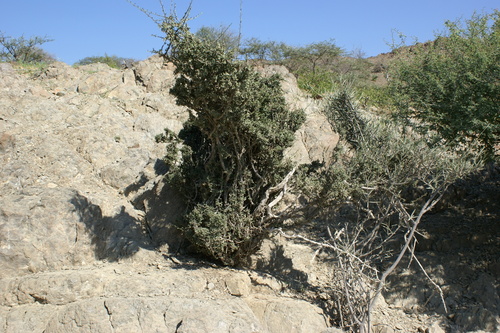
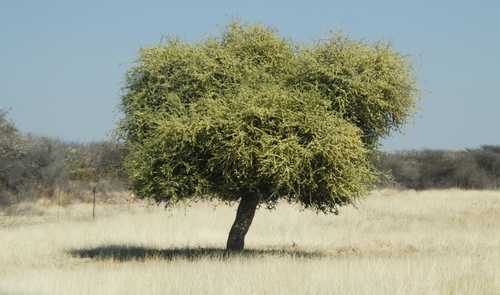
The appearance of the tree varies in different places. It is a tree. It can be 3-4.5 m tall. The trunk is long and clean. It is white. The crown is neat and dense. In other places the trunks may be dark the the leaves drooping. It can also be a low many stemmed shrub. The leaves are grey-green. They are hard when mature. They are usually 2.5-5 cm long and narrow. They taper at the base and have short thin stalks. The midrib is prominent under the leaf. Mostly the leaves grow in bunches of 4-5 together. The flowers are small and star shaped. They are yellow and have a sweet smell. They are usually on old wood and in the axils of leaves. The fruit is round and smooth. It is usually green then turns light brown. It is acrid and edible.
Nutrition Score: 49/100
| Part | Moisture | kJ | kcal | Protein | Vit A | Vit C | Iron | Zinc |
|---|---|---|---|---|---|---|---|---|
| Roots | 68.1 | 449 | 107 | 6.5 | — | 6.6 | 0.4 | 0.8 |
| Fruit | — | — | — | — | — | — | — | — |
| Seeds | — | — | — | — | — | — | — | — |
| Flower buds | — | — | — | — | — | — | — | — |
How to Grow
It grows easily from seed. Seeds are collected from ripe fruit off the tree and then dried in a shady place after all the flesh is removed. Seeds germinate in 7-14 days. Seedlings are then transplanted directly into open ground. It can also be grown from shoot or root cuttings. It can be cut back and will re-grow.
Propagation: Seed - Cuttings Root cuttings
Medicinal Uses
The roots are boiled and made into syrup for traditional use.
Other Uses
Slices of the root are used as a food preservative by placing them in and around the food to protect it from going mouldy. This use has been confirmed by modern research which has shown that the root has a strong antifungal action. The wood is used to make household utensils. It is said to make mortars of outstanding quality that are very resistant to cracking.
Wikipedia
Source ↗Boscia albitrunca, commonly known as the shepherd tree or shepherd's tree (Afrikaans: Witgat, Sotho: Mohlôpi, Tswana: Motlôpi, Venda: Muvhombwe, Xhosa: Umgqomogqomo, Zulu: Umvithi), is a protected species of South African tree in the caper family. It is known for having the deepest known root structure of any plant at: -68 metres (223 ft). The species epithet "albitrunca" refers to the white trunk it oftentimes develops. Traditionally, the shepherd tree was used by Dutch settlers, boers, to create a variant of coffee from the roots of the tree. It is an evergreen tree native to southern and tropical Africa, living in the hot, dry, and often seasonally brackish low-lying areas, sometimes on abundant lime or occasionally on rocky terrain. It is a common tree of the Kalahari, bushveld and lowveld. It is one of the most important animal forage trees in the Kalahari.
Production
Trees grow quickly in moist soil.
Other Information
It is a commonly used fruit in Mozambique.
Notes
There are 37 Boscia species.
Names & Synonyms
Chocutsi, Chuchutzu, Honeb, Ingwavuma-lensikati, Ingwavuma, Ingwayana, Isikhwelampisi, Isiname, Koramu, Kursan, Mahlope, Mehlopi, Mopipi, Mohlopi, Motlhapi, Motlopi, Motopi, Mudobe, Mudowe, Mugaragora, Mupama, Muthobi, Mutobi, Muvgombwe, Namaloa, Omungerere, Omunkunzi, Omutendereti, T'namee, Tshibuyana, Umbombwe, Umbomwe, Umgqomogqomo, Umhlope, Umphitsi, Umtopi, Umvithi, Witgat, Witstamboom
References (36)
- Arnold, T.H., Wells, M.J. & Wehmeyer, A.S., Khoisan food plants: taxa with potential for future economic exploitation, in Wickens, G.E., Goodin, J.R., and Field, D.V.,(Eds.) 1985, Plants for Arid Lands. Unwin Hyman, London, p 73
- Bircher, A. G. & Bircher, W. H., 2000, Encyclopedia of Fruit Trees and Edible Flowering Plants in Egypt and the Subtropics. AUC Press. p 62
- Bot. Jahrb. Syst. 53:212. 1915
- Cheikhyoussef, A & Embashu, W., 2013, Ethnobotanical knowledge on Indigenous fruits in Ohangwena and Oshito regions in Northern Namibia. Journal of Ethnobiology and Ethnomedicine 9:34
- Facciola, S., 1998, Cornucopia 2: a Source Book of Edible Plants. Kampong Publications, p 71
- Fowler, D. G., 2007, Zambian Plants: Their Vernacular Names and Uses. Kew. p 16
- Fox, F. W. & Young, M. E. N., 1982, Food from the Veld. Delta Books. p 143
- Grivetti, L. E., 1980, Agricultural development: present and potential role of edible wild plants. Part 2: Sub-Saharan Africa, Report to the Department of State Agency for International Development. p 73, 79
- Jardin, C., 1970, List of Foods Used In Africa, FAO Nutrition Information Document Series No 2. p 123
- Lim, T. K., 2015, Edible Medicinal and Non Medicinal Plants. Volume 9, Modified Stems, Roots, Bulbs. Springer p 17
- Long, C., 2005, Swaziland's Flora - siSwati names and Uses http://www.sntc.org.sz/flora/
- Magwede, K., van Wyk, B.-E., & van Wyk, A. E., 2019, An inventory of Vhavenḓa useful plants. South African Journal of Botany 122 (2019) 57–89
- Mannheimer, C. A. & Curtis. B.A. (eds), 2009, Le Roux and Muller's Field Guide to the Trees and Shrubs of Namibia. Windhoek: Macmillan Education Namibia. p 58
- Maroyi, A. & Cheikhyoussef, A., 2017, Traditional knowledge of wild edible fruit in southern Africa: A comparative use patterns in Namibia and Zimbabwe. Indian Journal of Traditional Knowledge. 16(3): 385-392
- Mokganya, M. G. et al, 2018, An evaluation of additional uses of some wild edible fruit plants of the Vhembe District Municipality in the Limpopo Province, South Africa. Indian Journal of Traditional Knowledge. Vol 17(2) April 2018, pp 276-281
- Motlhanka, D. M. T., et al, 2008, Edible Indigenous Fruit Plants of Eastern Botswana. International Journal of Poultry Science. 7(5): 457-460
- Neelo, J., et al, 2015, Ethnobotanical Survey of Woody Plants in Shorobe and Xobe Villages, Northwest Region of Botswana. Ethnobotany Research & Applications 14:367-379
- Palgrave, K.C., 1996, Trees of Southern Africa. Struik Publishers. p 185
- Palmer, E and Pitman, N., 1972, Trees of Southern Africa. Vol. 1. A.A. Balkema, Cape Town p 619
- Peters, C. R., O'Brien, E. M., and Drummond, R.B., 1992, Edible Wild plants of Sub-saharan Africa. Kew. p 75
- Plowes, N. J. & Taylor, F. W., 1997, The Processing of Indigenous Fruits and other Wildfoods of Southern Africa. in Smartt, L. & Haq. (Eds) Domestication, Production and Utilization of New Crops. ICUC p 186
- Roodt, V., 1998, Trees & Shrubs of the Okavango Delta. Medicinal Uses and Nutritional value. The Shell Field Guide Series: Part 1. Shell Botswana. p 29
- Royal Botanic Gardens, Kew (1999). Survey of Economic Plants for Arid and Semi-Arid Lands (SEPASAL) database. Published on the Internet; http://www.rbgkew.org.uk/ceb/sepasal/internet [Accessed 5th April 2011]
- Ruiters-Welcome, A. K., 2019, Food plants of southern Africa. Ph.D. thesis. Univ. of Johannesburg p 42
- Story, 1958,
- Silberbauer, 1965, 1972, 1981,
- Sullivan, S., 1998, People plants and practice in drylands: Socio-political and ecological dimensions of resource-use by Damara farmers in north-west Namibia. Ph.D. Univ. College London. p 24
- Swaziland's Flora Database http://www.sntc.org.sz/flora
- Van Damme, P et al, 1922, Plant Uses by the Topnaar of the Kuiseb Valley Namib Desert. Afrika Focus Vol. 8(3-4):223-252
- van Wyk, B, van Wyk, P, and van Wyk B., 2000, Photographic guide to Trees of Southern Africa. Briza. p 66
- van Wyk, Be., & Gericke, N., 2007, People's plants. A Guide to Useful Plants of Southern Africa. Briza. p 102
- Venter, F & J., 2009, Making the most of Indigenous Trees. Briza. p 62
- Wehmeyer, A. S, 1986, Edible Wild Plants of Southern Africa. Data on the Nutrient Contents of over 300 species
- Welcome, A. K. & Van Wyk, B.-E., 2019, An inventory and analysis of the food plants of southern Africa. South African Journal of Botany 122 (2019) 136–179
- World Checklist of Useful Plant Species 2020. Royal Botanic Gardens, Kew
- www.zimbabweflora.co.zw 2011