Boscia foetida
Schinz
Smelly boscia, Smelly shepherd's tree

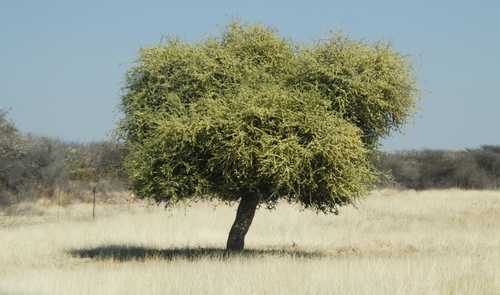
no rights reserved, uploaded by lallen

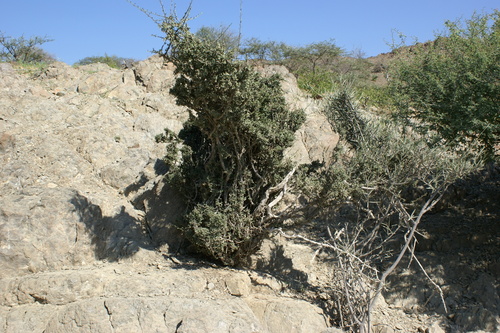
(c) Tony Benn, some rights reserved (CC BY-NC), uploaded by Tony Benn
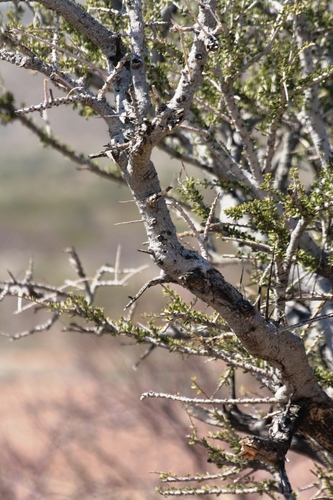
(c) Alan Horstmann, some rights reserved (CC BY-NC), uploaded by Alan Horstmann
What to Eat
Edible parts: Root, Fruit, Flowers
The fruit are eaten raw. The roots can be roasted and used as a chicory substitute for coffee-like drinks, or pounded and added to porridge.
Known Hazards
Where to Find It
A tropical plant. It grows in arid areas and on sand dunes. It grows in areas with a rainfall of about 50 mm. It grows between 50-1,400 m above sea level. It can grow in desert places. It is drought tolerant. It can grow in arid places. It is often on termite mounds.
Africa, Botswana, East Africa, Eswatini, Mozambique, Namibia, South Africa, Southern Africa, Swaziland, Zimbabwe,
How to Identify
An untidy shrub. It can grow 5 m tall. It has many stems from the base. The stems are smooth and grey. The branches are thickly set with small hard leaves. The leaves grow in tufts on short knobs. The leaves are about 8 mm long. They are oval and taper to the base. The twigs and branches can have spines at their tips. The flowers are small and green, They have a horrid smell. The fruit are round and hairy and the size of a cherry. They are light brown when ripe. There are 1-3 seeds inside. They have a sweet oily pulp. They are edible. There are some subspecies.
How to Grow
Trees can be grown from seed. They can also be grown by layering branches. This occurs naturally in areas with higher rainfall. Plants can be cut back and will re-grow.
Medicinal Uses
None mentioned.
Wikipedia
Source ↗Boscia foetida, commonly known as the stink shepherd's tree and the smelly shepherd's bush, is an evergreen shrub or tree that is native to the warmer and drier parts southern Africa. It is found in semi-desert and arid bushveld, and in the west it occurs commonly in areas which are otherwise sparsely wooded. It is known for the particularly unpleasant smell of its flowers which appear during early spring, to which its specific name foetida alludes. Its freshly cut wood likewise has an unpleasant smell, and has traditional medicinal and magical uses, for instance as a protection against lightning. In central Botswana the village of Mopipi is named after this species.
Other Information
The fruit are eaten especially by children.
Notes
There are 37 Boscia species.
Names & Synonyms
Ingcotho, Noeniebos, Stinkbos, Umpheme, Umphisi lomncane, Xaube hunis
References (17)
- Fox, F. W. & Young, M. E. N., 1982, Food from the Veld. Delta Books. p 144
- Grivetti, L. E., 1980, Agricultural development: present and potential role of edible wild plants. Part 2: Sub-Saharan Africa, Report to the Department of State Agency for International Development. p 79
- Long, C., 2005, Swaziland's Flora - siSwati names and Uses http://www.sntc.org.sz/flora/
- Malan & Owen-Smith, 1974,
- Mannheimer, C. A. & Curtis. B.A. (eds), 2009, Le Roux and Muller's Field Guide to the Trees and Shrubs of Namibia. Windhoek: Macmillan Education Namibia. p 60
- Palgrave, K.C., 1996, Trees of Southern Africa. Struik Publishers. p 187
- Palmer, E and Pitman, N., 1972, Trees of Southern Africa. Vol. 1. A.A. Balkema, Cape Town p 627
- Peters, C. R., O'Brien, E. M., and Drummond, R.B., 1992, Edible Wild plants of Sub-saharan Africa. Kew. p 75
- Plowes, N. J. & Taylor, F. W., 1997, The Processing of Indigenous Fruits and other Wildfoods of Southern Africa. in Smartt, L. & Haq. (Eds) Domestication, Production and Utilization of New Crops. ICUC p 186
- Royal Botanic Gardens, Kew (1999). Survey of Economic Plants for Arid and Semi-Arid Lands (SEPASAL) database. Published on the Internet; http://www.rbgkew.org.uk/ceb/sepasal/internet [Accessed 5th April 2011] (Also as subspecies rehmanniana)
- Ruiters-Welcome, A. K., 2019, Food plants of southern Africa. Ph.D. thesis. Univ. of Johannesburg p 42
- Sullivan, S., 1998, People plants and practice in drylands: Socio-political and ecological dimensions of resource-use by Damara farmers in north-west Namibia. Ph.D. Univ. College London. p 24
- Swaziland's Flora Database http://www.sntc.org.sz/flora
- Van Damme, P et al, 1922, Plant Uses by the Topnaar of the Kuiseb Valley Namib Desert. Afrika Focus Vol. 8(3-4):223-252
- van Wyk, B, van Wyk, P, and van Wyk B., 2000, Photographic guide to Trees of Southern Africa. Briza. p 67
- Welcome, A. K. & Van Wyk, B.-E., 2019, An inventory and analysis of the food plants of southern Africa. South African Journal of Botany 122 (2019) 136–179
- World Checklist of Useful Plant Species 2020. Royal Botanic Gardens, Kew