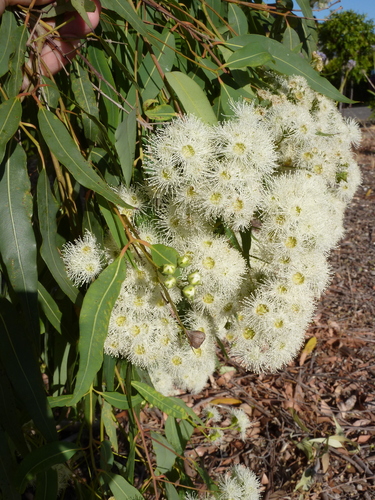
Plinia coronata
(Mattos) Mattos
Jaboticaba coroada, Jabitucaba-de-coroa

Wikimedia Commons (via Wikimedia Commons)

Universidade Federal Rural do Rio de Janeiro (RBR)
What to Eat
Edible parts: Fruit
The fruit are eaten fresh and also made into sweets and jellies.
Where to Find It
A tropical plant. It grows in humid forests above 700 m altitude near the Atlantic in Brazil.
Brazil*, South America,
How to Identify
A small tree. It loses any leaves during the year. It grows 3-4 m tall. The leaves are papery and smooth with hairs along the main veins. The leaves are 4-6 cm long. The leaf stalk is 2.5-3 mm long. The flowers are in clusters on the trunk and branches. They are in groups of 1-6. The fruit are green but turn dark red or black. There is a white circle at the top and a crown. The pulp is juicy.
How to Grow
Plants are grown from seed. The seeds are collected from fallen ripe fruit and allowed to partly decompose in a heap before the seeds are washed under running water. Seeds need to be planted fresh. Seedlings emerge in 20-35 days.
Propagation: Seed - it has a short viability and so is best sown as soon as it is ripe. Sow in a semi-shaded position in a nursery seedbed. Germination rates can be 65% or more, with the seed sprouting within 20 - 35 days. The seedlings grow fairly slowly.
Other Uses
The wood is moderately heavy and slightly susceptible to wood eating organisms. It is only used for fuel and making charcoal.
Wikipedia
Source ↗Plinia coronata, commonly known as jaboticaba coroada (king jabuticaba), is a species of plant in the family Myrtaceae. It is endemic to south-eastern Brazil. The tree grows to between 4 and 12 metres tall, and produces purple, edible fruit, which is between 25 and 30mm in diameter.
Production
Plants grow at a moderate rate.
Other Information
It is occasionally cultivated as a fruit tree.
Names & Synonyms
References (4)
- Leal, M. L. et al, 2018, Knowledge, use, and disuse of unconventional food plants. Journal of Ethnobiology and Ethnomedicine (2018) 14:6
- Lorenzi, H., Bacher, L., Lacerda, M. & Sartori, S., 2006, Brazilian Fruits & Cultivated Exotics. Sao Paulo, Instituto Plantarum de Estuados da Flora Ltda. p 221 (As Myrciaria coronata)
- Lorenzi, H., 2009, Brazilian Trees. A Guide to the Identification and Cultivation of Brazilian Native Trees. Instituto Plantarum de Estuados da Flora Ltda. Vol. 3 p 261 (As Myrciaria coronata)
- www.colecionandofrutas.org