Botrychium australe
R. Br.
Parsley fern, Austral moonwort
(c) Don Geddes, some rights reserved (CC BY-NC)

(c) John Steel, some rights reserved (CC BY)

(c) beckykerr, some rights reserved (CC BY-NC)
What to Eat
Edible parts: Leaves, Fronds
Edible Parts: Leaves Shoots Edible Uses: Unexpanded shoots. No further details are given.
Known Hazards
Where to Find It
It is a warm temperate plant. It grows in open forests and near the edges of rainforests. It needs light shade. It requires an acid soil. The soil should be well drained but moist. It is resistant to frost but sensitive to drought.
Australia, Lord Howe Island, New Zealand, Pacific, Papua New Guinea, PNG, Tasmania,
How to Identify
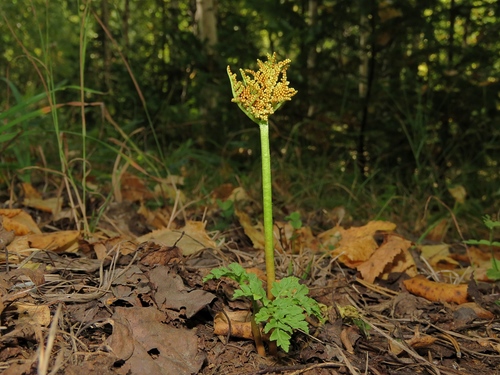
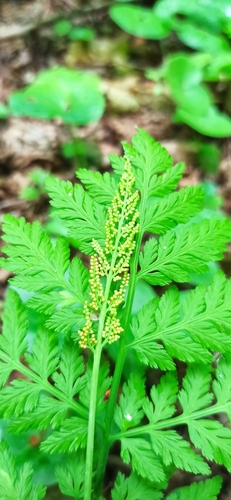
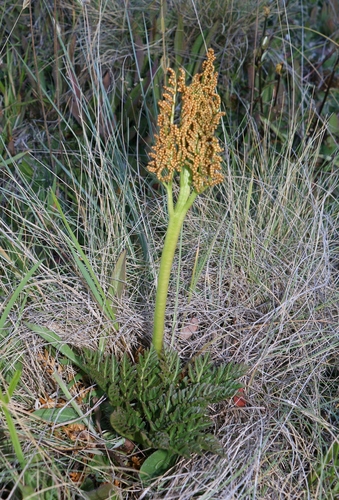
A tufted fern which grows to 40 cm high. It continues to grow from year to year and grows on dry land. The rhizome or underground stem is thick and fleshy. It does not have scales or hairs. Both fertile and sterile leaves occur from a common stem which is 2-5 cm long. The sterile leaves are 5-45 cm long and 5-20 cm wide. They are triangular shaped. They are divided up to 5 times. They are bright green and resemble parsley leaves. The fertile stalk is 10-20 cm long and branched 2 or 3 times. The spore bodies occur in rows and crowded on either side. The new frond is not curled when a bud.
How to Grow
Prefers a sandy loam with just a small portion of peat. Requires sharp drainage. Best grown in an open position. Plants can be difficult to establish. The prothalli (small plants formed when the spores germinate) of this plant form a symbiotic relationship with a mycorrhizal fungus, similar to the association of orchid seedlings with an invading fungus. A very ornamental plant, it is said to require greenhouse protection in Britain but might survive outdoors in the mildest areas of the country. Some botanists consider this species to be no more than a part of B. ternatum. Unlike most species of ferns, the fronds of this species grow up straight and not curled inward, crozier fashion. Members of this genus are rarely if ever troubled by browsing deer.
Propagation: Spores - best surface sown as soon as they are ripe in a greenhouse and do not allow the compost to dry out. Placing the pot in a plastic bag helps to maintain a humid atmosphere which promotes germination and growth. Prick out small clumps into pots when they are large enough to handle and keep moist until established. Grow on in a greenhouse for at least the first winter and plant out in late spring. Division. It is best not to try and disturb this plant.
Medicinal Uses
None known
Other Uses
None known Special Uses
Wikipedia
Botrychium australe is an evergreen fern growing to 0.5 m (1 ft 8 in) tall with year-round foliage. Tolerates light sandy and medium loamy soils with good drainage preference. Suitable for mildly acid to basic mildly alkaline soil pH. Grows in semi-shade (light woodland) or full sun. Prefers moist soil.
Other Information
It is not known if it is used for food in Papua New Guinea.
Notes
There are about 25-40 Botrychium species.
Names & Synonyms
References (8)
- Andrews, S.B., 1990, Ferns of Queensland. A handbook to the ferns and fern allies. Queensland DPI p 255
- Bodkin, F., 1991, Encyclopedia Botanica. Cornstalk publishing, p 162 (As Botrichium australe)
- Chaffey, C.H., 1999, Australian Ferns. Growing them successfully. Kangaroo Press. p 114
- Crowe, A., 1997, A Field Guide to the Native Edible Plants of New Zealand. Penguin. p 118
- Flora of Australia Volume 49, Oceanic Islands 1, Australian Government Publishing Service, Canberra. (1994) p 554
- Plants for a Future database, The Field, Penpol, Lostwithiel, Cornwall, PL22 0NG, UK. http://www.scs.leeds.ac.uk/pfaf/
- Tasmanian Herbarium Vascular Plants list p 99
- Williams, K.A.W., 1999, Native Plants of Queensland Volume 4. Keith A.W. Williams North Ipswich, Australia. p 76