Couma guianensis
Aubl.
Guianas couma

(c) Nils Servientis - Bivouac Naturaliste, some rights reserved (CC BY-NC)
(c) christian marty, some rights reserved (CC BY-NC)

(c) Jessica Launay, some rights reserved (CC BY-NC)
What to Eat
Edible parts: Fruit, Latex
Fruit - raw. The pulp has a sweet, pleasant flavour. The fruit is about 3 - 4cm in diameter, turning red when ripe. A latex obtained from the plant is used as a nourishing drink, either on its own or diluted with water.
Where to Find It
A tropical plant It grows in the rainforest and savanna. They grow up to 500 m above sea level.
Amazon, Brazil*, Colombia*, Ecuador, French Guiana, Guianas, Guyana, Suriname, South America, Venezuela,
How to Identify
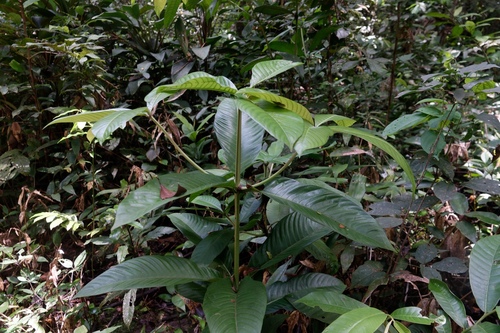
A tree. It grows 25 m tall. It is 7 m tall in dry places. The flowers are in flat topped groups. These occur singly or in pairs. The fruit is a round berry. They are 3-4 cm across. The fruit are green and turn red when ripe. The pulp is edible. There are 4-5 seeds. They are oval and 1 cm long.
How to Grow
Plants are grown by seed. Seed can be dried and stored.
Medicinal Uses
The latex is used in traditional preparations added to tea or coffee.
Other Uses
A latex is obtained from the trunk and branches.
Production
In Guyana plants flower before the leaves in August to September and produce fruit in September to October.
Names & Synonyms
Akoema, Dukaballi, Gan mapa, Guaimaromacho, Karimein, Mapa, Milky oudou, Nicuye, Oluca, Pera, Poue, Sorva, Tapooka, Ukum, Vacahosca, Yuwa
References (13)
- Allorge-Boiteau, L., Flora of the Guianas. 140 Apocynaceae p 72
- Allorge, L., Flore des trois Guyanes, Apocynaceae. p 72
- Boggan, J. et al. 1997. Checklist of the plants of the Guianas, ed. 2. (L Guianas ed2)
- Cavalcante, P.B. 1991. Frutas comestíveis da Amazônia. Edições CEJUP.
- Fouqué, A. 1972. Espèces fruitières d'Amérique tropicale. Institut français de recherches fruitierès outre-mer (ifac)
- Grandtner, M. M. & Chevrette, J., 2013, Dictionary of Trees, Volume 2: South America: Nomenclature, Taxonomy and Ecology. Academic Press p 167
- Hist. pl. Guiane 39, t. 392. 1775
- Janick, J. & Paul, R. E. (Eds.), 2008, The Encyclopedia of Fruit & Nuts. CABI p 72
- Johnson, M. and Colquhoun, A., 1996, Preliminary Ethnobotanical Survey of Kurupukari: An Amerindian Settlement of Central Guyana. Economic Botany, Vol. 50, No. 2, pp. 182-194
- Kermath, B. M., et al, 2014, Food Plants in the Americas: A survey of the domesticated, cultivated and wild plants used for Human food in North, Central and South America and the Caribbean. On line draft. p 271
- Martin, F. W., et al, 1987, Perennial Edible Fruits of the Tropics. USDA Handbook 642 p 82
- Paz, F. S., et al, 2021, Edible Fruit Plant Species in the Amazon Forest Rely Mostly on Bees and Beetles as Pollinators. Journal of Economic Entomology, XX(XX), 2021, 1–13
- van Roosmalen, M.G.M., 1985, Fruits of the Guianan Flora. Utrecht Univ. & Wageningen Univ. p 26


