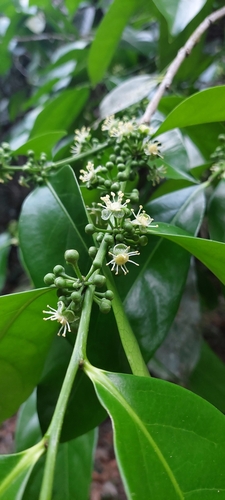
Drypetes variabilis
Uittien

(c) Geovane Siqueira, some rights reserved (CC BY-NC), uploaded by Geovane Siqueira

(c) Geovane Siqueira, some rights reserved (CC BY-NC)
What to Eat
Edible parts: Fruit
Fruit - raw. The fleshy, whitish pulp is eaten. The yellow, pear-shaped fruit is up to 33mm long and 26mm wide.
Where to Find It
A tropical plant. It grows in the rainforest, especially on slopes.
Amazon, Bolivia, Brazil, Colombia, Ecuador, Guiana, Guianas, Guyana, Peru, South America, Suriname, Venezuela,
How to Identify
A tree. It grows 30 m high. The plants are separately male and female. The male flowers are in clusters of 1-3 in the axils of leaves. There stalks are 0.4 cm long. The female flowers are in clusters of 6 in the axils of leaves. The fruit stalk is 1-3 cm long. The fruit is pear shaped and 3.3 cm long by 2.6 cm wide. They are green and turn yellow. The pulp is fleshy, white and edible. The hard covering over the seed is narrowly oval and 2.5 cm long by 1.5 cm wide.
How to Grow
A dioecious species, both male and female forms need to be grown if fruit and seed are required.
Medicinal Uses
The inner bark is rasped into water and boiled to make a wash that is used to treat fevers. A decoction of the leaves and rasped bark is used as a rub to remedy throat problems. If it does not perform effectively as a rub, then honey is added and the decoction is drunk. The juice from macerated leaves is used to remedy conjunctivitis. The leaves are boiled and the water used for washing the skin to lower the temperature in cases of high fever.
Names & Synonyms
Wetifoengoe, Weti-koeebi, Weti-koko
References (4)
- Grandtner, M. M. & Chevrette, J., 2013, Dictionary of Trees, Volume 2: South America: Nomenclature, Taxonomy and Ecology. Academic Press p 208
- Lopez-Diago, D. & Garcia, N., 2021, Wild edible fruits of Colombia. Biota ColomBiana 22 (2) p 49
- Roa, J. A. G. & Boada, D. S. G., 2018, Fundación para el Fortalecimiento de la Fruticultura y Plantas Alimenticias no Convencionales en Colombia.
- van Roosmalen, M.G.M., 1985, Fruits of the Guianan Flora. Utrecht Univ. & Wageningen Univ. p 118