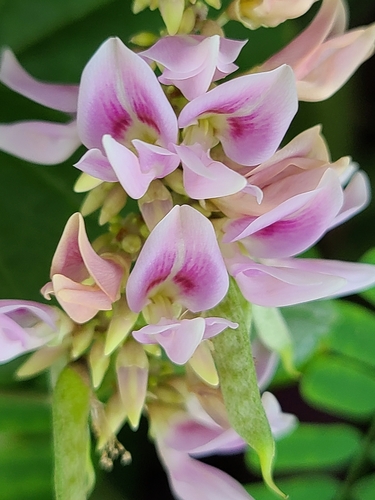
Inga disticha
Benth.
Warakosa, Baboen-weko

(c) Guillaume Léotard, some rights reserved (CC BY-NC), uploaded by Guillaume Léotard

(c) Guillaume Léotard, some rights reserved (CC BY-NC), uploaded by Guillaume Léotard
What to Eat
Edible parts: Fruit, Pod pulp
Fruit - raw. The white pulp surrounding the seeds is eaten. The seedpods are about 15cm long and 2.5cm wide.
Where to Find It
It is a tropical plant. It grows in forests near rivers and on slopes.
Amazon, Bolivia, Brazil, Colombia, French Guiana, Guianas, Guyana, South America, Suriname, Venezuela,
How to Identify
A tree. It grows 20 m tall. The twigs have rusty hairs. The leaves are compound. There are 4 stalks with leaflets. The leaflets are papery. The flowers are in spikes clustered in the axils of leaves. They are 5-9 cm long. The fruit are pods about 15 cm long by 2.5 cm wide. The seeds are in an edible pulp.
How to Grow
Plants grow easily from seeds. Seeds germinate in 1-2 weeks given moisture and shade.
Other Uses
The wood of Inga species is generally attractive, but it has a coarse texture, is susceptible to attack by dry-wood termites and is not durable in the soil.
Wikipedia
Source ↗Inga disticha is a species of Fabaceae that was described by botanist George Bentham.
Notes
Also as Mimosaceae.
Names & Synonyms
Baboen-weko, Cicipe-wiwi-hu, Swit'bonki, Warakosa
References (7)
- Grandtner, M. M. & Chevrette, J., 2013, Dictionary of Trees, Volume 2: South America: Nomenclature, Taxonomy and Ecology. Academic Press p 320
- ILDIS Legumes of the World http:www;ildis.org/Legume/Web
- London J. Bot. 2:143. 1840
- Lopez-Diago, D. & Garcia, N., 2021, Wild edible fruits of Colombia. Biota ColomBiana 22 (2) p 38
- Reis, S. V. and Lipp, F. L., 1982, New Plant Sources for Drugs and Foods from the New York Botanical Garden herbarium. Harvard. p 115
- Roa, J. A. G. & Boada, D. S. G., 2018, Fundación para el Fortalecimiento de la Fruticultura y Plantas Alimenticias no Convencionales en Colombia.
- van Roosmalen, M.G.M., 1985, Fruits of the Guianan Flora. Utrecht Univ. & Wageningen Univ. p 236