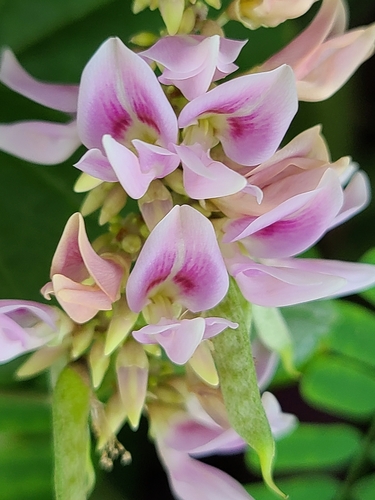
Inga heterophylla
Willd.
Heterophyllus inga

(c) Nereston (Nelinho) Camargo, some rights reserved (CC BY-NC), uploaded by Nereston (Nelinho) Camargo

(c) Nereston (Nelinho) Camargo, some rights reserved (CC BY-NC)
What to Eat
Edible parts: Fruit - aril, Pod pulp
Fruit - raw. The sweet, white pulp surrounding the seeds is eaten. The seedpod is 7 - 14cm long and 1 - 2cm wide, containing up to 14 seeds.
Where to Find It
It is a tropical plant. It grows in savanna forest.
Amazon, Bolivia, Brazil, Caribbean, Central America, Colombia, Costa Rica, Ecuador, French Guiana, Guianas, Guyana, Panama, Peru, South America, Suriname, Venezuela,
How to Identify
A tree. It grows 12 m tall. The twigs are thin. The leaves are compound. The leaflets are leathery. The flowers are in groups in the axils of leaves. The flowers are white. The fruit is a pod that can be straight or curved. It is 8-16 cm long by 1-2 cm wide and 0.6 cm thick. The pods is green or yellow and swollen over the seeds. There are about 14 seeds. The pod pulp is sweet and edible.
How to Grow
Plants grow easily from seeds. Seeds germinate in 1-2 weeks given moisture and shade.
Other Uses
The wood of Inga species is generally attractive, but it has a coarse texture, is susceptible to attack by dry-wood termites and is not durable in the soil.
Notes
Also as Mimosaceae.
Names & Synonyms
Guabo de mono, Guamo cajeto, Guamo copero, Guamo morrocoyero, Inga chichica, Inga-de-macaco. Inga-xixica, Ingai, Pacai, Warakosa
References (12)
- Duke, J. A., Amazonian Ethnobotanical Dictionary (As Inga stenocarpa)
- Grandtner, M. M., 2008, World Dictionary of Trees. Wood and Forest Science Department. Laval University, Quebec, Qc Canada. (Internet database http://www.wdt.qc.ca)
- Grandtner, M. M. & Chevrette, J., 2013, Dictionary of Trees, Volume 2: South America: Nomenclature, Taxonomy and Ecology. Academic Press p 321
- Kermath, B. M., et al, 2014, Food Plants in the Americas: A survey of the domesticated, cultivated and wild plants used for Human food in North, Central and South America and the Caribbean. On line draft. p 439 (Also as Inga stenocarpa)
- Lopez-Diago, D. & Garcia, N., 2021, Wild edible fruits of Colombia. Biota ColomBiana 22 (2) p 38
- Martin, F. W., et al, 1987, Perennial Edible Fruits of the Tropics. USDA Handbook 642 p 99
- NYBG herbarium "edible"
- Paz, F. S., et al, 2021, Edible Fruit Plant Species in the Amazon Forest Rely Mostly on Bees and Beetles as Pollinators. Journal of Economic Entomology, XX(XX), 2021, 1–13
- Roa, J. A. G. & Boada, D. S. G., 2018, Fundación para el Fortalecimiento de la Fruticultura y Plantas Alimenticias no Convencionales en Colombia.
- Sp. pl. 4(2):1020. 1806
- Torre, de la, L., et al, 2008, Enciclopedia de las Plantas Útiles del Ecuador. Herbario QCA. Pontificia Universidad Católica del Ecuador. p 344
- van Roosmalen, M.G.M., 1985, Fruits of the Guianan Flora. Utrecht Univ. & Wageningen Univ. p 238