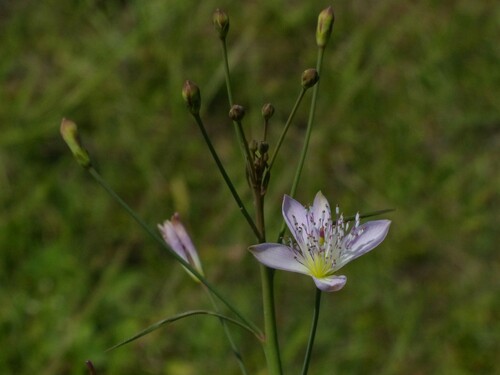
Cleome spinosa
Jacq.
Spiny spider flower

(c) Neptalí Ramírez Marcial, some rights reserved (CC BY), uploaded by Neptalí Ramírez Marcial
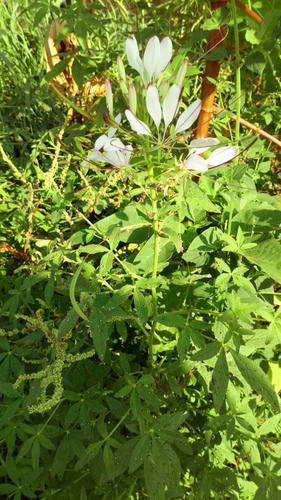
(c) Jeremy Flanagan, some rights reserved (CC BY-NC), uploaded by Jeremy Flanagan

(c) Aurelio Molina Hernández., some rights reserved (CC BY-NC), uploaded by Aurelio Molina Hernández.
What to Eat
Edible parts: Leaves
The leaves are edible.
Where to Find It
It is a tropical plant. It is best in a well-drained, moist soil. It needs a sunny position. It is resistant to frost but damaged by drought. It grows in tropical America.
Africa, Asia, Australia, Cameroon, Central Africa, Central America, Congo, Cuba*, Dominican Republic, Gabon, Guiana, Guianas, Guyana, Haiti, Hawaii, India, Jamaica, Korea, Lesser Antilles*, Mexico, Myanmar, Nigeria, North America, Pacific, Pakistan, SE Asia, Slovenia, South America*, Suriname, Venezuela, West Africa, West Indies*,
How to Identify
A small herb. It grows 60-90 cm high. It spreads 1.2 m wide. The stems are slender. It has prickly stems. The leaves are large. They have 5-7 lobes. The flowers are pink to white or purple. They are in clusters at the top of the plant.
How to Grow
Plants are grown from seeds.
Wikipedia
Source ↗Cleome spinosa, called the spiny spiderflower, is a species of flowering plant in the genus Cleome. It is native to the New World Tropics, and has been introduced to the United States, tropical Africa, the Indian Subcontinent, Vietnam, New Caledonia, and Korea. It is pollinated by bats.
Notes
Cleome afrospinosa and Cleome spinosa may be separate species.
Names & Synonyms
Akoghele, Trnata kleoma
References (10)
- Bodkin, F., 1991, Encyclopedia Botanica. Cornstalk publishing, p 265
- Burkill, H. M., 1985, The useful plants of west tropical Africa, Vol. 1. Kew.
- Dalziel,
- Enum. syst. pl. 26. 1760 (Select. stirp. amer. hist. 190. 1763)
- Flora of Pakistan. www.eFlora.org (As Cleome heptaphylla)
- Hedrick, U.P., 1919, (Ed.), Sturtevant's edible plants of the world. p 204 (As Cleome heptaphylla)
- Peters, C. R., O'Brien, E. M., and Drummond, R.B., 1992, Edible Wild plants of Sub-saharan Africa. Kew. p 77
- Plants of Haiti Smithsonian Institute http://botany.si.edu
- Raponda-Walker, A & Sillans, R., 1961, Les Plantes Utiles du Gabon. Editions Paul Lechevalier, Paris. p 117
- World Checklist of Useful Plant Species 2020. Royal Botanic Gardens, Kew