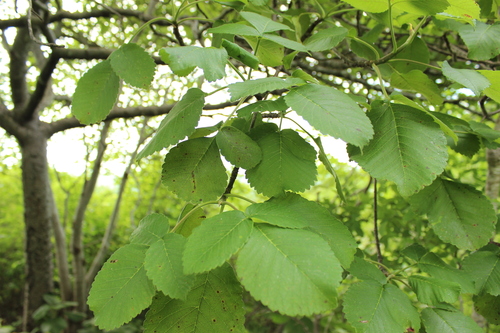
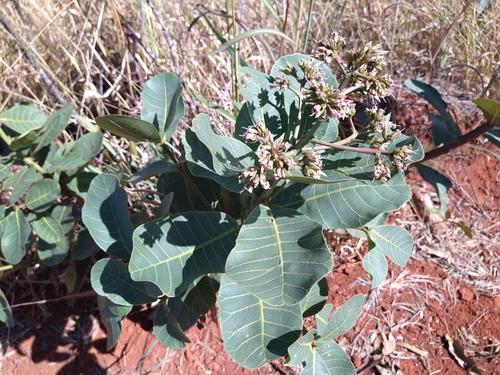
Searsia discolor
(E. Mey. ex Sond.) Moffett
Grassveld currant
AnacardiaceaeFruit
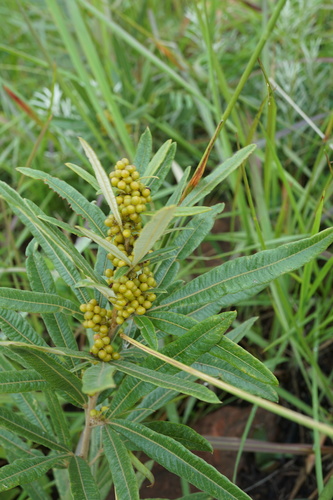
iNaturalist · cc-by-sa
(c) Andrew Hankey, some rights reserved (CC BY-SA), uploaded by Andrew Hankey
(c) Andrew Hankey, some rights reserved (CC BY-SA), uploaded by Andrew Hankey
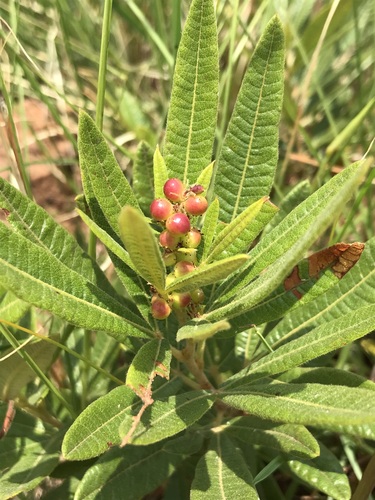
iNaturalist · cc-by-nc-sa
(c) David Hoare, some rights reserved (CC BY-NC-SA), uploaded by David Hoare
(c) David Hoare, some rights reserved (CC BY-NC-SA), uploaded by David Hoare

iNaturalist · cc-by-nc
(c) amphibolite, some rights reserved (CC BY-NC), uploaded by amphibolite
(c) amphibolite, some rights reserved (CC BY-NC), uploaded by amphibolite
What to Eat
Edible parts: Fruit
The fruit is eaten raw.
Where to Find It
It is a subtropical plant. It grows in the highveld in Swaziland.
Africa, Eswatini, South Africa, Southern Africa, Swaziland,
Countries: Angola, Burkina Faso, Burundi, Benin, Botswana, Congo (DRC), Central African Republic, Congo (Republic), Cote d'Ivoire, Cameroon, Cape Verde, Djibouti, Algeria, Egypt, Eritrea, Ethiopia, Gabon, Ghana, Gambia, Guinea, Equatorial Guinea, Guinea-Bissau, Kenya, Comoros, Liberia, Lesotho, Libya, Morocco, Madagascar, Mali, Mauritania, Mauritius, Malawi, Mozambique, Namibia, Niger, Nigeria, Rwanda, Seychelles, Sudan, Sierra Leone, Senegal, Somalia, South Sudan, Sao Tome & Principe, Eswatini, Chad, Togo, Tunisia, Tanzania, Uganda, South Africa, Zambia, Zimbabwe
How to Identify
A shrub. It has erect, tufted, unbranched shoots. It grows up to 50 cm high. These arise from a woody base. The leaves are erect and the leaf stalks are 5 mm long. The leaflets are oblong and blunt but with a small point. They are 8 cm long by 1.7 cm wide. The veins are prominent underneath. The flowering stalks are at the ends and along the sides. They are hairy.
Production
In South Africa plants flower November to January.
Names & Synonyms
Inhlangushane
References (9)
- Guillarmod, J., 1971, (As Rhus discolor)
- Long, C., 2005, Swaziland's Flora - siSwati names and Uses http://www.sntc.org.sz/flora/ (As Rhus discolor)
- Moffett, R. O., 2007, Name changes in the Old World Rhus and recognition of Searsia (Anacardiaceae). Bothalia 37,2: 165-175 (2007)
- Ogle & Grivetti, 1985, (As Rhus discolor)
- Peters & Maguire, 1981, (As Rhus discolor)
- Peters, C. R., O'Brien, E. M., and Drummond, R.B., 1992, Edible Wild plants of Sub-saharan Africa. Kew. p 50 (As Rhus discolor)
- Ruiters-Welcome, A. K., 2019, Food plants of southern Africa. Ph.D. thesis. Univ. of Johannesburg p 15
- Swaziland's Flora Database http://www.sntc.org.sz/flora (As Rhus discolor)
- Welcome, A. K. & Van Wyk, B.-E., 2019, An inventory and analysis of the food plants of southern Africa. South African Journal of Botany 122 (2019) 136–179