Asclepias multicaulis
(E. Mey.) Schltr.
Mankiling

(c) Tony Rebelo, some rights reserved (CC BY-SA), uploaded by Tony Rebelo

(c) berthapi2, some rights reserved (CC BY-NC), uploaded by berthapi2
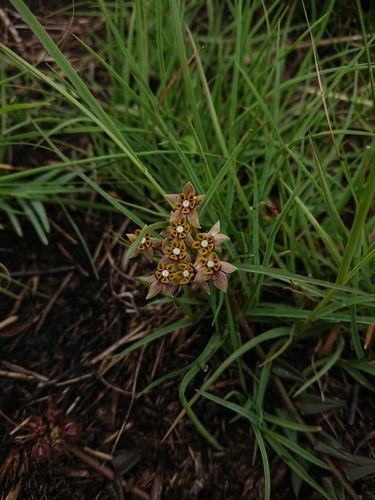
(c) Matt Prinsloo, some rights reserved (CC BY-NC)
What to Eat
Edible parts: Leaves, Stems, Flowers, Pods, Roots
The leaves are eaten raw or cooked. The stems, flowers, and pods are also similarly prepared and eaten. The roots are eaten raw.
Where to Find It
It is a subtropical plant.
Africa, Lesotho, South Africa, Southern Africa,
How to Identify
A slender herb. It grows 30 cm long and can be lying along the ground. It branches at the base and can have several spreading and hairy stems. It has a milky sap. The leaves are simple and spreading. They are broad at the base and taper to the tip. The flowers are in a single group at the top. There are 6-8 flowers in the group with equal length stalks from one point. The flowers are small and 5 mm long. The fruit is a follicle tapering to a beak.
Notes
Also put in the family Asclepiadaceae. An unresolved name in The Plant List.
Names & Synonyms
Lenkileng
References (7)
- Fox, F. W. & Young, M. E. N., 1982, Food from the Veld. Delta Books. p 105
- Guillarmod, J., 1966, 1971,
- Letsela, T., et al, 2003, Plant Resources Used for Subsistence in Tsehlanyane and Boking in Lesotho. Economic Botany 57(4): 619-639
- Peters, C. R., O'Brien, E. M., and Drummond, R.B., 1992, Edible Wild plants of Sub-saharan Africa. Kew. p 61
- Plowes, N. J. & Taylor, F. W., 1997, The Processing of Indigenous Fruits and other Wildfoods of Southern Africa. in Smartt, L. & Haq. (Eds) Domestication, Production and Utilization of New Crops. ICUC p 185
- Ruiters-Welcome, A. K., 2019, Food plants of southern Africa. Ph.D. thesis. Univ. of Johannesburg p 21
- Welcome, A. K. & Van Wyk, B.-E., 2019, An inventory and analysis of the food plants of southern Africa. South African Journal of Botany 122 (2019) 136–179


