Calotropis procera
(Aiton) Dryand
Caltrops, Purple crown flower, Giant milkweed

(c) Susan J. Hewitt, some rights reserved (CC BY-NC), uploaded by Susan J. Hewitt
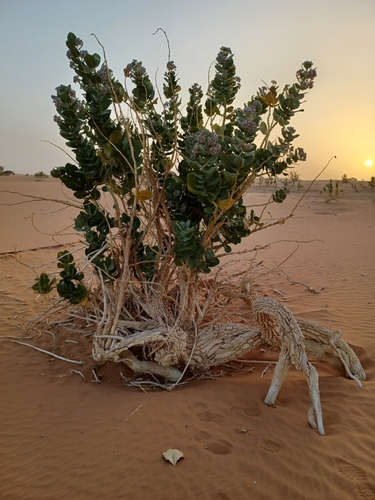
(c) leandroop, some rights reserved (CC BY-NC)

(c) David Kaposi, some rights reserved (CC BY-NC), uploaded by David Kaposi
What to Eat
Edible parts: Flowers, Caution, Leaves - drink, Seeds, Sap, Fruit
Edible Parts: Leaves Sap Shoots Edible Uses: Drink The flower shoots are eaten young and raw. The leaves are occasionally eaten. The leaves are used for making an alcoholic drink. In Ethiopia the sap is added to milk to help it coagulate. The leaves have been used as a soup ingredient in sauces. A rather strange report - see the notes above on toxicity.
Known Hazards
Where to Find It
It is a tropical plant. It grows in arid and semiarid regions in Central America. It is resistant to drought, frost and salt. It grows in the Sahel. It grows in savannah woodland. It grows in areas with an annual rainfall between 400-900 mm. It can grow in arid places. In Zimbabwe it grows up to 1,000 m above sea level. In Yunnan.
Afghanistan, Africa, Algeria, Antigua and Barbuda, Aruba, Asia, Australia, Bahamas, Bangladesh, Benin, Burkina Faso, Cameroon, Caribbean, Central Africa, Chad, China, Colombia, Congo, Cuba, Dominica, Dominican Republic, East Africa, Egypt, Equatorial Guinea, Ethiopia, Gambia, Ghana, Grenada, Guinea, Guinée, Guinea-Bissau, Haiti, Hawaii, Himalayas, India, Indochina, Iran, Iraq, Israel, Jamaica, Kenya, Kuwait, Libya, Malawi, Mali, Mauritania, Mediterranean, Middle East, Morocco, Mozambique, Myanmar, Nepal, Nicaragua, Niger, Nigeria, North Africa, Oman, Pacific, Pakistan, Panama, Puerto Rico, Sahel, Saudi Arabia, SE Asia, Senegal, Sierra Leone, Socotra, Somalia, South America, Sudan, Syria, Tanzania, Thailand, Uganda, United Arab Emirates, UAE, Venezuela, Vietnam, West Africa, West Indies, Yemen, Zambia, Zimbabwe,
How to Identify
A small shrub. It has broad leaves and keeps its leaves throughout the year. It grows 2-5 m high. The bark is fibrous and deeply cracked when old. The stem is simple and only occasionally branched. The leaves are opposite and simple. The leaves are greyish-green. They are broadly oval and 5-30 cm long by 3-15 cm wide. They end abruptly. The flowers are purple and white. They are in dense groups from the nodes. The fruit is simple, fleshy and inflated. It is an oblique to oval follicle 10 cm across. There are many seeds.
How to Grow
Plants can be grown from seed.
Propagation: Seed. The tree seeds freely, and natural regeneration is common. Vegetative propagation through half stumps assumes a special importance as compared with the entire stumps because they help in faster multiplication of the parent genotype with plus characters, as each plant gives rise to 2 half stumps. Stumps also help in propagating only 1 plant. Vegetative propagation through stem and root cuttings is very useful in large-scale multiplication of the superior genotypes.
Medicinal Uses
Anthelmintic Antiasthmatic Antibacterial Antidiarrhoeal Cathartic Digestive Diuretic Dysentery Emetic Laxative Leprosy Mouthwash Odontalgic Ophthalmic Purgative Rubefacient Skin Tonic Vermifuge Compounds derived from the plant have been found to have emetic-cathartic and digitalic properties. The principal active compounds are asclepin and mudarin. Other compounds have been found to have bactericidal and vermicidal propertie. The root bark is an emetic. An infusion of bark powder is used in the treatment and cure of leprosy and elephantiasis. It is inadvisable to use bark that has been kept for more than a year. The extremely poisonous roots are used in the treatment of snakebites. The leaves are used for the treatment of asthma. The milky sap is used as a rubefacient and is also strongly purgative and caustic. The latex is used for treating ringworm, guinea worm blisters, scorpion stings, venereal sores and ophthalmic disorders, it is also used as a laxative. Its use in India in the treatment of skin diseases has caused severe bullous dermatitis leading sometimes to hypertrophic scars. The local effect of the latex on the conjunctiva is congestion, epiphora and local anaesthesia. The latex contains a proteolytic enzyme called caloptropaine. The flower is digestive and tonic. It is used in the treatment of asthma and catarrh. The twigs are applied for the preparation of diuretics, stomach tonic and anti-diarrhoetics and for asthma. Also used in abortion, as an anthelmintic, for colic, cough, whooping cough, dysentery, headache, lice treatment, jaundice, sore gums and mouth, toothache, sterility, swellings and ulcers.
Other Uses
Charcoal Cotton wool Dye Fibre Green manure Latex Paper Repellent Roofing Soil conditioner Soil stabilization String Stuffing Teeth Tinder Weaving Wood Other uses rating: High (4/5). Agroforestry Uses: A source of green manure. The plant can help improve soil water conditions and also acts as a soil binder. Plants often escape from cultivation, especially when growing on sandy soils. It often self-sows freely on overgrazed land and has been used as an indicator of exhausted soil. Other Uses A strong fibre is obtained from the stem. Durable under water. White, silky, strong, cylindrical, flexible and durable stem fibre used for various purposes, such as for making ropes, to form cheap cots, gunny bags, bow strings, fishing nets, and in the manufacture of paper, pulp and duplicating stencils. Strong inner bark fibres produce a binding material and are processed into fabrics. The floss from the seed capsules is used as a stuffing material in mattresses etc. The floss from the seeds, which is about 2 - 3.5 cm long, white silky and strong, is used as an inferior stuffing for mattresses and pillows as well as for weaving into a strong cloth. The floss may also substitute cotton wool for surgical purposes. The plant is the source of a rubber-like product called Mudar Gummi. The liquid latex can be used as a renewable source of hydrocarbons and intermediate energy resources. The latex contains 11 - 23% of rubber. The latex is 80% effective in inhibiting the activity of the tobacco mosaic virus. The leafy branches are said to deter ants. A macerated bark extract can be used for dyes An ideal plant for monitoring sulphur dioxide emissions in the air. The stems are termite proof and are used for roofing and building huts. The very light wood can also be used for fishing net floats. The wood is a source of charcoal, used for making gunpowder. Stems produce a good charcoal, while the stem pith makes good tinder. The dogbane-milkweed family Asclepias, Apocynum, Calotropis, and Trachomitum spp) has been used for fiber industrial crops for millennia with a number in cultivation as regional crops. All of these crops are dual-purpose fibres, offering bast fibres from the stem and seed fiber or ‘floss’ in the fruit pods. Many have also been identified as potential hydrocarbon crops due to high latex content. Could be integrated into various agroforestry systems rather than as monocultures [1-1]. Special Uses Carbon Farming Coppice
Wikipedia
Source ↗Calotropis procera is a species of flowering plant in the family Apocynaceae that is native to Northern and Tropical Africa, Western Asia, South Asia and Indochina (mainland Southeast Asia). It typically reaches a height between 6 feet (1.8 m) to 8 feet (2.4 m), and rarely to as high as 15 feet (4.6 m), and grows in sunny to partly-shaded habitats such as disturbed and overgrazed lands, rangeland, roadsides, river flats and coastal dunes. Its green fruits contain a toxic milky sap that is extremely bitter and turns into a latex-like substance, which is resistant to soap. Common names for the plant include apple of Sodom, Sodom apple, roostertree, king's crown, small crownflower, giant milkweed, rubber bush, and rubber tree. The names "Apple of Sodom" and "Dead Sea Apple" stem from the ancient authors Josephus and Tacitus, who described the plant growing in the area of biblical Sodom. Although not native to the New World, the plant (and other related milkweed species) has been cultivated, and feeds monarch butterfly caterpillars, in places such as California, Hawaii and the island of Puerto Rico. In Arabic, it is known as al-ashkhar.
Other Information
The flowers are sucked by children.
Notes
There are 3 Calotropis species. It has anticancer properties. Also put in the family Asclepiadaceae.
Names & Synonyms
Akanda, Ankh, Ashkhar, Bagueuone, Bawami, Belapse, Bombardera, Bombardiera, Bomboederu, Booc, Borderi, Bussuma, Cumpampam-o, Dead sea apple, King's crown, Kunaakoobu, Mandar, Mpilo, N'olim'nhe, N'olininhe, Oshur, Pama, Pampam, Panpango, Pompo pokolo, Popo-ho, Pourampo, Rui, Sageye, Small crown-flower, Tchimpampam Bfo, Thophiya, Tumfafia, Tumfafiya, Ufo, Um-olim-nhe
References (26)
- Bernholt, H. et al, 2009, Plant species richness and diversity in urban and peri-urban gardens of Niamey, Niger. Agroforestry Systems 77:159-179
- Bircher, A. G. & Bircher, W. H., 2000, Encyclopedia of Fruit Trees and Edible Flowering Plants in Egypt and the Subtropics. AUC Press. p 75
- Bodkin, F., 1991, Encyclopedia Botanica. Cornstalk publishing, p 203
- Bohra, N., et al, 2017, Ethnobotany of wild edible plants traditionally used by the local people in the Ramnagar regions from Nainital District, Uttarakhand, India. Biolife 5(1): 12-19
- Bonou, A., et al, 2013, Valeur economique des Produits Forestiers Non Ligneux (PFNL) au Benin. Editions Universitaires Europeennes p 93
- Dalziel, J. M., 1937, The Useful plants of west tropical Africa. Crown Agents for the Colonies London.
- Diarra, N. et al, 2016, Etude ethnobotanique des plantes alimentaires utilisées en période de soudure dans les régions Sud du Mali. Int. J. Biol. Chem. Sci. 10(1): 184-197
- Fowler, D. G., 2007, Zambian Plants: Their Vernacular Names and Uses. Kew. p 9
- Grivetti, L. E., 1980, Agricultural development: present and potential role of edible wild plants. Part 2: Sub-Saharan Africa, Report to the Department of State Agency for International Development. p 25
- Ibrahim, H. A., et al, 2012, Ethnobotanical Survey of the Wild Edible Food Plants Consumption among Local Communities in Kano State, North-Western, Nigeria, International Journal of Science and Technology. Vol. 2. No. 10 p 716
- Journal of Food Composition and Analysis, 2004, 277-289
- Karim, F. M. & Dakheel, A, J., 2006, Salt-tolerant plants of the United Arab Emirates. 2006. International Center for Biosaline Agriculture, Dubai, UAE.
- Kintzios, S. E., 2006, Terrestrial Plant-Derived Anticancer Agents and Plant Species Used in Anticancer research. Critical Reviews in Plant Sciences. 25: pp 79-113
- Kumar, S. A., Manus, D. & Mallika, M., 2018, Impact of non-timber forest products on Forest and in Livelihood Economy of the People of Adjoining Areas of Jalpaiguri Forest Division, West Bengal, India. Int. J. of Life Sciences, 2018; 6 (2):365-385
- Le Houerou, H. N., (Ed.), 1980, Browse in Africa. The current state of knowledge. International Livestock Centre for Africa, Ethiopia. p 161
- Maydell, H. von, 1990 Trees and shrubs of the Sahel: their characteristics and uses. Margraf. p 213
- Miller, A. G., Morris, M. & Stuart-Smith, S., 1988, Plants of Dhofar. The Southern Region of Oman, Traditional, Economic and Medicinal Uses. Sultanate of Oman. p 42
- Molla, A., Ethiopian Plant Names. http://www.ethiopic.com/aplants.htm
- Mutie, F. M., et al, 2023, Important Medicinal and Food Taxa (Orders and Families) in Kenya, Based on Three Quantitative Approaches. Plants 2023, 12, 1145
- Peters, C. R., O'Brien, E. M., and Drummond, R.B., 1992, Edible Wild plants of Sub-saharan Africa. Kew. p 62
- Plants of Haiti Smithsonian Institute http://botany.si.edu
- Royal Botanic Gardens, Kew (1999). Survey of Economic Plants for Arid and Semi-Arid Lands (SEPASAL) database. Published on the Internet; http://www.rbgkew.org.uk/ceb/sepasal/internet [Accessed 28th March 2011]
- Segnon, A. C. and Achigan-Dako, E. G., 2014, Comparative analysis of diversity and utilization of edible plants in arid and semi-arid areas in Benin. Journal of Ethnobiology and Ethnomedicine. 10:80
- Setiya, A. V., et al, 2016, Exploration and documentation of some wild edible plants used by the aboriginals from Gadchiroli District (M.S.) India. International Advanced Research Journal in Science, Engineering and Technology. 3(7)
- World Checklist of Useful Plant Species 2020. Royal Botanic Gardens, Kew
- www.worldagroforestrycentre.org/treedb/


